Streamline workplace disinfection: a step-by-step workflow
TL;DR:
- A structured disinfection workflow ensures consistent, effective pathogen elimination in workplaces.
- Proper tools, PPE, and documentation are essential for compliance and safety.
- Regular verification and staff engagement prevent workflow failure and reduce outbreak risks.
One workplace outbreak is all it takes. A single contaminated surface, a missed high-touch zone, or a rushed cleaning round can trigger a chain of illness that sidelines staff, triggers regulatory scrutiny, and damages your reputation. For facility managers and business owners across Brisbane, Gold Coast, and Melbourne, effective disinfection is not a nice-to-have. It is a legal and operational necessity. This guide walks you through a practical, compliant disinfection workflow, covering the rationale, the tools, the step-by-step process, and the verification practices that keep your workplace genuinely safe year-round.
Table of Contents
- Why a defined disinfection workflow matters
- Essential tools, materials and documentation for disinfection
- Step-by-step workplace disinfection workflow
- Verification, record-keeping and common pitfalls
- Why most workplace disinfection workflows fail — and what actually works
- Take the next step with professional hygiene solutions
- Frequently asked questions
Key Takeaways
| Point | Details |
|---|---|
| Disinfection workflow saves time | A defined process makes it easier to train staff and ensure compliance every cycle. |
| Right tools make a difference | Using proper disinfectants, PPE, and logs reduces health risks and workplace errors. |
| Verification prevents costly mistakes | Routine checks and record-keeping help avoid regulatory issues and missed spots. |
| Review and adapt | Regularly updating your workflow keeps your workplace one step ahead of compliance and health threats. |
Why a defined disinfection workflow matters
A disinfection workflow is a documented, repeatable process for eliminating pathogens from workplace surfaces and shared spaces. It is not simply mopping floors or wiping desks. It is a structured sequence with defined responsibilities, approved products, and measurable outcomes. Without that structure, hygiene becomes inconsistent and your facility becomes a liability.
Poor workplace hygiene carries real risks. Staff absenteeism rises, cross-contamination spreads between zones, and regulators take notice. Under Australian WHS hygiene duties, employers are obligated to maintain safe working environments, which includes hygiene management. The Safe Work Australia guidance on cleaning and disinfecting reinforces this obligation, particularly for facilities with shared spaces, customer-facing roles, or vulnerable occupants.
A well-defined workflow delivers measurable benefits:
- Consistent outcomes: Every shift follows the same process, eliminating gaps caused by staff turnover or memory lapses.
- Lower risk of illness: A structured disinfection process reduces virus and bacteria transmission across your facility.
- Easier staff training: New team members learn a clear checklist rather than vague instructions, which shortens onboarding and improves accuracy.
- Accountability built in: When every step is documented, supervisors can verify completion and identify gaps quickly.
- Regulatory and insurance alignment: Many insurers and regulators now expect documented cleaning protocols, particularly in healthcare, hospitality, and education sectors.
Worth noting: A disinfection workflow is not a one-time project. It is a living system that should be reviewed whenever your workplace layout changes, new staff join, or an outbreak occurs. Treat it like any other critical operational procedure.
Now that the stakes and approach are clear, let’s look at what you need to set up an effective workflow.
Essential tools, materials and documentation for disinfection
Before your team picks up a single cloth, you need the right resources in place. Missing even one item, whether it is the correct PPE or an up-to-date Safety Data Sheet (SDS), can compromise both safety and compliance. The cleaning and disinfection principles published by the Australian Government outline the baseline expectations for facility operators.
Essential tools and supplies:
- Microfibre cloths (colour-coded by zone to avoid cross-contamination)
- Mops with disposable or washable heads
- Personal protective equipment: gloves, eye protection, and aprons
- Wet floor signage and barrier tape
- Spray bottles and dispensing systems
- Sealed disposal bags for contaminated materials
- Diluters or dosing caps for chemical concentrates
- Adequate ventilation equipment where required
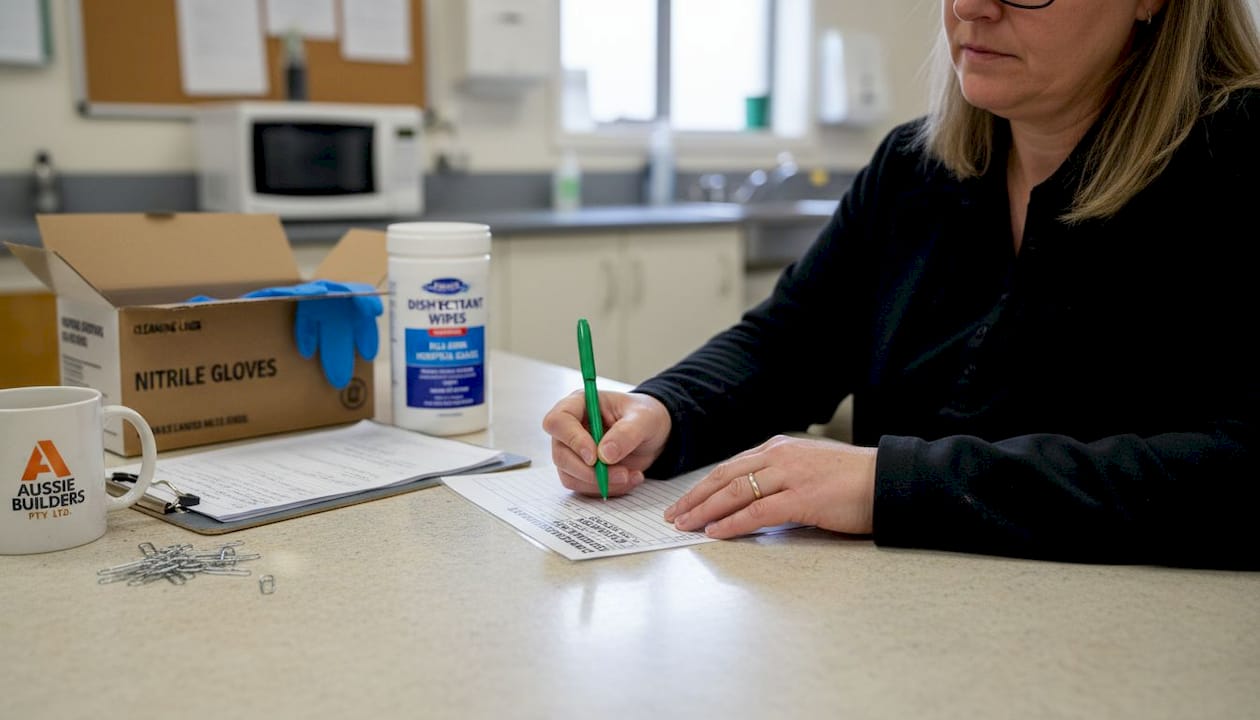
Documentation is equally important. Effective surface sanitising relies on using approved disinfectants and PPE that meet workplace safety standards.
| Item | Requirement | Notes |
|---|---|---|
| Disinfectant product | ARTG-listed or TGA-approved | Check label for correct contact/dwell time |
| PPE | Gloves, goggles, apron | Match to chemical risk level |
| Safety Data Sheet (SDS) | Current and accessible on-site | Required for every chemical used |
| Cleaning log | Dated, signed entries | Minimum 12-month retention recommended |
| Waste disposal record | For sharps, biohazards, sanitary waste | Per state/territory regulations |
Knowing which products to use across your various hygiene service types helps you match solutions to specific facility zones, such as bathrooms, kitchens, and shared workstations.
Pro Tip: Pre-mixed, ARTG-listed disinfectants remove guesswork and reduce the risk of incorrect dilution. They save time, protect staff from chemical errors, and make compliance documentation straightforward.
With resources assembled, you’re ready for the main event: the systematic workflow.
Step-by-step workplace disinfection workflow
This sequence is designed to work in commercial workplaces across Brisbane, Gold Coast, and Melbourne. Adapt it to your facility size and sector, but keep the order intact. Skipping steps, particularly the cleaning phase before disinfection, dramatically reduces effectiveness.
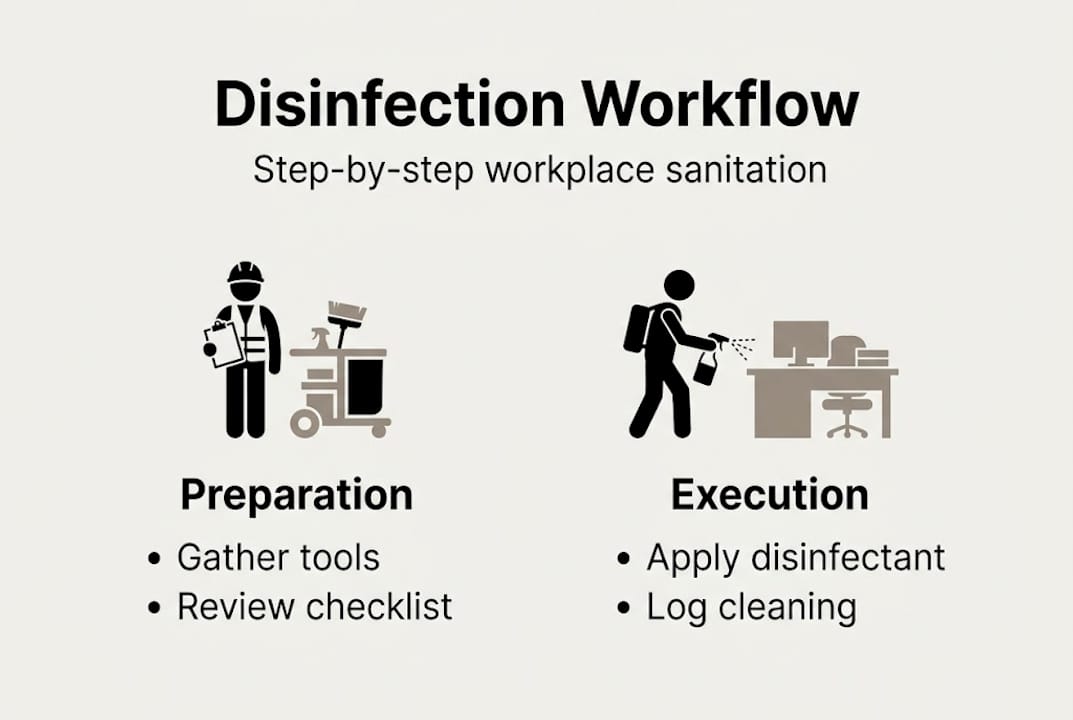
- Prepare site and PPE. Brief your team, don appropriate PPE, and set up wet floor signs and barriers around the work zone.
- Remove waste and gross contaminants. Clear bins, remove visible debris, and bag any biohazardous material before any cleaning begins.
- Clean with detergent. Wash all surfaces with a neutral detergent and water. Disinfectants do not work properly on dirty surfaces. This step is non-negotiable.
- Disinfect key areas with correct dwell time. Apply your ARTG-listed disinfectant and allow it to remain wet on the surface for the manufacturer’s specified dwell time. High-touchpoint areas like door handles require this daily attention.
- Ventilate as required. Open windows or activate HVAC to clear chemical vapours and support surface drying.
- Record all actions. Log the date, time, products used, areas covered, and staff member responsible.
Proper dwell time is the most overlooked factor in workplace disinfection. Many products require 30 to 60 seconds of wet contact to eliminate up to 99.9% of pathogens. Wiping immediately after application defeats the purpose entirely.
| Method | Cost | Speed | Effectiveness | Best suited for |
|---|---|---|---|---|
| Manual (cloth/mop) | Low | Moderate | High if done correctly | Targeted spot cleaning, smaller areas |
| Mechanised (electrostatic sprayer) | Higher upfront | Fast | Very high, even coverage | Large open areas, high-risk zones |
| Fogging | High | Very fast | Varies by product | Post-outbreak remediation |
For guidance on commercial hygiene best practices, including how to tailor your process to different facility types, it helps to reference sector-specific frameworks.
Pro Tip: Always work from the cleanest area to the dirtiest. Start at the entrance or least-used zones and finish at high-traffic areas like bathrooms and kitchens. This prevents contaminated cloths and mop heads from spreading pathogens back into clean zones.
Now that the workflow is clear, ensure it delivers the results you expect.
Verification, record-keeping and common pitfalls
A workflow without verification is just a hope. You need mechanisms to confirm that disinfection is actually working, not just happening.
Practical verification methods:
- Visual inspection by a supervisor at the end of each shift
- ATP (adenosine triphosphate) testing, a rapid method that measures biological residue on surfaces
- Spot checks using UV light markers applied before cleaning and inspected afterwards
- Periodic third-party audits for high-risk environments such as healthcare and aged care
- Staff self-reporting with signed completion checklists
Audit trails and cleaning logs are now a requirement for many sectors, including healthcare, food service, and childcare. Keeping thorough records protects your business in the event of a complaint, an outbreak investigation, or a WHS inspection.
What should you log? At minimum: date and time, areas covered, products used with batch numbers, staff name and signature, and any issues identified. Store records securely for at least 12 months. Many facility managers now use digital logs to streamline this and flag missed tasks automatically.
Use the workplace cleaning checklist from Safe Work Australia as a baseline, then customise it for your specific facility.
The managers’ hygiene guide outlines how to build accountability into your hygiene programme from the top down, which is especially valuable when managing multiple sites or large teams.
Common pitfalls to avoid:
- Neglecting high-touch zones: Light switches, lift buttons, tap handles, and shared keyboards are frequently missed. Build them into every checklist explicitly.
- Skipping the cleaning step: Applying disinfectant to a dirty surface is ineffective. Detergent cleaning always comes first.
- Poor or absent documentation: Without records, you cannot prove compliance or identify where your workflow is breaking down.
Why most workplace disinfection workflows fail — and what actually works
After more than 40 years working with facilities across Brisbane, Gold Coast, and Melbourne, we have seen the same patterns. Workflows fail not because they are poorly designed but because they are poorly embedded. Staff do not follow processes they do not understand or believe in. Supervisors do not check what they are not trained to look for. And managers do not review systems until something goes wrong.
The hard-won lessons are straightforward. Keep the workflow simple enough that every staff member can recall the steps without consulting a laminated poster. Involve your team in designing or reviewing the process. People follow systems they helped create. And review frequently, not annually. A quarterly check catches drift before it becomes a compliance issue.
Our experience with proven hygiene strategies across diverse industries consistently shows that the businesses with the best outcomes are those that treat hygiene as a cultural priority, not a cleaning roster.
Pro Tip: Incentivise proactive hygiene behaviour. Recognise staff who flag a missed zone or suggest a workflow improvement. Small gestures build a culture where hygiene is everyone’s responsibility, not just the cleaning team’s.
The real cost of getting it wrong: A workplace outbreak can mean days of lost productivity, staff compensation claims, regulatory fines, and lasting reputational damage. The investment in a solid workflow is a fraction of that cost.
Take the next step with professional hygiene solutions
Managing a compliant, effective disinfection workflow is demanding, especially across multiple sites or high-traffic facilities. That is where a trusted local partner makes the difference. Ozifresh has supported businesses across Brisbane, Gold Coast, and Melbourne for over 40 years, delivering tailored professional hygiene services that take the compliance burden off your team. From sanitary disposal to hand hygiene systems and consumables, we provide the full picture. Explore our industry hygiene solutions to find what fits your facility, or visit Ozifresh to request a consultation and start building a workflow your workplace can rely on.
Frequently asked questions
How often should workplaces be disinfected for best results?
High-touchpoint areas should be disinfected at least daily, with more frequent cycles during outbreaks or periods of high usage. Frequency should increase in proportion to foot traffic and the vulnerability of building occupants.
What’s the difference between cleaning and disinfecting?
Cleaning removes visible dirt and grime from surfaces, while disinfecting uses approved chemicals to kill germs that remain after cleaning. Surface cleaning and disinfecting serve distinct roles and must both be performed for effective infection prevention.
Is workplace disinfection legally required in Australia?
Yes, in many sectors it is. Certain industries must maintain disinfected workplaces under WHS legislation and sector-specific compliance frameworks. Cleaning records are required for healthcare, food service, childcare, and other regulated environments.
What are the most common workplace disinfection mistakes?
Missing high-touch points, applying disinfectant without cleaning first, and failing to document completed tasks are the most frequent errors. Neglecting high-risk areas and poor record-keeping are the pitfalls that most often trigger compliance issues during inspections.
Recommended
- Workplace sanitation explained: Steps for safer facilities | Ozifresh
- Commercial hygiene best practices for safer facilities | Ozifresh
- Surface sanitising explained: What it is and how to apply it | Ozifresh
- Hospital bathroom cleaning steps for hygiene compliance | Ozifresh
- Surface Preparation Workflow for Industrial Projects
Ready for a cleaner, safer workplace?
Contact our team today to discuss hygiene services for your business in Brisbane, Melbourne or the Gold Coast.