
Why sanitiser concentration matters for safe hygiene
The single most important number on a hand sanitiser label is the alcohol percentage. Get it wrong in either direction and the product fails. Australian clinical guidance and the WHO confirm that the effective range sits within a scientifically supported alcohol concentration range. Below a certain lower threshold, there simply is not enough alcohol to disrupt microbial proteins reliably. Above a certain upper threshold, the product evaporates before it can do its job.
The three active alcohols approved for use in Australian hand sanitisers include ethanol, isopropanol (isopropyl alcohol), and n-propanol. Ethanol and isopropanol formulations are effective within regulated concentration ranges, with n-propanol used less commonly in clinical settings.
A sanitiser at adequately high ethanol or isopropyl alcohol concentrations operates on a different biochemical mechanism and is effective, whereas formulations below the effective range do not reliably kill germs. For organisations managing hygiene across workplaces, healthcare facilities, or hospitality venues, understanding why sanitiser concentration matters is the difference between genuine infection control and a false sense of security.
The Therapeutic Goods Administration (TGA) oversees hand sanitiser regulation in Australia, and products sold as registered medicines must carry an AUST R number confirming verified ingredient concentrations. That number is your first quality checkpoint.

Table of Contents
- How alcohol concentration determines whether a sanitiser actually works
- Safety and skin health: what concentration means for the people using it
- Australian regulatory standards and quality assurance for hand sanitisers
- How to use hand sanitiser correctly
- Dilution practices and the risks of reformulating sanitisers
- Ozifresh keeps your sanitiser programme compliant and effective
- Key takeaways
How alcohol concentration determines whether a sanitiser actually works
Alcohol kills germs by denaturing the proteins inside microbial cells, essentially unfolding and destroying the structures the organism needs to survive. The catch is that pure alcohol is less effective at this than a properly diluted solution. Water is not a filler ingredient. It is a functional component that facilitates the protein denaturation process, allowing alcohol to penetrate the cell membrane more effectively.
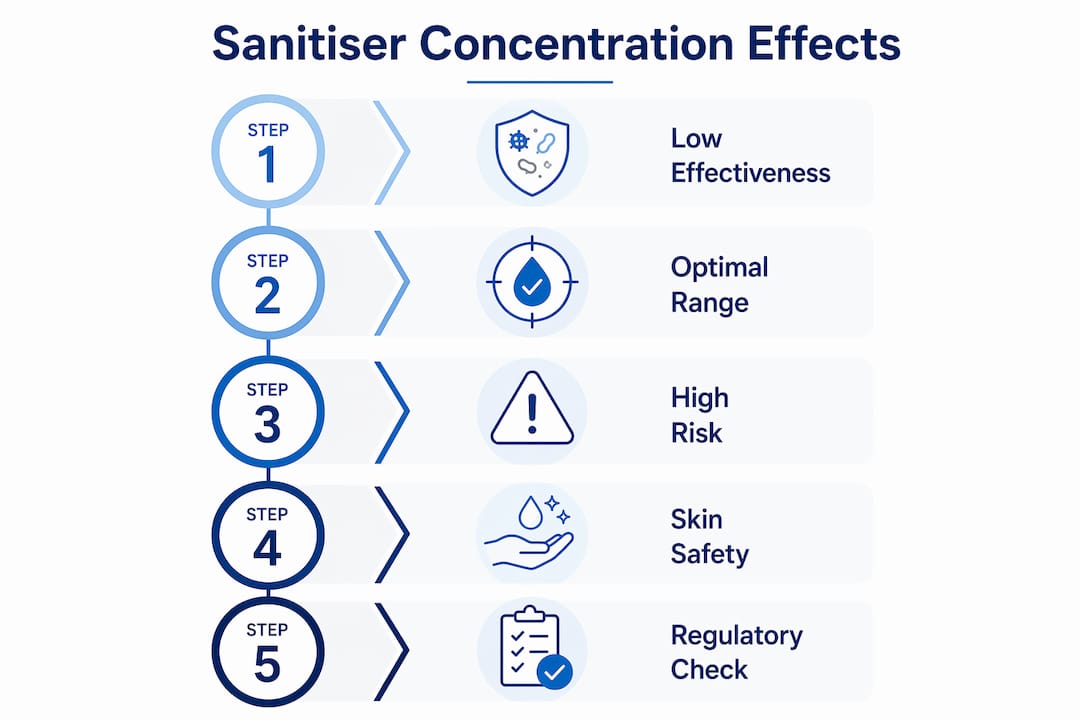
This is why a sanitiser at 99% ethanol performs worse than one at 80%. The absence of water slows the denaturation reaction and causes the alcohol to evaporate from the skin surface before it can complete the job.
Within the 60–95% band, the specific alcohol type also shapes what gets killed:
- Isopropanol tends to be more potent against bacteria at lower concentrations, making it a practical choice in settings where bacterial contamination is the primary concern
- Ethanol has a broader antiviral spectrum, which is why it appears in most formulations designed for general-purpose or healthcare use
- Both alcohols are effective against fungi and enveloped viruses (including influenza and coronaviruses), but neither reliably kills non-enveloped viruses like norovirus or bacterial spores
Delivery format also plays a role. Liquid hand rubs reduce bacteria counts more effectively than gels in some conditions, largely because gels can create contact time challenges at higher concentrations. That said, concentration remains the primary driver of efficacy regardless of format.
Evaporation rate is another practical variable. In warm Australian conditions, a product near the top of the concentration range can evaporate faster than expected, particularly if dispensed in a thin layer or applied in a breezy outdoor environment. The solution is not to use less product. It is to apply enough and rub until the hands are dry, which is the point at which the alcohol has completed its antimicrobial action.
Safety and skin health: what concentration means for the people using it
Higher concentration does not automatically mean safer or better. Alcohol concentrations above 95% increase the risk of skin dryness and irritation, and with frequent use, that dryness can progress to cracking. Cracked skin is a direct infection pathway, which means a sanitiser that damages the skin barrier can actively undermine the hygiene outcome it was meant to support.
Professional formulations address this with emollients. Glycerol is the most commonly used, and its inclusion in the WHO-recommended formulation (at 1.45% v/v for isopropyl alcohol-based products) is deliberate. Glycerol reduces contact dermatitis and keeps skin intact, which in turn encourages people to use the sanitiser as often as they should. A product that healthcare workers or hospitality staff avoid because it wrecks their hands is a product that fails at the population level.
Key safety considerations for organisations:
- Products above 95% alcohol are not more effective and carry higher skin irritation risk
- Formulations without emollients are unsuitable for high-frequency use environments
- High-concentration products near ignition sources (kitchens, laboratories) require specific storage and handling protocols
- Ingestion of alcohol-based sanitisers is a genuine hazard, particularly for children. Products should be stored out of reach and dispensers positioned at adult height in mixed-use facilities
Pro Tip: When selecting sanitisers for high-traffic or healthcare environments, look for formulations that include glycerol or a comparable emollient alongside the active alcohol. A hand sanitiser with moisturising aloe or glycerol maintains skin integrity and keeps compliance rates high across shifts.
Non-alcohol-based sanitisers (typically using chlorhexidine gluconate or triclosan) operate differently. They do not rely on protein denaturation and are not subject to the same concentration dynamics. However, their antimicrobial spectrum is narrower and they are generally less effective against viruses. For most workplace and healthcare applications in Australia, alcohol-based products in the 60–95% range remain the standard.
Australian regulatory standards and quality assurance for hand sanitisers
The TGA regulates hand sanitisers sold as therapeutic goods in Australia under the Therapeutic Goods Act 1989. For registered products, the AUST R number on the label confirms that the product has been assessed for safety, quality, and efficacy, including verification of alcohol concentration.
The TGA’s OTC medicine monograph for hand sanitisers specifies the approved active substances and permits concentration ranges consistent with clinical guidance for efficacy and safety.
Manufacturers are required to verify alcohol concentration in each batch using gas chromatography, an alcoholmeter, a hydrometer, or another method of equivalent accuracy. This batch testing requirement is what separates a regulated product from a home-made or unregulated one.
Unregulated or home-made sanitisers carry real risks. Without batch testing, the actual alcohol concentration may fall well outside the effective range, and unauthorised ingredients may introduce additional hazards. During the COVID-19 period, the TGA issued temporary exclusion determinations to allow certain specified formulations to be manufactured outside the usual registration pathway, but those formulations still required batch concentration testing and compliance with specified ingredient lists.
For organisations purchasing sanitisers, a practical compliance checklist:
- Confirm the product carries an AUST R number or was manufactured under a TGA-approved exclusion
- Check that the active alcohol and its concentration appear clearly on the label
- Avoid products with unlisted or unverified ingredients
- Source from suppliers who can provide batch testing documentation on request
- Review hand hygiene standards for businesses to align purchasing decisions with workplace compliance requirements
How to use hand sanitiser correctly
Correct application technique is where concentration and real-world effectiveness either connect or come apart. A product at 75% isopropyl alcohol applied incorrectly delivers a fraction of its potential germ-killing power.
The steps are straightforward but frequently rushed:
- Apply enough product to cover all surfaces of both hands. For most adult hands, this means roughly 3 ml, which is more than most people use.
- Rub hands together, covering the backs of hands, between fingers, and around the thumbs and fingertips.
- Continue rubbing until hands are completely dry. This is the critical step. Wiping hands on clothing or a towel before they are dry removes the active alcohol before it has finished working.
A few practical points worth knowing:
- Hand sanitiser does not replace handwashing when hands are visibly soiled or contaminated with organic matter. Dirt and protein residue physically block alcohol from reaching the microbial surface.
- Sanitiser is less effective against non-enveloped viruses (norovirus, for example) and bacterial spores regardless of concentration. In settings where these are a specific risk, soap and water is the preferred method.
- Gloves do not eliminate the need for hand hygiene. Alcohol-based hand rubs should be used when gloves are removed.
For healthcare settings, the 2026 healthcare sanitisation compliance guide outlines the specific protocol points where concentration and technique intersect with regulatory requirements.
Dilution practices and the risks of reformulating sanitisers
Diluting a commercial sanitiser reduces its alcohol concentration and may push the product to the lower limit or below the effective concentration range. Dilute it further and it falls below the threshold entirely.
The problem is not just the maths. Commercial sanitiser formulations are engineered as complete systems. The alcohol concentration, water content, emollient levels, and any additional active ingredients (such as chlorhexidine gluconate) are calibrated together. Introducing additional water or other substances disrupts that balance in ways that are not always visible. The product may still look and smell identical while delivering significantly reduced antimicrobial activity.
Reformulation risks organisations should be aware of:
- Concentration drop: any post-manufacture dilution reduces alcohol content and may push the product below the 60% effective threshold
- Emollient imbalance: diluting a glycerol-containing formulation reduces its skin-protective effect proportionally
- Contamination risk: adding water from an unverified source introduces potential microbial contamination into the product itself
- Regulatory non-compliance: a product that has been altered from its registered formulation no longer carries the protections of its AUST R registration
The same logic applies to mixing sanitiser products. Combining two products with different active ingredients or concentrations creates an unverified formulation with no batch testing behind it. The TGA’s position is clear: products should be used as supplied, without modification.
If volume or cost is the driver behind dilution practices, the better path is sourcing appropriately concentrated products in bulk through a verified supplier. Ozifresh’s hand sanitiser range covers compliant formulations suited to high-volume workplace and healthcare environments, without the compliance risk that comes with improvised dilution.
Ozifresh keeps your sanitiser programme compliant and effective
Getting sanitiser concentration right is not a one-time purchase decision. It requires consistent supply of verified, TGA-compliant products, correct dispensing equipment, and a supplier who understands the regulatory environment your organisation operates in.
Ozifresh has delivered professional hygiene solutions across Brisbane, the Gold Coast, and Melbourne for over 40 years. For businesses that need more than a bottle on the counter, Ozifresh provides end-to-end hygiene services and compliant sanitiser products tailored to commercial workplaces, healthcare facilities, educational institutions, hospitality venues, and residential complexes. Every product in the range meets Australian regulatory standards, and the service model means your dispensers are maintained, restocked, and functioning correctly.
Contact Ozifresh to discuss a hygiene programme that keeps your team and your clients protected with the right products at the right concentration, every time.
Key takeaways
Sanitiser alcohol concentration must be within the 60–95% v/v range for reliable germ-killing action and safe skin outcomes, as confirmed by Australian clinical guidance and the WHO. Any product outside this band is not considered effective or safe for routine use.
| Point | Details |
|---|---|
| Effective concentration range | 60–95% v/v alcohol is the scientifically supported performance zone for ethanol and isopropyl alcohol sanitisers. |
| Why pure alcohol underperforms | Water enables protein denaturation; concentrations above 95% evaporate too fast for antimicrobial efficacy. |
| Alcohol type shapes germ coverage | Isopropanol is more potent against bacteria at lower concentrations; ethanol covers a broader antiviral spectrum. |
| Emollients protect skin and compliance | Glycerol and similar emollients help prevent skin cracking and support frequent use. |
| Ozifresh for compliant supply | Ozifresh provides TGA-compliant hand sanitisers and managed hygiene services across Brisbane, Gold Coast, and Melbourne. |
Recommended
Ready for a cleaner, safer workplace?
Contact our team today to discuss hygiene services for your business in Brisbane, Melbourne or the Gold Coast.