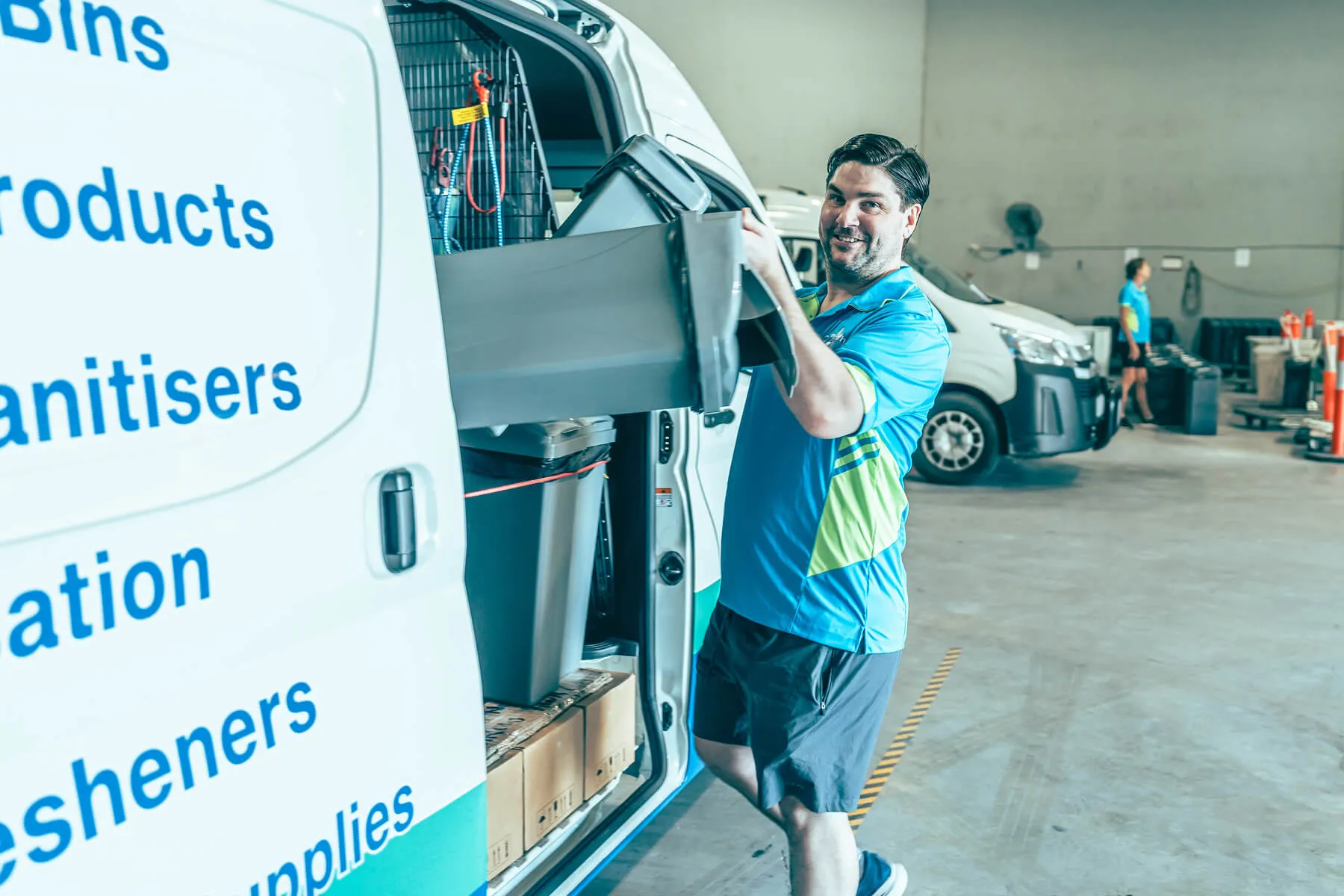
Sanitary bin signage: compliance guide for facilities managers
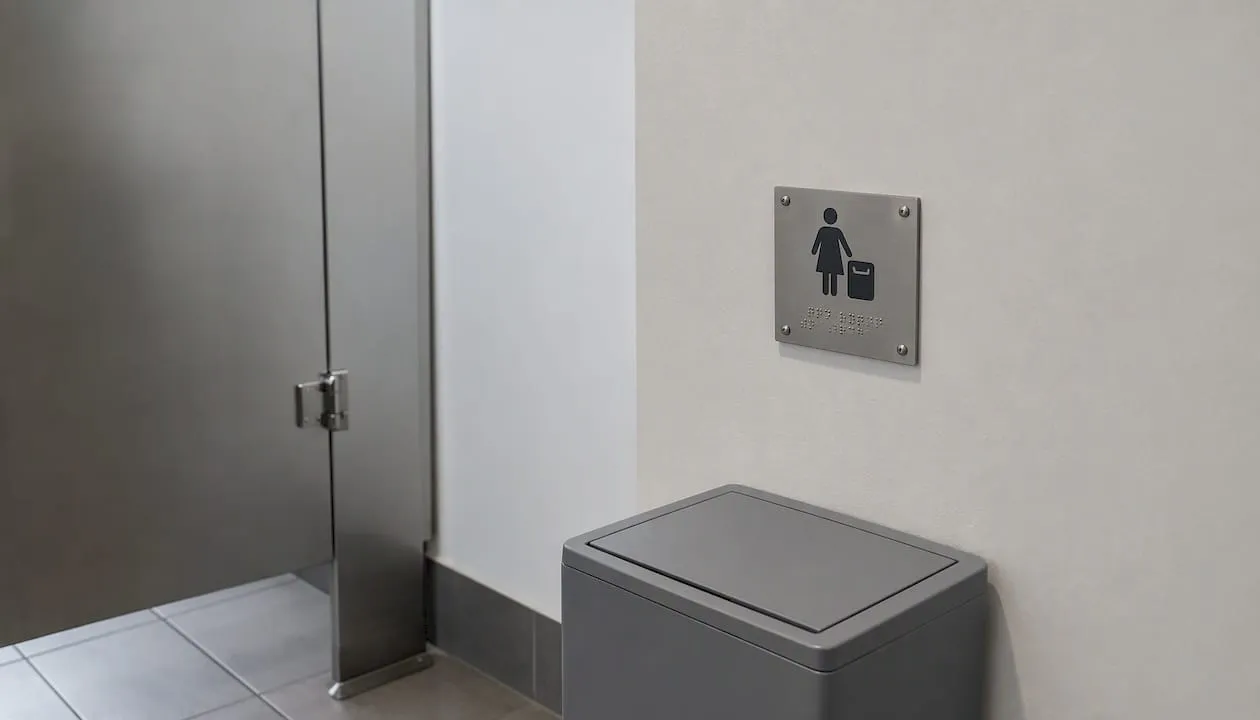
Every toilet cubicle and accessible/all-genders toilet in your facility needs a clearly labelled sanitary bin with signage directing users to it. That is the baseline under Safe Work Australia’s model code and the National Construction Code 2025. Getting it right means three things: a dedicated bin (not a general rubbish bin), clear restroom sanitary signage on or inside the cubicle, and braille/tactile marks on accessible toilet signs.
Act now:
- Check every accessible and all-genders toilet for a sanitary disposal unit and matching signage
- Replace any faded, damaged, or braille-free signs in accessible cubicles
- Add sanitary bin signage to your next servicing round and procurement order
- For a single-supplier solution covering bins, signs, and scheduled collection, Ozifresh sanitary bins covers commercial and healthcare facilities across Brisbane, the Gold Coast, and Melbourne
Key takeaways
Compliant sanitary bin signage requires a dedicated bin, clear labelling inside every cubicle, and certified braille/tactile signs in accessible toilets, backed by Safe Work Australia, the NCC 2025, and AS 1428.1.
| Point | Details |
|---|---|
| Bin in every cubicle | Every accessible and all-genders toilet needs a dedicated sanitary bin, not a general rubbish bin. |
| Clear, respectful wording | Use neutral language: “Please use the sanitary bin provided” or “Sanitary bin — do not flush.” |
| Braille/tactile for accessible toilets | AS 1428.1 and WorkSafe Victoria require certified tactile/braille signs in accessible cubicles. |
| Prefer Australian suppliers | Local suppliers offer faster lead times and clearer compliance documentation for certified signs. |
| Add signage to servicing rounds | Check signs at every bin service visit and photograph for your WHS audit record. |
| Ozifresh integrated service | Ozifresh bundles bin supply, signage, and scheduled collection into a single contract for commercial and healthcare facilities. |
Table of Contents
- Where can you buy sanitary bin signs in Australia?
- What does Australian law actually require for sanitary disposal and signage?
- What should your sanitary bin signs actually say?
- What do accessible toilet signs need to include?
- Where should you mount sanitary bin signs?
- What materials and sizes should you specify?
- How much do sanitary bin signs cost, and how long do they take?
- Compliance checklist: keeping signs legible and current
- Why clear signage actually matters: the evidence
- The part most facilities get wrong
- Ozifresh: bins, signage, and servicing in one contract
- Sources
Where can you buy sanitary bin signs in Australia?
Off-the-shelf signs suit most standard cubicles. Custom signs with braille, tactile symbols, or brand-matched colours take longer and cost more, but they are the right call for accessible toilets and high-profile public facilities.
Buying guidance:
- Off-the-shelf (New Signs, National Safety Signs): fastest path to compliance for standard cubicles; New Signs carries a broad toilet and sanitary bin sign catalogue suited to quick stock orders; National Safety Signs positions its sanitary items toilet sign explicitly as a compliance tool
- Marketplaces (Amazon Australia, Etsy Australia): useful for immediate replacements or bespoke aesthetics, but neither platform certifies braille embossing or tactile compliance; Amazon Australia wins on speed and price; Etsy Australia wins on design flexibility
- Integrated supplier (Ozifresh): the only option here that bundles signage procurement with scheduled bin collection and replacement, which removes the admin of managing two separate suppliers and keeps signage matched to current bin models
What does Australian law actually require for sanitary disposal and signage?
The obligation sits across WHS legislation, the NCC, and state compliance codes. Here is what each layer requires.
The Safe Work Australia model code requires toilets to be clearly signposted and to include a hygienic means of sanitary disposal. “Hygienic means” is consistently interpreted in practice as a dedicated sanitary bin. A standard rubbish bin does not meet this standard.
The NCC 2025 goes further: it requires sanitary product disposal in commercial facilities where females use the facility, and adds a requirement for a menstruation product dispenser. All-genders facilities must also contain sanitary product disposal.
WorkSafe Victoria’s compliance code is the most specific: accessible toilets must contain a sanitary disposal unit, signage must include braille, and all-genders toilets must contain a sanitary disposal unit and be clearly signposted.
WorkSafe WA confirms the same PCBU obligation: adequate and accessible facilities for worker welfare, including hygienic disposal for sanitary items.
Construction sites have a harder rule. Under the WorkSafe Queensland amendment regulation 2024, principal contractors on qualifying projects must provide sanitary bins immediately adjacent to the pan in designated female toilets.
Minimum compliance actions for most facilities:
- Provide a dedicated sanitary bin in every accessible and all-genders toilet
- Clearly signpost all toilet facilities, including the location of disposal units
- Include sanitary disposal in workplace facility planning and WHS consultations
- Treat generic rubbish bins as non-compliant for sanitary waste
What should your sanitary bin signs actually say?
Simple, respectful, gender-neutral wording works best. Avoid euphemisms and avoid anything that reads as shaming. The goal is clarity: users should know the bin is there and what goes in it without having to read a paragraph.
Ready-to-use wording templates:
- Standard cubicle: “Please use the sanitary bin provided”
- Accessible/all-genders cubicle: “Sanitary disposal unit provided — please use bin, do not flush”
- Door or entrance sign: “Sanitary bin available inside”
- Staff or service area: “Sanitary waste disposal — staff use only. Contact facilities for servicing.”
- Waste room or collection point: “Sanitary waste collection point — do not place general waste in this bin”
Icon guidance:
- Use a toilet silhouette paired with an “All genders” label for unisex facilities
- Add a sanitary bin pictogram (a stylised bin with a lid) inside the cubicle
- For accessible toilets, include the International Symbol of Access alongside the bin symbol
- Specify ISO or AS-aligned pictograms when ordering custom signs to keep symbols consistent across your facility
Pro Tip: When writing a purchase order for custom signs, specify the pictogram standard (ISO 7001 or AS-aligned) and the braille standard (Grade 2 Unified English Braille) in the order notes. Suppliers who cannot confirm these standards are unlikely to produce certified accessible signs.
What do accessible toilet signs need to include?
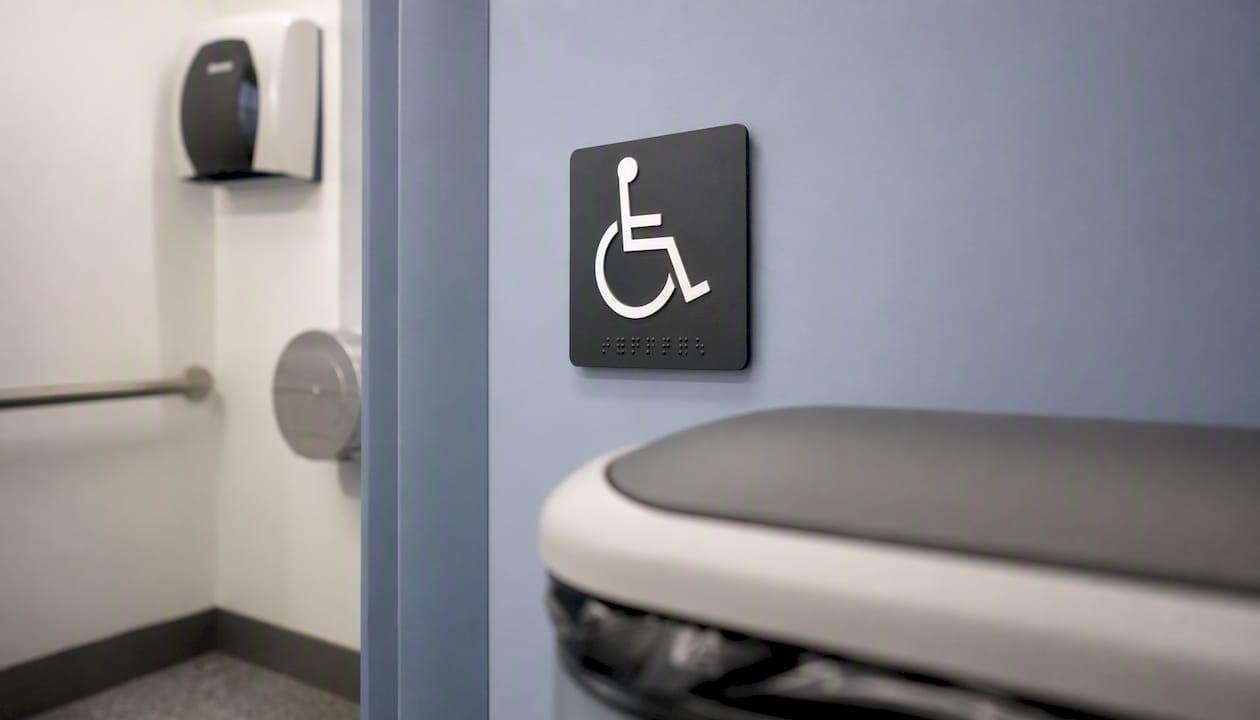
Accessible and all-genders toilets require more than a printed label. WorkSafe Victoria’s compliance code explicitly requires braille on signage for accessible toilets, and AS 1428.1 sets the technical specifications.
Minimum requirements for accessible toilet signage:
- Raised tactile symbol (the International Symbol of Access) on the sign face
- Grade 2 Unified English Braille below or adjacent to the text
- High-contrast text: minimum 70% luminance contrast between text and background
- Minimum character height of 15mm for tactile lettering per AS 1428.1
- Mounting height: sign centre between 1,200mm and 1,600mm from finished floor level
- Non-reflective finish to prevent glare under artificial lighting
Ambulant cubicles (those designed for people with limited mobility but not full wheelchair access) follow the same braille and tactile requirements as fully accessible cubicles. Standard cubicles do not require braille, but adding it does no harm and future-proofs the installation.
For all-genders facilities, WorkSafe Victoria recommends clear signposting at the entrance as well as inside the cubicle, so users know what facilities are available before entering.
Pro Tip: Ask your signage supplier to confirm AS 1428.1 compliance in writing and include it as a line item in your purchase order. If they cannot provide that confirmation, source from a supplier who can.
Where should you mount sanitary bin signs?
Inside each cubicle, on the wall immediately adjacent to or above the bin, at seated eye level. That is the placement that works. Signs mounted on the outside of cubicle doors are useful for directing users to the right facility, but they do not replace the in-cubicle label.
Placement checklist:
- Inside cubicle: sign on the wall beside or above the bin, visible from the seated position
- Cubicle door (interior face): secondary sign if the bin is not immediately visible on entry
- All-genders/accessible toilet entrance: sign at the door indicating sanitary disposal is available inside
- Multi-toilet banks: directional sign in the corridor pointing to the accessible toilet with disposal unit
- Waste rooms or service areas: sign at the door and on the bin itself
Installation steps:
- Confirm bin position first (immediately adjacent to the pan, within arm’s reach whilst seated)
- Mark the sign position at 1,200–1,600mm centre height for accessible signs; standard signs at natural eye level for a seated adult (approximately 900–1,100mm)
- Use tamper-resistant fixings in public locations (security screws or adhesive-backed plates)
- Check that braille and tactile elements face outward and are unobstructed by door frames or fixtures
- Use a non-reflective sign finish in fluorescent-lit environments to prevent glare
- For corridor or doorway directional signs, confirm the sign is visible from at least 3 metres away
What materials and sizes should you specify?
Choose materials rated for your environment. PVC and acrylic suit most indoor washrooms. Aluminium is the right call for exposed or semi-outdoor sites, construction amenities, and anywhere subject to heavy cleaning with industrial products.
Material guide:
| Material | Typical thickness | Recommended environment | Expected lifespan |
|---|---|---|---|
| PVC (rigid) | 1–3mm | Standard indoor washrooms | 3–5 years |
| Acrylic | 3–5mm | Corporate, healthcare, hospitality interiors | 5 years |
| Aluminium (anodised) | 3mm | Outdoor, construction, industrial | 12 years |
| Tactile/braille acrylic | 3–5mm | Accessible toilets, NCC-compliant facilities | 5 years |
Size and legibility:
- Minimum sign size for a single-line instruction: 100mm × 50mm
- Recommended for cubicle signs with pictogram: 150mm × 100mm
- Pictogram height: minimum 50mm for clear recognition at 1 metre
- Text height: minimum 5mm for body text; 15mm for tactile characters
Specify wipeable, chemical-resistant finishes for healthcare and hospitality settings where surfaces are cleaned with hospital-grade disinfectants. Anti-microbial coatings are available from specialist suppliers and worth specifying for high-traffic clinical environments.
How much do sanitary bin signs cost, and how long do they take?
Off-the-shelf signs are the cheapest and fastest option. Custom and tactile/braille signs cost more and take longer, but they are the only compliant choice for accessible toilets.
Indicative cost ranges (AUD, per sign):
- Standard off-the-shelf PVC sign: $5–$20
- Mid-range custom printed acrylic or aluminium sign: $25–$80
- Tactile/braille certified sign (AS 1428.1 compliant): $80–$200+
These are indicative ranges only. Prices vary by supplier, order volume, and finish.
Lead times:
- Stock signs (New Signs, National Safety Signs, Amazon Australia): same-day to 7 days
- Custom domestic production (acrylic, aluminium, printed): 1–3 weeks
- Certified tactile/braille signs: 2–4 weeks depending on supplier and order volume
Buying tips:
- Bundle sign orders with sanitary bin supply to reduce per-unit cost and simplify procurement
- Confirm production lead times before a compliance audit or facility refurbishment deadline
- For large facilities, order 10–15% extra stock signs to cover replacements without reordering
- Tactile/braille signs from Australian suppliers typically have shorter lead times than imported equivalents and come with clearer compliance documentation
Compliance checklist: keeping signs legible and current
Signage maintenance belongs in your WHS audit schedule and your sanitary bin servicing rounds. A sign that was compliant at installation can fail an audit if it fades, gets obscured, or the bin moves.
- Monthly (high-use facilities): visually check all cubicle signs for legibility, damage, and obstruction; confirm bin position matches signage
- Quarterly (lower-use buildings): full audit of text clarity, tactile/braille integrity, mounting security, and pictogram condition
- Immediately: replace any sign where braille or tactile elements are damaged, text is illegible, or the sign has been removed
- At every bin service visit: check that the sign is present, unobstructed, and matches the current bin location
- After refurbishments: re-confirm sign placement and mounting heights meet current NCC and AS 1428.1 requirements
Pro Tip: Include a signage photo in your sanitary bin service log at each visit. A dated photo record is your fastest evidence of compliance during a WHS audit or insurance review.
Why clear signage actually matters: the evidence
Clear sanitary bin signage reduces plumbing faults, protects hygiene, and supports user dignity. Those are not soft benefits.
When users cannot find or identify a disposal unit, sanitary items get flushed. That causes blockages, increases plumbing maintenance costs, and creates hygiene risks for the facility. Clear, well-placed hygienic bin labels directly reduce that outcome.
The regulatory direction is also moving. Victoria has seen an active parliamentary push to standardise sanitary bin provision across all bathrooms, including men’s facilities, driven by both plumbing fault data and dignity considerations. The NCC 2025 update requiring sanitary disposal in male facilities where females are present reflects the same trend nationally.
From a WHS compliance posture, the combination of a dedicated bin and clear signage is the defensible standard. WorkSafe WA and Safe Work Australia both frame this as a PCBU obligation, not a discretionary amenity. Signage is the visible proof that the obligation has been met.
The part most facilities get wrong
Most facilities managers focus on getting the bin in place and treat the sign as an afterthought. That is backwards. The sign is what makes the bin findable, and in an accessible toilet, it is also what makes the facility legally compliant. A bin without a sign is invisible to a first-time visitor and invisible to an auditor.
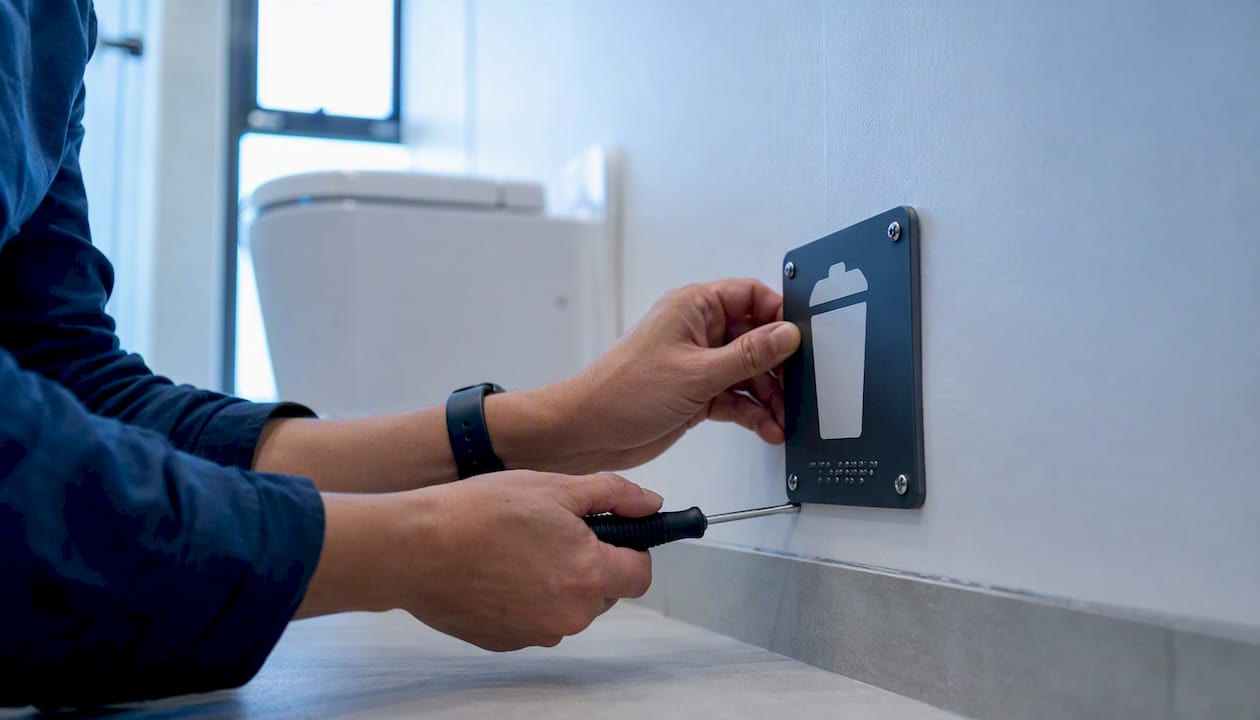
The other common mistake is ordering standard signs for accessible toilets. A printed PVC label with no braille is not compliant for an accessible cubicle under WorkSafe Victoria’s code or AS 1428.1. The cost difference between a standard sign and a certified tactile/braille sign is real, but it is small compared to the cost of a WHS non-compliance finding.
The third gap is maintenance. Signs get painted over, covered by toilet paper dispensers, or simply fade. A sign that was compliant at installation and is now illegible is a liability. Building signage checks into your servicing schedule, rather than treating them as a separate task, is the most reliable way to keep the facility audit-ready.
Ozifresh: bins, signage, and servicing in one contract
For facilities that want to stop managing bins and signage as separate procurement lines, Ozifresh bundles sanitary bin supply, signage, and scheduled collection into a single service contract. That means one supplier, one invoice, and signage that stays matched to current bin models across your servicing cycle.
Ozifresh serves commercial workplaces, healthcare facilities, hospitality venues, and managed properties across Brisbane, the Gold Coast, and Melbourne. With over 40 years in Australian hygiene services, the compliance documentation is straightforward and the servicing schedule is built around your facility’s use patterns, not a generic calendar.
To discuss supply, signage, and scheduled servicing for your facility, visit the Ozifresh sanitary bins page or contact the team directly for a quote.
Sources
These are the primary documents to cite in procurement packs, WHS audits, and compliance cases:
- NCC 2025 - Sanitary facilities | NCC
- Model Code of Practice - Managing the work environment and facilities - December 2025
- Compliance code: Workplace facilities and the working environment
- Work health and safety amenities for construction work — amendment regulation 2024 | WorkSafe Queensland
- Work environment and facilities | WorkSafe WA
Recommended
Ready for a cleaner, safer workplace?
Contact our team today to discuss hygiene services for your business in Brisbane, Melbourne or the Gold Coast.