
Why businesses need sanitary bins: a 2026 guide
TL;DR:
- Sanitary bins are essential workplace safety infrastructure required by law in Australia, not optional amenities. Proper units with sealed liners, sensor lids, and compliance with AS 1428.1 prevent health risks, plumbing damage, and protect employee dignity. Regular professional servicing and site assessments ensure legal compliance, hygiene, and avoid costly penalties or infrastructure failures.
Sanitary bins are specialised disposal units designed to safely contain feminine hygiene products, incontinence pads, and other sanitary waste in workplace washrooms. Understanding why businesses need sanitary bins goes beyond basic tidiness. Under the Work Health and Safety Act 2011 and Safe Work Australia’s updated 2025 Code of Practice, providing hygienic sanitary disposal is a legal duty of care. Failing to meet that duty exposes your business to regulatory penalties, plumbing disasters, and indirect discrimination claims. This guide covers the legal requirements, health benefits, common misconceptions, and practical steps for getting sanitary waste management right.
What are the legal requirements for sanitary bins in Australian workplaces?
Australian workplace law treats sanitary bins as mandatory safety infrastructure, not optional amenities. The WHS Act 2011 places a duty on employers to provide and maintain safe working environments, and that obligation extends directly to washroom facilities.
Safe Work Australia’s 2025 updated Code of Practice goes further. It identifies period products and sanitary bins as core workplace safety infrastructure, placing them in the same category as toilets and drinking water. That framing matters because codes of practice carry significant legal weight. They serve as key evidence in proceedings when a regulator assesses whether a duty holder met the “reasonably practicable” standard.
The WHS Code recommends providing period products and sanitary bins, particularly in high-risk and remote workplaces, as a ‘reasonably practicable’ measure to eliminate health and safety risks. Codes of practice act as key evidence in legal proceedings on WHS duty compliance.
The consequences of non-compliance are real and varied:
- Regulatory breach: Failure to provide hygienic disposal facilities may constitute a breach of safety duties under the WHS Act, attracting fines and improvement notices.
- Indirect discrimination liability: Denying menstruating employees a dignified disposal option can support a claim of indirect discrimination under federal and state anti-discrimination law.
- Reputational damage: Poor washroom standards generate complaints, affect staff retention, and undermine your organisation’s duty of care reputation.
- Plumbing liability: Where inadequate facilities lead employees to flush sanitary products, the resulting infrastructure damage may fall on the building owner or facility manager.
Understanding sanitary bin compliance requirements before an audit or incident occurs is the only sensible approach.
How do sanitary bins benefit workplace hygiene and building infrastructure?
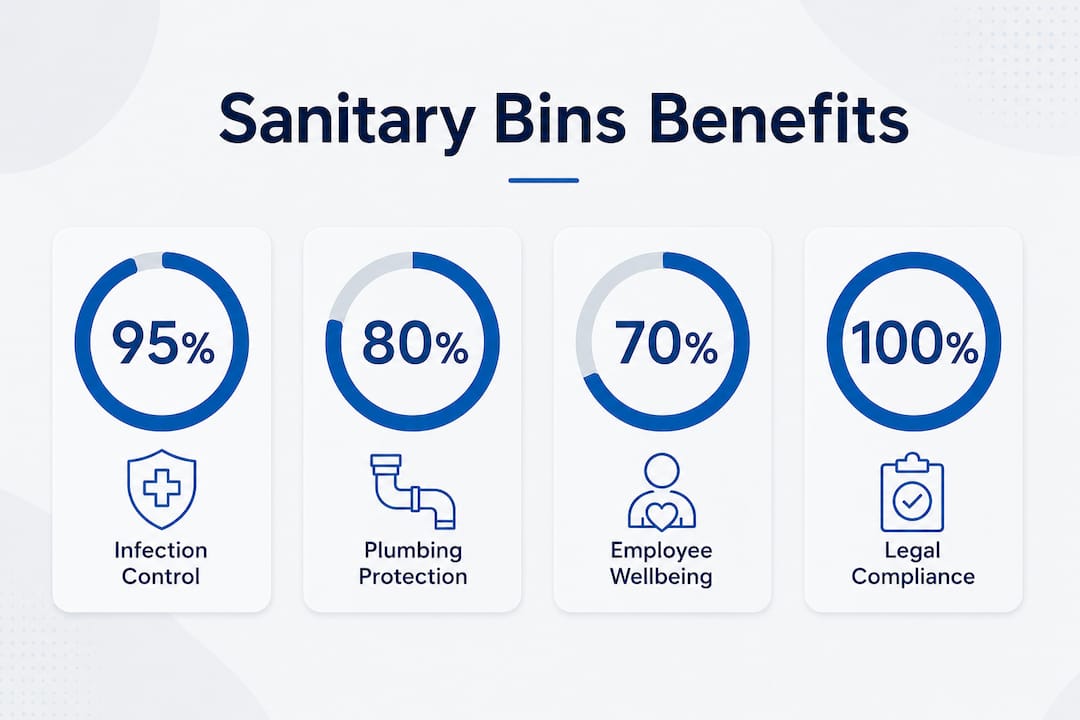
Sanitary bins deliver three distinct categories of benefit: infection control, facility protection, and employee wellbeing. Each one has a direct cost implication for your business.
Infection control and pathogen reduction
Used sanitary products carry blood-borne pathogens and biological material. Professional sanitary bins use no-touch operation and sealed containers to isolate that material from the surrounding environment. Sensor-activated lids and medical-grade vapour neutralisation prevent odour and airborne contamination. Standard household bins offer none of these features. Maintaining clean washrooms is a legal requirement under the WHS Act 2011, with hospital-grade disinfectants meeting AS/NZS 4815 standards recommended for regular use on high-touch surfaces. Sanitary bins reduce the frequency and severity of contamination events that trigger those cleaning obligations.
Protecting your plumbing and building
Flushing sanitary products causes fatbergs. A fatberg is a mass of non-degradable material that accumulates in sewer pipes, and it is far more destructive than a simple blockage. Fatbergs cause blockages, flooding, and structural damage requiring expensive emergency plumbing. For a facility manager, a single fatberg event can cost more than years of professional sanitary bin servicing. Providing proper disposal units removes the temptation and the risk entirely.
Statistic: Sanitary products are among the most common causes of sewer blockages in commercial buildings. Proper disposal units eliminate the pathway that leads to infrastructure failure.
Pro Tip: Schedule a washroom audit every six months and check for evidence of flushed products, such as slow-draining toilets or recurring blockages. Early detection prevents costly emergency repairs.
Supporting employee wellbeing and ESG goals
Safe Work Australia’s 2025 Code directly links access to period products to preventing stress and psychosocial hazards at work. An employee who cannot dispose of sanitary waste discreetly and hygienically experiences a genuine psychosocial stressor. That stressor affects concentration, comfort, and willingness to remain in the workplace. Proper sanitary disposal also aligns with environmental, social, and governance commitments. Professional servicing providers use sealed waste streams that meet regulated disposal standards, keeping sanitary waste out of general landfill and reducing cross-contamination risk.
What misconceptions exist about sanitary bins, and why do standard bins fail?
The most common misconception is that any lidded bin placed in a toilet cubicle satisfies the requirement. It does not.
Why standard bins are non-compliant
Standard household pedal bins lack sealed liners and odour control. They have no mechanism to prevent biological material from contacting the bin interior, which means cleaning staff handle contaminated surfaces directly. They also sit on the floor, creating a cleaning obstacle and a hygiene risk. Compliant sanitary bins feature sensor-activated lids and medical-grade vapour neutralisation, features that standard bins simply do not offer. The gap between a household bin and a compliant unit is not cosmetic. It is the difference between meeting your duty of care and breaching it.
The dignity problem with inadequate facilities
A lack of proper sanitary bins creates a specific and avoidable problem. Without dedicated units, employees carry used products out of cubicles, which is unhygienic and undermines personal dignity. This situation is not hypothetical. It is a documented outcome of inadequate provision. Dedicated units eliminate the need for what is sometimes called “courtesy disposal,” representing a measurably higher hygiene standard.
| Feature | Standard bin | Compliant sanitary bin |
|---|---|---|
| Sealed liner | No | Yes |
| Odour control | No | Medical-grade vapour neutralisation |
| No-touch operation | Foot pedal only | Sensor-activated lid |
| AS 1428.1 wall mounting | No | Yes |
| Biological containment | No | Full containment |
Pro Tip: When specifying sanitary bins for a new site, confirm that units are wall-mounted at the ergonomic height required by AS 1428.1. Floor-standing units fail the accessibility standard and create cleaning complications.
How should businesses select, install, and maintain sanitary bins?
Getting the right units in the right locations, serviced at the right frequency, is where compliance becomes practical. The process has four stages.
Assess your site and traffic
Start by counting the number of female-identified and gender-neutral toilet cubicles across your site. Every cubicle requires its own dedicated unit. High-traffic sites, such as retail venues, hospitality businesses, and healthcare facilities, need more frequent servicing than low-traffic offices. Remote and high-risk workplaces have an explicit obligation under the WHS Code to provide sanitary bins as a reasonably practicable measure. Refer to workplace compliance setup guidance to map your obligations against your site profile.
Installation standards
Australian accessibility standard AS 1428.1 requires sanitary bins to be wall-mounted at ergonomic heights for seated users. Wall mounting keeps floors clear for cleaning and allows minimal-reach operation. Every unit must be positioned within easy reach from the toilet, without requiring the user to stand or stretch. Confirm that your installer follows AS 1428.1 specifications on every site.
Servicing: replacement, not emptying
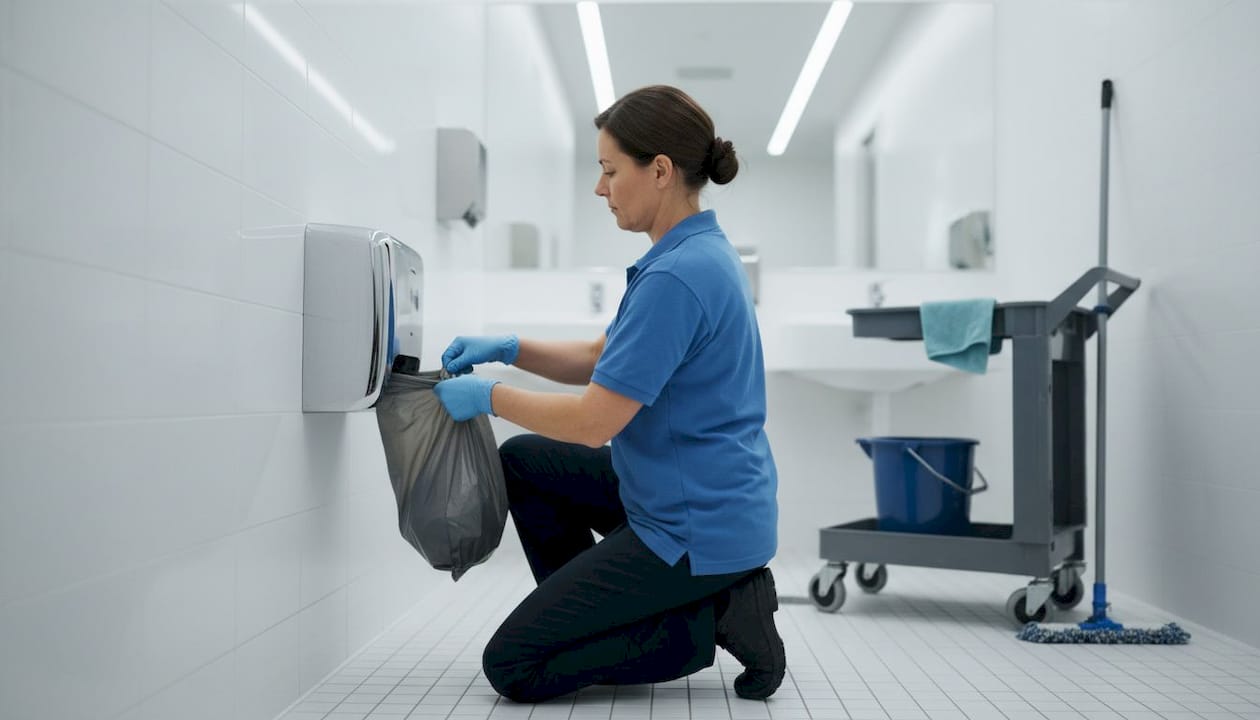
Professional servicing means complete unit replacement, not emptying and relining. The used unit is removed, sealed, and taken away for regulated disposal. A fresh, pre-lined unit is installed in its place. Cleaning staff never handle the contents. This approach eliminates cross-contamination risk and keeps your cleaning team safe.
The following checklist covers the key maintenance obligations for facility managers:
- Confirm servicing frequency matches site traffic (monthly minimum for low-traffic, fortnightly or weekly for high-traffic sites).
- Verify that the service provider replaces entire units rather than emptying them.
- Check that waste is disposed of through a regulated sanitary waste stream, not general waste.
- Inspect wall-mounting hardware at each service visit for security and compliance.
- Include sanitary bin condition in your routine washroom hygiene audit.
Integrating bins into your hygiene risk management programme
Sanitary bins belong inside your broader washroom hygiene framework alongside hand hygiene products, soap dispensers, and air fresheners. A washroom risk audit that covers all these elements gives you a defensible record of compliance. Document servicing dates, unit conditions, and any incidents. That documentation is your evidence if a regulator or insurer ever questions your duty of care.
Key takeaways
Businesses that treat sanitary bins as essential safety infrastructure, not optional amenities, meet their legal obligations and protect their facilities from costly plumbing and reputational damage.
| Point | Details |
|---|---|
| Legal obligation | The WHS Act 2011 and 2025 Safe Work Australia Code make sanitary bin provision a duty of care. |
| Compliant units only | Standard household bins do not meet AS 1428.1 or provide the sealed containment required by law. |
| Plumbing protection | Proper disposal units prevent fatbergs, blockages, and structural damage from flushed sanitary products. |
| Psychosocial health | Adequate sanitary disposal reduces workplace stress and supports employee dignity and wellbeing. |
| Professional servicing | Complete unit replacement, not emptying, is the correct servicing method for hygiene and safety compliance. |
Sanitary bins as non-negotiable workplace infrastructure
Facility managers often ask me where sanitary bins sit in the hierarchy of workplace safety priorities. My answer is always the same: they sit alongside hard hats and high-visibility vests. You would not tell a construction worker to improvise their PPE. You should not tell a menstruating employee to improvise their sanitary disposal.
What I have seen over many years is that the businesses that treat sanitary waste management as a genuine safety investment save money in the long run. The plumbing bills alone justify the cost of professional servicing. A fatberg in a commercial building is not a minor inconvenience. It is a facility emergency that disrupts operations, damages your building, and lands on your insurance record.
The psychosocial dimension is equally real. Safe Work Australia’s 2025 Code did not add period products and sanitary bins to the list of core safety infrastructure by accident. The evidence connecting inadequate menstrual facilities to workplace stress and absenteeism is clear. Facility managers who understand their washroom safety obligations are better placed to prevent those outcomes before they affect productivity.
The reputational argument is the one that tends to land with business owners. A single complaint about inadequate washroom facilities, posted publicly or raised in a Fair Work proceeding, costs far more to manage than a year of professional sanitary bin servicing. Treat this as a risk management decision, not a hygiene afterthought.
— Ozifresh
Professional sanitary bin services for Australian businesses
Ozifresh has delivered professional hygiene services across Brisbane, the Gold Coast, and Melbourne for over 40 years. Their sanitary bin services cover complete unit replacement, odour control, and regulated waste disposal, tailored to your site’s traffic and compliance requirements. Whether you manage a single office washroom or a multi-site retail or healthcare operation, Ozifresh provides servicing schedules that match your needs. Their team handles the compliance detail so you can focus on running your business. Contact Ozifresh to arrange a site assessment and get your washroom hygiene programme working at the standard the law requires.
FAQ
What does the law say about sanitary bins in Australian workplaces?
The Work Health and Safety Act 2011 requires employers to provide safe facilities, which includes hygienic sanitary waste disposal. Safe Work Australia’s 2025 updated Code of Practice identifies sanitary bins as core safety infrastructure alongside toilets and drinking water.
Are standard pedal bins acceptable in workplace toilet cubicles?
No. Standard pedal bins lack sealed liners, odour control, and no-touch operation. Compliant sanitary bins must meet AS 1428.1 wall-mounting requirements and provide full biological containment.
How often should sanitary bins be serviced?
Low-traffic sites require monthly servicing at a minimum. High-traffic venues such as retail, hospitality, and healthcare sites need fortnightly or weekly unit replacement to maintain hygiene and compliance.
What happens if a business does not provide sanitary bins?
Non-provision may constitute a breach of WHS duties, attract regulatory fines, and support indirect discrimination claims. Employees may also flush sanitary products, causing fatbergs and costly plumbing damage.
Do sanitary bins need to be in every toilet cubicle?
Yes. Every female-identified and gender-neutral cubicle requires its own dedicated unit. Placing a single bin in a common area does not meet the hygiene or accessibility standard required under the WHS Code and AS 1428.1.
Recommended
Ready for a cleaner, safer workplace?
Contact our team today to discuss hygiene services for your business in Brisbane, Melbourne or the Gold Coast.