Retail hygiene safety tips for Australian stores in 2026
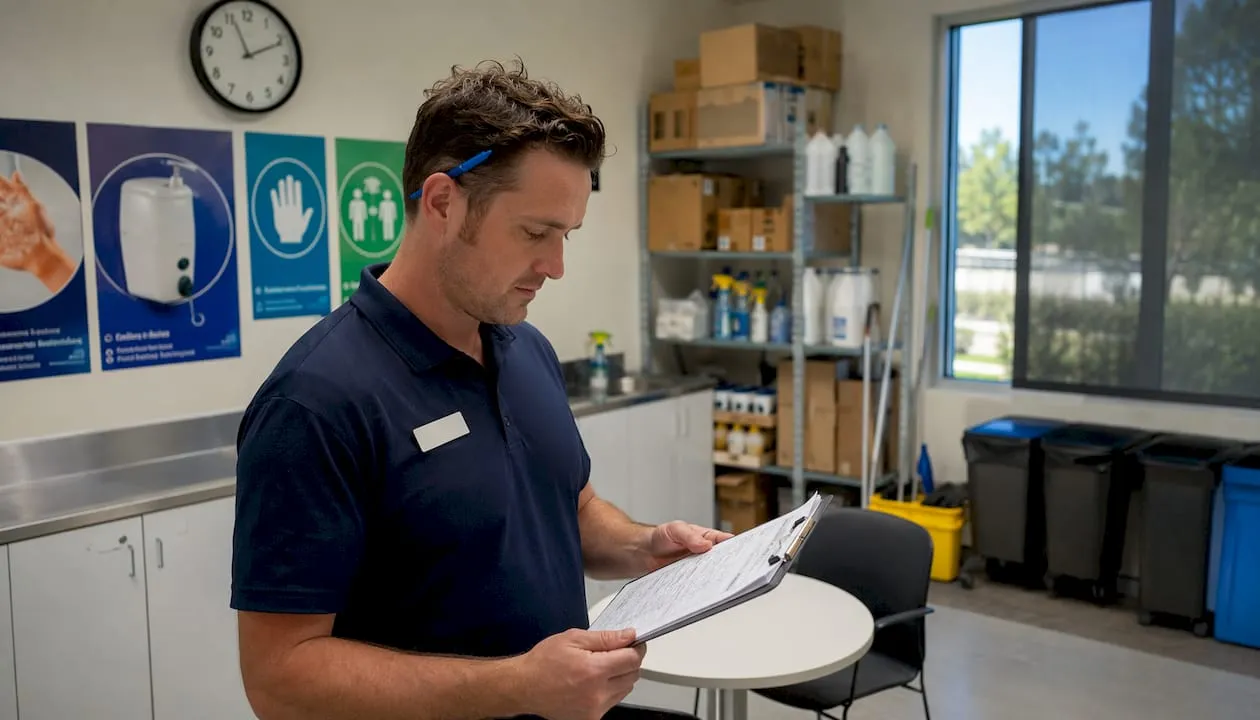
Prioritise hand hygiene, high-touch surface cleaning, and slip-risk floor maintenance. Those three form the non-negotiable baseline every retail manager should lock in this week, before anything else.
Start here — first-day actions:
- Check every handwashing basin: hot and cold water running, soap dispenser stocked, single-use towels or air dryer present
- Walk the entrance zone and inspect mats for saturation or curling edges
- Confirm a spill kit is accessible on the sales floor
- Verify a cleaning log is posted and dated within the last 24 hours
- Check sanitary bins in all staff and customer toilets are sealed and not overflowing
- Restock all hand hygiene consumables today
- Post a visible cleaning log at the entrance and near POS terminals
- Confirm your floor chemical is compatible with your floor surface
- Book a sanitary bin service if the last one was more than four weeks ago
- Schedule a staff hygiene induction for any worker who has not had one
Table of Contents
- What does a week-one hygiene schedule actually look like?
- What do Australian law and food standards require?
- Are your handwashing facilities actually compliant?
- How do you clean floors without creating a slip hazard?
- Which surfaces need cleaning most often, and with what?
- Sanitary bins, sharps and waste: what retail sites need
- How should you train staff and meet WHS consultation duties?
- What records do you need, and how do you audit them?
- What does a hygiene programme cost, and how long does rollout take?
- How do you choose the right commercial hygiene provider?
- Key takeaways
- What actually goes wrong in retail hygiene
- Ozifresh supports retail hygiene across Australia
- Useful sources to keep on file
What does a week-one hygiene schedule actually look like?
Getting the first week right sets the rhythm for everything after. Treat it as a staged rollout, not a one-day blitz.
Immediate (same day): Restock consumables, post cleaning logs, inspect mats, confirm spill kit location.
First week: Audit all handwashing facilities to confirm at least one handwashing basin per 30 workers, equipped with hot and cold running water, soap dispenser, and single-use towels or automatic drying (as required by the WHS model code), review your floor chemical Safety Data Sheets (SDS), brief staff on high-touch cleaning frequencies, and contact a hygiene provider for a site assessment.
Ongoing cadence:
| Task | Frequency |
|---|---|
| High-touch surface clean (POS, handles, counters) | Several times daily during trading |
| Entrance mat inspection | Periodic checks during trading |
| Consumable restock check | Daily (opening) |
| Sanitary bin service | Monthly or as contracted |
| Floor strip and seal (vinyl/VCT) | Quarterly |
| Carpet hot-water extraction | Periodic (traffic-dependent) |
| Staff hygiene training refresher | Quarterly |
| Full hygiene audit | Six-monthly |
Pro Tip: Mount your cleaning log at eye level near the entrance — visible to both staff and customers. A log that customers can see signals accountability and builds trust without a single word of marketing.
What do Australian law and food standards require?
Two frameworks govern retail hygiene in Australia, and both carry real penalties for non-compliance.
WHS duties for PCBUs: Under the WHS model code, a Person Conducting a Business or Undertaking must provide a safe physical environment, consult workers on safety matters, and deliver adequate training. Hygiene programmes sit squarely within these duties and cannot be contracted out to a cleaning company and forgotten. The PCBU remains responsible.
Food Safety Standard 3.2.2: Any retail site handling food — a supermarket deli, a bakery counter, a café within a store — must comply with FSANZ Standard 3.2.2. Food handlers must wash hands with warm running water and soap, then dry with single-use towels. Fixtures and fittings must show no accumulation of food waste, dirt, or grease, and single-use items must never be reused.
Compliance checklist to keep on file:
- Copy of the WHS Model Code of Practice: Managing the Work Environment and Facilities
- Copy of FSANZ Standard 3.2.2
- SDS for every cleaning chemical in use
- Signed training records for all staff
- Service contracts and logs from your hygiene provider
Regulatory note: This article is general information. Confirm current obligations with Safe Work Australia, your state WHS regulator, or a qualified compliance professional for your specific situation.
Are your handwashing facilities actually compliant?
The WHS model code sets a clear minimum: one handwashing basin per 30 workers, with hot and cold running water, non-irritating soap from a dispenser, and hygienic drying via single-use towels or automatic air dryers. Where work involves food preparation or exposure to contaminants, additional basins are required beyond those provided with toilets.
For food-retail areas, FSANZ 3.2.2 adds the requirement for warm running water and single-use drying. A shared tea-room sink does not satisfy this. Pop-up stalls or temporary retail formats without fixed plumbing may use a water container with soap and paper towels, hand wipes, or alcohol-based sanitiser as an interim measure.
Practical placement checklist: basin within 10 metres of food prep areas, wall-mounted soap dispensers at every basin, tamper-resistant paper towel holders or sensor-activated dryers, and a lined bin for used towels. For more on hand hygiene standards in commercial settings, the specifics go further than most managers expect.
How do you clean floors without creating a slip hazard?
The wrong cleaning chemical on the wrong floor surface can actively reduce slip resistance. WorkSafe Queensland links cleaning methods directly to slip-risk management and recommends consulting floor and equipment suppliers before committing to a chemical programme.
Manage the store as zones, each with its own risk profile:
| Zone | Risk level | Key action |
|---|---|---|
| Entrance (external mat, transition tile) | High | Mat inspection every 2 hours; weekly extraction |
| Sales floor (vinyl, polished concrete) | Medium | Daily maintenance clean; quarterly strip and seal |
| Fitting rooms | Medium | Mid-day check; mop with compatible chemical |
| Back-of-house / loading | High | Immediate spill response; non-slip matting |
Entrance zones account for roughly 60% of tracked-in soil, so they need proportionally more attention than the rest of the floor. Vinyl and VCT floors typically need a quarterly strip and seal to restore non-slip properties — this is a safety task, not a cosmetic one.
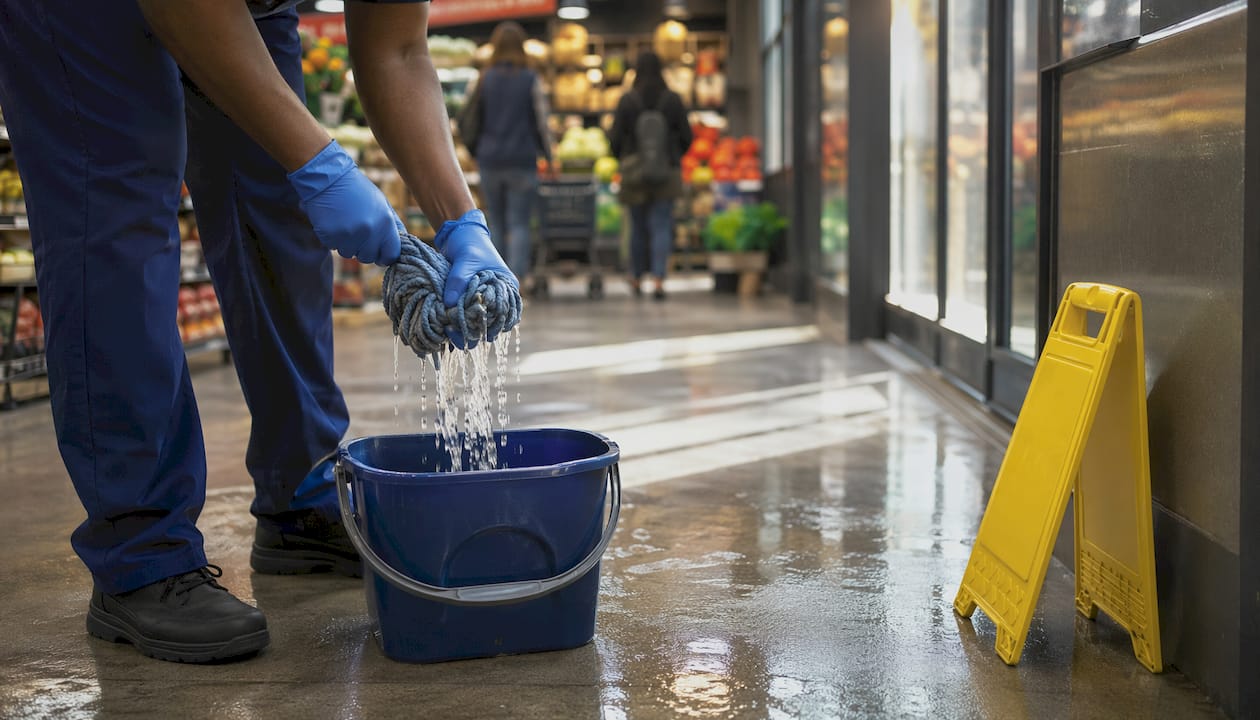
Spill response steps: Isolate the area with a wet-floor sign immediately, absorb the spill, clean with a compatible chemical, dry thoroughly, and document the incident in your log before removing the sign.
Pro Tip: Before switching cleaning products, request the SDS and call your floor supplier. A product that works perfectly on ceramic tiles can leave a residue on polished concrete that takes weeks to strip out.
Which surfaces need cleaning most often, and with what?
High-touch surfaces — POS terminals, door handles, service counters, EFTPOS keypads, trolley handles, and handrails — should be cleaned every 2–4 hours during trading and those cleaning times documented in a visible log.
Priority surface list:
- POS terminals and EFTPOS keypads
- Entry door handles and push plates
- Service counters and checkout belts
- Shopping trolley and basket handles
- Fitting room door handles and hooks
- Stair handrails and lift buttons
For chemical selection: use APVMA-registered products and, in any food-handling zone, confirm food-contact safety on the product label or SDS. Never mix disinfectants without checking compatibility.
Pro Tip: Use a colour-coded microfibre cloth system — one colour per zone (food prep, bathrooms, general floor). It costs almost nothing and eliminates the most common cross-contamination pathway in retail cleaning.
Sanitary bins, sharps and waste: what retail sites need
Every staff toilet must have a sealed sanitary bin serviced on a regular cycle. Customer toilets in higher-traffic stores warrant the same. The bin must be hygienic, lidded, and collected by an authorised provider — not emptied into general waste by staff.
For sites where sharps are a realistic risk (pharmacies, some convenience formats, high-footfall public toilets), a sharps disposal container must be wall-mounted, puncture-resistant, and serviced by a licensed contractor. Staff must never handle a found sharp directly — report, isolate, and call the provider.
When contracting a waste and hygiene provider, specify in writing: service frequency, what happens if a bin is missed, and the provider’s disposal compliance documentation. For detailed sanitary bin compliance requirements, the rules around placement and servicing are more prescriptive than most managers realise.
Pro Tip: Schedule sanitary bin services on a fixed day each week or fortnight, not “when full.” A predictable cycle prevents overflow and keeps your service records clean for any inspection.
How should you train staff and meet WHS consultation duties?
Training is not optional under WHS law — it is a PCBU duty. The practical minimum:
- Induction: Every new staff member covers hand hygiene procedure, spill response, and how to report a hygiene issue before their first shift
- Quarterly refresher: 15-minute team briefing covering log completion, consumable checks, and any new products or procedures
- On-the-job checks: Supervisors spot-check log completion and consumable levels weekly
Consultation steps under WHS duties:
- Engage staff in developing or reviewing hygiene procedures
- Ask for feedback after any incident or near-miss
- Record the consultation outcome and any changes made
- Communicate the outcome back to staff
Beyond compliance, visible hygiene investment — stocked dispensers, clean bathrooms, posted logs — improves staff pride and customer perception. Retail managers who treat hygiene as a morale investment, not just a compliance cost, tend to see lower turnover in customer-facing roles.
What records do you need, and how do you audit them?
Keep three core logs: a high-touch cleaning log (surface, time, staff initials), a consumable restock record, and a spill incident log. These do not need to be elaborate — a printed sheet in a folder or a simple digital form works.
Incident response sequence: isolate the affected area, clean and disinfect, document the incident with time and staff name, notify the store manager, and escalate to the relevant health authority if the incident involves food contamination or a reportable illness.
Audit frequency: run a self-audit monthly using your checklist, and commission an external hygiene audit every six months. Track three KPIs: log completion rate, number of missed cleans flagged, and hygiene-related customer complaints. For a structured approach to hygiene compliance documentation, the recordkeeping requirements are worth reviewing before your next inspection.
What does a hygiene programme cost, and how long does rollout take?
Cost drivers vary by store size, floor type, and service frequency. The main variables: number of sanitary bins and service cadence, whether the site has food-handling areas requiring APVMA-registered products, floor area and surface type (vinyl strip-and-seal costs more than carpet extraction per visit), and consumable volume (soap, towels, sanitiser).
Staged rollout timeline:
- Week 1: Assess current state — audit facilities, check SDS files, identify gaps
- Weeks 2–3: Remediate immediate hazards — restock consumables, fix non-compliant basins, post logs
- Week 4: Onboard a professional hygiene provider — site visit, scope agreement, first service
- Month 2: Train all staff, run first self-audit, confirm log completion rate
- Month 3 onwards: Schedule quarterly floor programs, six-monthly external audit, annual contract review
When getting quotes, require a site visit before any price is given. A quote without a site inspection is guesswork. Ask for itemised service levels, not a lump sum, so you can compare providers on the same scope.
How do you choose the right commercial hygiene provider?
Ask every prospective provider these questions before signing anything:
A provider who hesitates on any of those three is not ready for a compliance-sensitive retail environment.
Onboarding checklist:
- Confirm product SDS files are provided before first service
- Agree on a service schedule in writing with missed-service protocols
- Establish who receives audit reports and how quickly
- Confirm staff who enter the site hold any required licences (sharps, waste)
Service scope template (adapt as needed): sanitary bin placement and monthly service, hand hygiene consumable supply and restock, high-touch surface disinfection programme, quarterly floor maintenance, and six-monthly audit report.
Providers with decades of operation in the Australian market carry service history and compliance documentation that newer entrants simply cannot match — ask for proof of service tenure, not just a sales pitch.
Key takeaways
Retail hygiene compliance in Australia requires hand hygiene infrastructure, documented high-touch cleaning every 2–4 hours, and periodic professional floor maintenance — all backed by WHS and FSANZ obligations that sit with the PCBU, not the cleaning contractor.
| Point | Details |
|---|---|
| Hand hygiene baseline | One basin per 30 workers, hot and cold running water, non-irritating soap from a dispenser, single-use towels or automatic dryer — minimum standard under WHS model code. |
| High-touch cleaning frequency | Clean POS terminals, door handles and counters every 2–4 hours during trading; log every clean visibly. |
| Floor safety is a compliance task | Quarterly strip and seal for vinyl floors restores slip resistance — schedule it, document it, don’t skip it. |
| Sanitary and sharps disposal | Every staff and customer toilet needs a sealed, serviced sanitary bin; sharps require a licensed contractor. |
| Ozifresh for retail hygiene | Ozifresh delivers sanitary bins, hand hygiene consumables, and floor programmes across Brisbane, Melbourne, and Southern Downs — with 40+ years of documented service history. |
What actually goes wrong in retail hygiene
The failure mode I see most often is not ignorance of the rules — it is the gap between knowing and doing. A manager knows the cleaning log should be completed every two hours. But when the store gets busy, the log gets skipped, and within a week it has become optional. Then an inspector arrives, or someone slips, and the missing entries become the story.
The fix is almost always structural, not motivational. A log posted at eye level near the POS terminal gets completed far more reliably than one kept in a back-office folder. Colour-coded cloths hanging visibly in each zone get used correctly because the system is obvious. A mat that gets checked on a timer — not “when someone notices” — gets replaced before it becomes a trip hazard.
Small operational changes, consistently applied, prevent the incidents that cost far more than the hygiene programme ever would.
Ozifresh supports retail hygiene across Australia
Retail managers who want compliance without the guesswork have a direct option: Ozifresh hygiene services covers sanitary bins, hand hygiene consumables, and periodic floor programmes across Brisbane, Melbourne, and Southern Downs. With over 40 years of Australian operation, Ozifresh brings documented service history, APVMA-compliant products for food-handling zones, and regular audit reporting — the three things a compliance-focused retail manager actually needs from a provider.
Before a site visit, prepare your store’s floor area, staff headcount, and a note of any food-handling zones. That information lets Ozifresh scope the right service level from the first conversation.
Contact Ozifresh to arrange a site assessment and get a scoped quote for your store.
Useful sources to keep on file
Every retail manager running a hygiene programme should hold these documents:
- WHS Model Code of Practice: Managing the Work Environment and Facilities — basin ratios, facility specs, housekeeping duties
- FSANZ Standard 3.2.2: Food Safety Practices and General Requirements — food handler hygiene, facility cleanliness, single-use item rules
- Safe Work Australia — WHS duties for retail — PCBU obligations and consultation requirements
- WorkSafe Queensland — slips, trips and falls: cleaning — chemical and floor-surface compatibility guidance
Documents to keep in your hygiene folder:
- SDS for every cleaning product on site
- Service contracts and scheduled service logs from your hygiene provider
- Signed staff training records (induction and refreshers)
- Cleaning logs (high-touch, spill incidents, consumable restocks)
- Audit reports (self-audit and external)
During an inspection, you will be asked for training records, cleaning logs, and SDS files first. Keep them in one folder, physical or digital, and make sure your store manager knows where it is.
Recommended
Ready for a cleaner, safer workplace?
Contact our team today to discuss hygiene services for your business in Brisbane, Melbourne or the Gold Coast.