Hygiene compliance explained: Strategies for safer Australian facilities
TL;DR:
- Genuine hygiene compliance involves sector-specific standards and daily discipline, not just appearance.
- Structured methods like risk assessment, colour-coding, and documentation are essential for sustained compliance.
- Staff understanding and engagement are critical; culture impacts long-term hygiene safety more than checklists.
Most facility managers assume that a clean-looking building equals a compliant one. That assumption is where serious problems begin. [Sector-specific standards](https://healthfacilityguidelines.com.au/sites/default/files/Part D_8_Final April 2025 for publication - Updated.pdf) govern hygiene compliance across Australian healthcare, commercial, education, and hospitality settings, and each sector carries its own legal obligations, responsible parties, and risk thresholds. A basic mop-and-bucket routine simply does not cut it when you are accountable for staff safety, visitor wellbeing, and regulatory accreditation. This guide breaks down what genuine hygiene compliance looks like sector by sector, how to achieve it practically, and where most facilities quietly fall short.
Table of Contents
- What hygiene compliance means in Australian facilities
- Essential methods for achieving hygiene compliance
- Addressing the challenges and nuances of compliance
- Best-practice strategies for sustainable compliance
- What most compliance guides leave out: The realities on the ground
- Next steps for transforming your facility’s hygiene compliance
- Frequently asked questions
Key Takeaways
| Point | Details |
|---|---|
| Standards vary by sector | Healthcare, workplaces, schools and hospitality each have unique compliance rules managers must understand. |
| Regular documented cleaning is critical | Using schedules, audits, and tailored methods helps meet both legal and safety obligations. |
| Tackle edge cases proactively | Account for outbreaks, special-risk zones and staffing pressures to maintain real compliance. |
| Culture matters as much as checklists | Staff engagement and honest feedback are essential for long-term hygiene compliance success. |
What hygiene compliance means in Australian facilities
Hygiene compliance is not just about appearances. It is a structured, legally grounded responsibility to manage biological, chemical, and environmental risks within your facility. The specific framework that applies to you depends on your industry, and getting it wrong carries consequences ranging from WorkSafe notices to serious outbreak liability.
[Sector-specific standards](https://healthfacilityguidelines.com.au/sites/default/files/Part D_8_Final April 2025 for publication - Updated.pdf) govern each setting differently. Healthcare facilities must align with the National Safety and Quality Health Service (NSQHS) standards. General workplaces fall under the WHS Model Code of practice. Food businesses must comply with the FSANZ Food Standards Code. Schools are guided by state education department requirements layered on top of WHS obligations.

| Sector | Governing standard | Key responsible party |
|---|---|---|
| Healthcare | NSQHS Standards | Clinical governance lead |
| General workplace | WHS Model Code | Person conducting business |
| Hospitality/food | FSANZ Food Standards Code | Food business operator |
| Education | State WHS + Education Dept policy | Principal/facility manager |
A one-size-fits-all hygiene programme fails because risk profiles are vastly different. A school toilet block and a hospital isolation ward both need cleaning, but the methods, frequencies, and documentation requirements share almost nothing in common. Understanding sanitary bin compliance essentials is a useful entry point, but it represents only one slice of the broader obligation.
Real-world failure looks like this:
- Cleaning logs completed but not verified
- Disinfectants applied without adequate wet contact time
- Staff using incorrect colour-coded cloths across zones
- No documented procedure for outbreak escalation
Understanding your sector’s governing standard is the first step. The next is knowing how WHS responsibilities for hygiene translate into daily operations, and how professional hygiene for safer workplaces can close the gap between policy and practice.
“Compliance is not a destination. It is a daily discipline that protects people before problems arise.”
Essential methods for achieving hygiene compliance
Once you understand the applicable standards, the question becomes practical: how do you actually build a compliant hygiene programme? The answer lies in structured, repeatable methods rather than reactive cleaning.
[Evidence-based methodologies](https://healthfacilityguidelines.com.au/sites/default/files/Part D_8_Final April 2025 for publication - Updated.pdf) include risk assessment using the hierarchy of controls, colour-coded cleaning systems, high-touch disinfection schedules, and multimodal strategies that combine training, auditing, and feedback.
Here is a step-by-step framework for implementing compliance on the ground:
- Conduct a site risk assessment. Map all areas by risk level, from high-touch surfaces like door handles and lift buttons to wet areas and food preparation zones.
- Assign cleaning frequencies. Match frequency to risk. High-touch healthcare surfaces require disinfection 3-4 times daily. Hospitality kitchens need continuous monitoring and scheduled deep cleans.
- Implement colour-coded equipment. Colour coding prevents cross-contamination between zones. Red for toilets, blue for general areas, green for food prep, and yellow for clinical isolation areas.
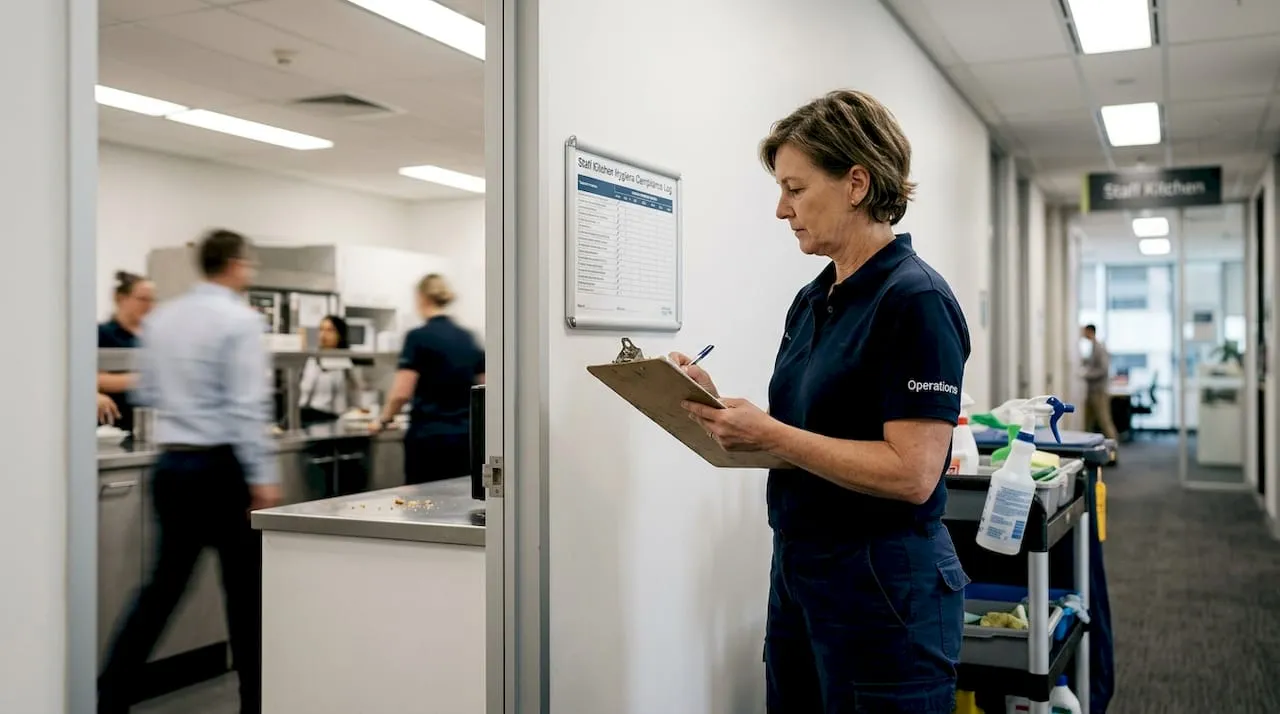
- Document everything. Cleaning logs must be date and time-stamped, signed by the responsible cleaner, and available for audit.
- Train staff regularly. Induction training is not enough. Refresher sessions tied to audit outcomes keep standards current.
- Schedule professional deep cleans. Routine cleaning cannot replace periodic professional services, particularly for high-risk or specialist areas.
| Facility area | Recommended frequency | Primary method |
|---|---|---|
| High-touch surfaces (healthcare) | 3-4 times daily | Disinfectant wipe, correct wet time |
| Toilets (hospitality/schools) | Every 2-4 hours | Scrub, disinfect, inspect log |
| Kitchen surfaces | Continuous + scheduled | Sanitise, temperature log |
| General office surfaces | Daily minimum | Clean then disinfect |
Aligning with NSQHS guidelines also means applying Spaulding classification to equipment cleaning: critical items require sterilisation, semi-critical items require high-level disinfection, and non-critical items require low to intermediate disinfection.
Pro Tip: Multimodal programmes that combine written procedures, direct observation, electronic monitoring, and staff feedback have been shown to outperform single-method approaches. Pair your documentation with commercial hygiene best practices to understand which workplace hygiene service types suit your specific risk profile.
Addressing the challenges and nuances of compliance
Hygiene compliance sounds straightforward on paper. In practice, real facilities deal with complicating factors that standard checklists simply do not anticipate.
[Edge cases in compliance](https://healthfacilityguidelines.com.au/sites/default/files/Part D_8_Final April 2025 for publication - Updated.pdf) include outbreak scenarios, isolation protocols, glove use risks, Legionella management in water systems, and slip-testing requirements in wet areas. Each of these demands a specific, documented response that goes well beyond standard cleaning schedules.
Common complicating factors facility managers face include:
- Outbreak response. During a gastrointestinal or respiratory outbreak, cleaning frequencies for affected areas must double or triple. Isolation zones require separate equipment and dedicated staff.
- Staffing gaps. When trained cleaners are absent, untrained fill-ins may not follow colour-coding or contact time requirements, breaking the compliance chain.
- Hard-to-reach surfaces. Ledges, under-bench areas, behind fixtures, and ceiling vents harbour pathogens that routine cleaning misses.
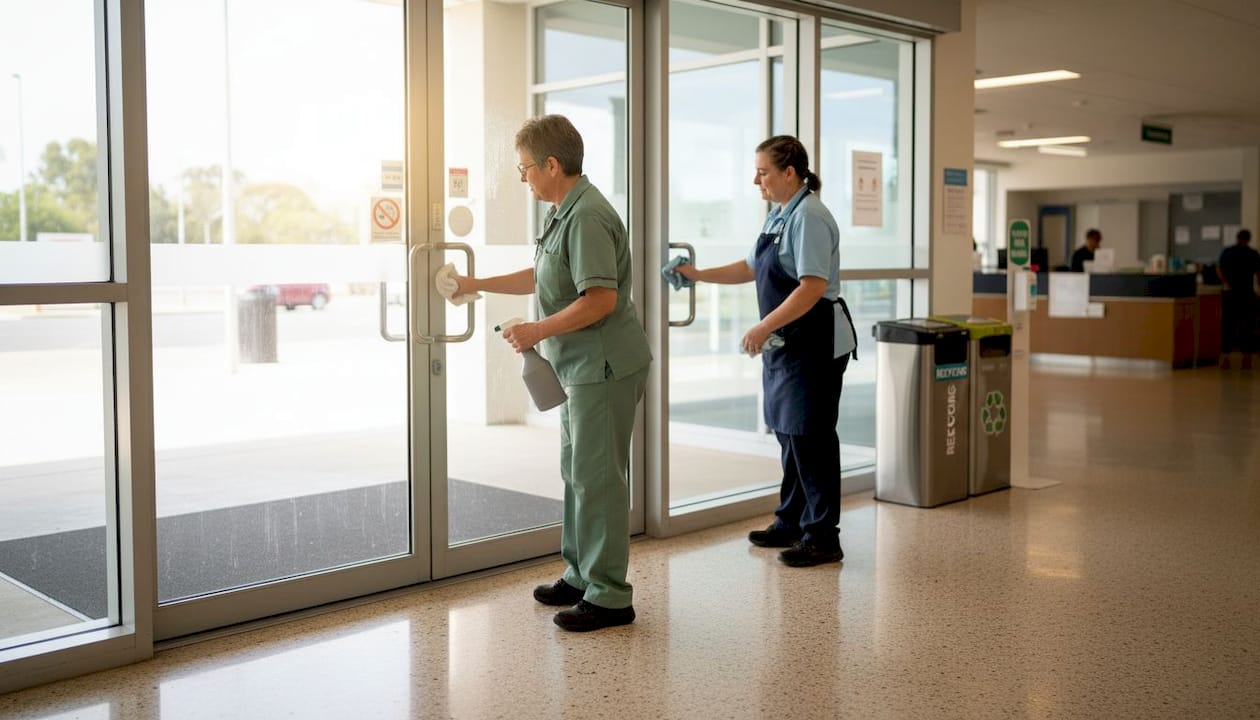
- Disinfectant wet time. Many staff spray and immediately wipe, eliminating the product’s effectiveness. Disinfectants must remain visibly wet on the surface for the full dwell time, often 30 seconds to 4 minutes depending on the product.
- Legionella risk. Cooling towers, spa pools, and complex water systems in commercial and healthcare settings require water treatment programmes and documented testing schedules.
- Glove use. Incorrectly worn or double-gloved hands become contamination vectors rather than barriers.
“In outbreak conditions, a facility that was 90% compliant yesterday may become a serious risk today unless escalation protocols are already practised and documented.”
Monitoring compliance in real time is increasingly possible through electronic logging and surrogate measures such as ATP (adenosine triphosphate) bioluminescence testing, which detects organic residue invisible to the naked eye. Balancing direct observation of cleaning staff against these electronic tools gives managers a far more accurate picture than paper logs alone.
For the toughest environments, understanding hospital hygiene cleaning steps provides a transferable model, even for non-clinical settings managing similar risk levels.
Best-practice strategies for sustainable compliance
Short-term compliance is achievable. Sustaining it through staff turnover, seasonal demand shifts, and evolving standards is the real challenge. The facilities that maintain consistently high hygiene compliance share a few non-negotiable habits.
Documented schedules, regular audits, and professional services form the backbone of any audit-ready compliance framework. These are not optional extras; they are the structural elements inspectors look for.
Here is a sustainable compliance framework:
- Create a master cleaning schedule. Separate daily, weekly, monthly, and annual tasks. Assign ownership and make it accessible to every team member involved in hygiene operations.
- Run internal audits monthly. Use a standardised checklist aligned to your governing standard. Record findings and corrective actions taken.
- Engage professional hygiene services quarterly. Deep cleans, consumable restocking, and specialist waste management should not rely entirely on in-house staff.
- Establish a feedback loop. Cleaners, not just managers, should have a simple way to flag issues, supply shortages, or access problems. Frontline insight drives real improvement.
- Benchmark against sector standards. Compare your audit results against published guidelines and update procedures when standards are revised.
- Review training records annually. Ensure every staff member involved in hygiene tasks has current, documented training with evidence of competency.
Pro Tip: Multimodal compliance approaches consistently produce the best outcomes because they combine governance, real-time feedback, and human accountability rather than relying on any single solution. Pair strong internal processes with office hygiene tips and ensure your team has access to the right essential hygiene products for each area.
External audits are particularly valuable for accreditation readiness. They surface blind spots that internal teams normalise over time and provide an objective baseline for ongoing improvement.
What most compliance guides leave out: The realities on the ground
After working alongside facilities across Brisbane, the Gold Coast, and Melbourne for over 40 years, one pattern stands out clearly. The facilities that struggle most with hygiene compliance are not the ones with poor checklists. They are the ones where staff do not genuinely understand why the standards exist.
Tick-box compliance is seductive because it feels complete. Logs are signed. Schedules are posted. Audits are passed. Yet outbreaks still occur, complaints still arrive, and regulators still find gaps. Why? Because the cleaner who rushes through a toilet block at 7am without reading the dwell time on the disinfectant label is the real compliance variable, not the policy document in the manager’s office.
The value of B2B hygiene providers goes beyond products and scheduled visits. A good provider should be building the knowledge and culture of hygiene within your team, not just servicing equipment. Ask your cleaners what they find difficult. Their answers will tell you more about real compliance gaps than any audit report.
Facility culture and genuine staff engagement are the true bedrock of sustained hygiene compliance. Processes support people; they never replace them.
Next steps for transforming your facility’s hygiene compliance
Understanding the frameworks, methods, and challenges of hygiene compliance is a strong start. Turning that knowledge into consistent, audit-ready practice across your facility is where expert partnership makes a measurable difference. Ozifresh delivers tailored hygiene solutions to commercial workplaces, schools, healthcare facilities, and hospitality venues across Australia, with industry-specific products and services designed to meet your exact compliance obligations. Whether you need Melbourne hygiene services, specialist waste disposal for service stations, or a reliable supply of quality hand sanitiser, Ozifresh can help you build a hygiene programme that holds up under scrutiny. Contact us to arrange a site assessment and see where your facility stands today.
Frequently asked questions
What is considered hygiene compliance in Australian workplaces?
[Hygiene compliance](https://healthfacilityguidelines.com.au/sites/default/files/Part D_8_Final April 2025 for publication - Updated.pdf) means following all relevant sector-specific regulations, standards, and guidelines for your facility type to protect staff, visitors, and your business’s legal standing.
How often must high-touch areas be cleaned?
[High-touch surfaces](https://healthfacilityguidelines.com.au/sites/default/files/Part D_8_Final April 2025 for publication - Updated.pdf) in healthcare require disinfection 3-4 times daily, while schools and hospitality settings typically require cleaning every 2-4 hours in critical zones such as toilets and food prep areas.
What are the biggest challenges to sustaining hygiene compliance?
[Outbreaks, isolation protocols, glove use, and Legionella risks](https://healthfacilityguidelines.com.au/sites/default/files/Part D_8_Final April 2025 for publication - Updated.pdf) are among the most demanding edge cases, alongside staffing gaps and inadequate disinfectant wet times in everyday operations.
How do audits improve facility hygiene compliance?
External audits measure real-world adherence, support accreditation readiness, and identify weak points that internal teams may have normalised over time, enabling targeted corrective action.
Recommended
- Sanitary bin compliance: Essential rules and best practices | Ozifresh
- Professional hygiene for safer workplaces: What managers need to know | Ozifresh
- Workplace sanitation explained: Steps for safer facilities | Ozifresh
- Commercial hygiene best practices for safer facilities | Ozifresh
- Effective Trip Hazard Prevention Strategies for Facilities – Mats4U USA
- Commercial Drain Cleaning: Prevent Disruption and Stay Compliant
Ready for a cleaner, safer workplace?
Contact our team today to discuss hygiene services for your business in Brisbane, Melbourne or the Gold Coast.