How to improve restaurant hygiene: a practical guide
TL;DR:
- Restaurant hygiene involves strict cleaning, personal hygiene, and food safety protocols to protect health. Staff must follow rigorous handwashing, glove use, and proper attire to prevent contamination. Regular documented cleaning routines, correct food storage, and daily self-inspections are essential for compliance and safety.
Restaurant hygiene is the application of strict cleaning standards, personal hygiene measures, and food safety protocols to protect the health of customers and staff. Getting it right is not optional. Food businesses in Australia operate under the Australia New Zealand Food Standards Code, which sets mandatory requirements for cleanliness, temperature control, and pest management. Failing to meet these standards risks customer illness, failed inspections, and reputational damage that is difficult to recover from. This guide covers the practical strategies restaurant owners and managers need to maintain a safe, compliant, and genuinely clean environment every day.
What essential hygiene practices must staff follow?
Personal hygiene is the first line of defence against foodborne illness. No cleaning schedule or sanitising product can compensate for staff who handle food with contaminated hands.
Handwashing for at least 20 seconds with soap and warm water is the minimum standard after specified activities. Bacteria double every 20 minutes in the temperature danger zone of 4°C to 60°C, which means even brief lapses in hand hygiene create serious contamination risk.
Staff must wash hands:
- After handling raw meat, poultry, or seafood
- After using the restroom
- After touching their face, hair, or phone
- After handling rubbish or cleaning chemicals
- After any break, before returning to food preparation
Pro Tip: Install dedicated handwashing stations in both the kitchen and front of house. Stations used for food preparation must never double as handwashing points. Proximity matters. Staff wash hands more consistently when the station is within arm’s reach of their work area.
Glove use does not replace handwashing. Gloves must be changed between tasks, particularly when moving from raw to ready-to-eat foods. Hair must be tied back or covered with a net. Jewellery, including rings and bracelets, should be removed before food handling because it traps bacteria and is difficult to clean properly. Uniforms must be clean at the start of each shift and changed if heavily soiled during service. These requirements are not suggestions. They are the foundation of effective hygiene training for staff that reduces pathogen transmission at the source.

How to implement cleaning and sanitising routines in your venue
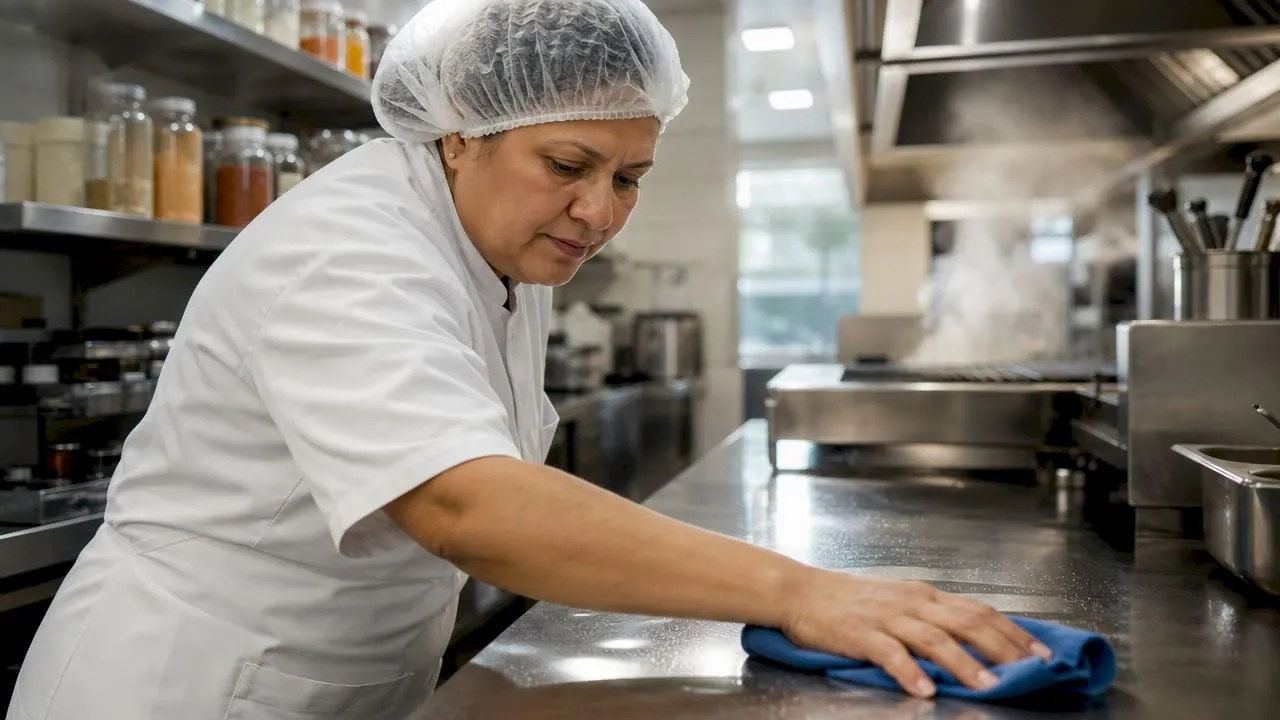
Many restaurant managers treat cleaning and sanitising as the same task. They are not. Cleaning removes visible dirt, grease, and food debris. Sanitising kills the pathogens that remain after cleaning. A clean surface is not a safe surface until it has been sanitised. This distinction is the most common gap in restaurant sanitation practice.

The correct sequence is always: clean first, then sanitise. Applying a sanitiser to a dirty surface reduces its effectiveness significantly because organic matter neutralises the active ingredients.
Setting up a structured cleaning schedule
A structured restaurant sanitation checklist prevents tasks from being forgotten or deferred. Divide responsibilities by frequency:
- Daily tasks: Wipe down all food contact surfaces after each use. Clean and sanitise prep benches, cutting boards, and equipment between tasks. Mop floors at the end of service. Clean and sanitise sinks, taps, and handwashing stations. Empty and clean grease traps. Sanitise dining tables, chairs, and menus between seatings.
- Weekly tasks: Deep clean ovens, grills, and fryers. Degrease rangehoods and filters. Scrub floor drains and grout lines. Clean refrigerator door seals and shelving. Wipe down walls near cooking equipment.
- Monthly tasks: Clean behind and underneath fixed equipment. Inspect and clean cool room walls, floors, and door seals. Check and clean ventilation ducts. Audit cleaning product stock and replace expired items.
Bleach solutions must remain on surfaces for at least 1 minute and should be replaced every 2 to 3 days. A solution that sits longer loses its efficacy and gives a false sense of security.
| Area | Cleaning frequency | Sanitising frequency |
|---|---|---|
| Food prep surfaces | After each use | After each use |
| Floors (kitchen) | End of each service | Daily |
| Refrigerator shelves | Weekly | Weekly |
| Rangehood filters | Weekly | Weekly |
| Cool room walls | Monthly | Monthly |
Assign specific cleaning responsibilities for each zone to a named staff member rather than leaving tasks to shared ownership. Shared ownership creates gaps. When everyone is responsible, no one is.
Pro Tip: Use your point-of-sale data to identify your quietest trading periods. Schedule sanitisation tasks before your peak order surges, not during them. This protects service quality and means sanitising gets done properly rather than rushed.
Avoid sponges in commercial kitchens entirely. Sponges harbour harmful bacteria and spread contamination across surfaces. Use daily clean dishcloths or disposable wipes instead, and check sanitiser concentration regularly with test strips to confirm efficacy. For more detail on applying sanitising solutions correctly, the process matters as much as the product.
Best practices for food storage and handling
Correct food storage is inseparable from kitchen hygiene. Improper storage creates conditions for bacterial growth, pest entry, and cross-contamination that no amount of surface cleaning can fix.
The core temperature rules are non-negotiable:
- Refrigerators must operate at or below 4°C at all times
- Freezers must maintain temperatures at or below -18°C
- Food must be stored at least 15 centimetres off the floor to prevent pest contact and allow cleaning underneath
- Raw proteins must be stored below ready-to-eat foods to prevent drip contamination
- All stored food must be labelled with the date of preparation or opening
Proper storage prevents pest entry and makes cleaning underneath storage units practical. Pests follow food sources. Gaps in storage discipline create the conditions they need.
| Storage area | Required temperature | Key rule |
|---|---|---|
| Refrigerator | At or below 4°C | Check twice daily with a calibrated thermometer |
| Freezer | At or below -18°C | Never refreeze thawed product |
| Dry storage | Ambient, cool, and dry | Sealed containers only |
| Cooked food (hot hold) | Above 60°C | Discard after 2 hours in the danger zone |
Date labelling is not just a regulatory requirement. It is the fastest way to identify food that has exceeded its safe use period during a busy service. Train staff to check labels before use, not just when restocking. Spills inside refrigerators must be cleaned immediately. A spill left overnight becomes a bacterial colony by morning.
How can restaurant owners prepare for health inspections?
The most reliable approach to passing a health inspection is to treat every day as an inspection day. Daily self-inspections using local health authority checklists reduce violations because they catch problems before an inspector does. This is not about performance. It is about building habits that make compliance automatic.
Documentation is what separates a well-run kitchen from one that looks well-run. Health inspectors prioritise documented evidence of hygiene routines over visible cleanliness alone. The records that matter most include:
- Daily temperature logs for all refrigeration units
- Cleaning and sanitising schedules with staff sign-offs
- Pest control reports and contractor visit records
- Staff hygiene training records and induction checklists
- Corrective action logs when a temperature breach or hygiene issue is identified
Pro Tip: Keep a physical folder or digital record system that is accessible to any manager on shift. If an inspector arrives and your head chef is off, the documentation must speak for itself.
Engage staff in hygiene culture rather than just compliance. Staff who understand why a task matters do it more consistently than staff who follow a rule they do not understand. Brief daily team meetings before service to flag hygiene priorities take less than five minutes and build accountability across the team. Scheduling software can assign and track cleaning tasks by shift, which removes ambiguity and creates a digital paper trail. Understanding your workplace hygiene responsibilities under Work Health and Safety legislation also protects you legally if a staff illness or customer complaint leads to an investigation.
Key takeaways
Improving restaurant hygiene requires consistent staff practices, structured cleaning routines, correct food storage, and documented evidence of compliance across every shift.
| Point | Details |
|---|---|
| Handwashing is non-negotiable | Staff must wash hands for at least 20 seconds after handling raw food, using the restroom, or touching their face. |
| Clean before you sanitise | Sanitising a dirty surface is ineffective. Always remove debris first, then apply a sanitising solution with correct contact time. |
| Store food at safe temperatures | Refrigerators must stay at or below 4°C and freezers at or below -18°C, with raw proteins stored below cooked foods. |
| Document everything | Temperature logs, cleaning schedules, and training records are what health inspectors look for beyond visible cleanliness. |
| Assign tasks to individuals | Named responsibility for each zone prevents the task neglect that comes from shared ownership. |
The hygiene gap most restaurants miss
After working with food service businesses across Australia for many years, the pattern I see most often is this: managers focus on what customers can see. Tables are wiped. Floors are mopped. The kitchen looks tidy at the start of service. But the sanitising step gets skipped or rushed because it adds time and the surface already looks clean.
That is the gap. A surface that looks clean can still carry enough pathogens to cause illness. The visible standard and the safe standard are not the same thing. I have seen kitchens with spotless benches and contaminated cutting boards because the cleaning cloth was never sanitised between uses.
The other mistake is treating hygiene training as a one-off induction task. Staff turnover in hospitality is high. New team members arrive constantly. If your hygiene standards are only communicated once at onboarding, they degrade with every new hire. The kitchens that maintain genuine hygiene excellence run short, regular refreshers. They treat hygiene as a daily conversation, not a document filed away after induction week.
The practical fix is simple. Build sanitising into every cleaning step as a non-negotiable second action. Make it a habit, not a choice. And review your training records quarterly to confirm every current staff member has received up-to-date hygiene instruction.
— Ozifresh
Professional hygiene support for your restaurant
Ozifresh has supported hospitality businesses across Brisbane, the Gold Coast, and Melbourne for over 40 years. Restaurants that want to meet and maintain hygiene standards without managing every product and protocol in-house can access Ozifresh’s full range of professional hygiene services, including hand sanitiser dispensers, surface sanitising products, and sanitary disposal solutions. Ozifresh tailors service plans to your venue’s size, layout, and operational hours, so your team has the right products in the right places at all times. Contact Ozifresh to discuss a hygiene plan built around your restaurant’s specific requirements.
FAQ
How often should restaurant kitchens be deep cleaned?
Restaurant kitchens require daily cleaning of food contact surfaces and equipment, weekly deep cleaning of ovens, grills, and rangehood filters, and monthly cleaning of fixed equipment and cool room interiors.
What temperature should a restaurant refrigerator be set to?
Refrigerators must maintain a temperature at or below 4°C. Freezers must operate at or below -18°C to prevent bacterial growth in stored food.
What is the difference between cleaning and sanitising in a restaurant?
Cleaning removes visible dirt and grease. Sanitising kills pathogens that remain after cleaning. Both steps are required, always in that order, for a surface to be genuinely safe.
How can staff improve personal hygiene in a restaurant?
Staff must wash hands for at least 20 seconds with soap and warm water after handling raw food, using the restroom, or touching their face. Gloves, hair restraints, and clean uniforms are also required.
What records should a restaurant keep for health inspections?
Restaurants should maintain daily temperature logs, signed cleaning schedules, pest control reports, and staff training records. Health inspectors treat documented evidence as proof of consistent hygiene practice.
Recommended
Ready for a cleaner, safer workplace?
Contact our team today to discuss hygiene services for your business in Brisbane, Melbourne or the Gold Coast.