How building operators shape hygiene and compliance
TL;DR:
Building operators are responsible for behind-the-scenes decisions that impact hygiene and safety.
Adopting structured protocols like risk assessments, SOPs, ATP testing, and predictive maintenance enhances compliance.
Prevention-focused, proactive management by operators is essential for maintaining safe, invisible hygiene standards.
Cleaning schedules and mop buckets are visible. What’s invisible is the system of decisions, protocols, and oversight that actually determines whether a commercial building is genuinely safe. Facility managers and building operators hold far more responsibility for hygiene outcomes than most people realise. The products used, the sequencing of tasks, the documentation maintained, and the maintenance cycles scheduled all flow from operator-level decisions. This article breaks down the methods, common pitfalls, compliance frameworks, and practical tools that separate high-performing facility managers from those who are simply keeping up appearances.
Table of Contents
-
Practical frameworks: Applying hygiene best practice in your facility
-
The uncomfortable truth: Why building operators are hygiene’s unsung heroes
Key Takeaways
| Point | Details |
|---|---|
| Strategic operator impact | Building operators drive facility hygiene outcomes far beyond basic cleaning. |
| Predictive maintenance wins | Forward planning and risk-based scheduling are key to compliance and cost control. |
| Clean before disinfect | Ensuring proper cleaning processes delivers safer results and avoids compliance traps. |
| Documentation is vital | Keeping thorough records ensures regulatory compliance and protects operators. |
| Tailored solutions available | Sector-specific hygiene services support operators in maintaining best standards. |
How building operators shape hygiene outcomes
Most occupants of a commercial building judge cleanliness by what they see: clear benchtops, clean floors, fresh-smelling bathrooms. But as any experienced facility manager knows, visual cleanliness and actual hygiene compliance are two very different things. Operators are the people who set the standard behind the scenes.
Building operators create and enforce hygiene frameworks that govern everything from which products are used on which surfaces to how often ventilation systems are serviced. This means writing and updating cleaning SOPs (standard operating procedures), conducting formal risk assessments, and ensuring that every team member understands the correct sequence and technique for each task. Environmental cleaning for facility managers is a discipline in itself, one that requires both technical knowledge and systematic management.
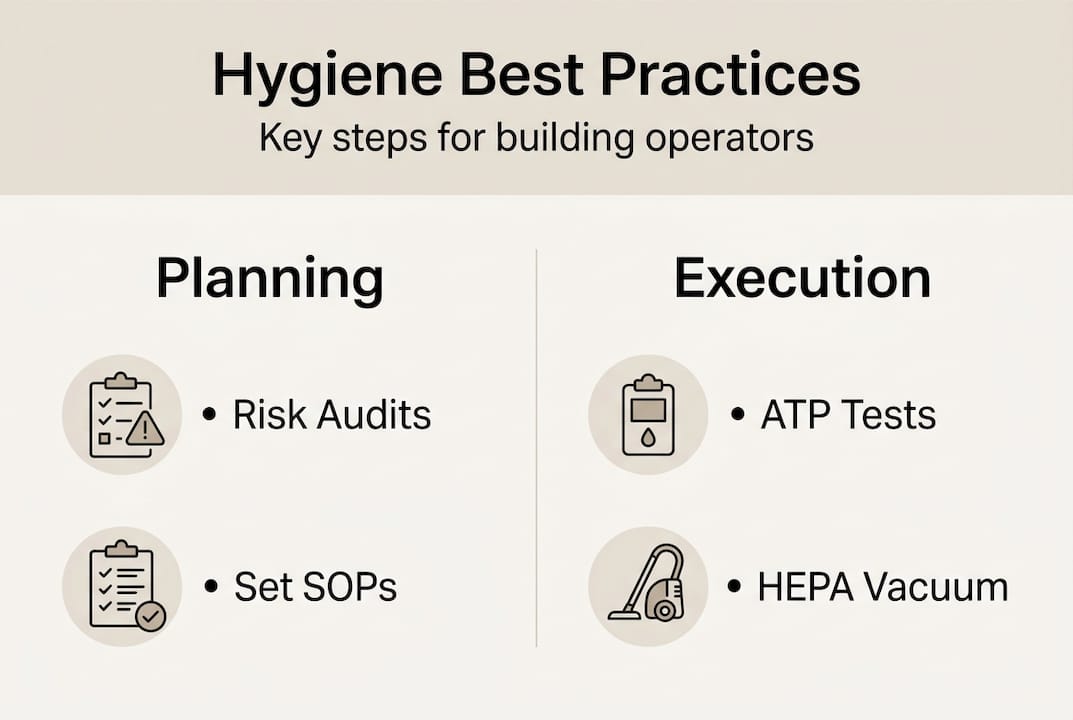
Key methodologies that high-performing operators integrate into their facilities include:
-
Risk assessments conducted at regular intervals and after any significant change in building use or occupancy
-
Documented SOPs for cleaning processes, ensuring the correct order of operations and product usage
-
HEPA vacuuming protocols for areas with sensitive occupants or high pathogen risk, such as healthcare-adjacent spaces
-
ATP (adenosine triphosphate) testing to verify surface cleanliness through measurable data rather than visual inspection alone
-
Predictive maintenance schedules for ventilation systems, aligned with TR19 standards
It is worth pausing on ATP testing because it is still underused in many Australian facilities. ATP swab tests measure biological residue on surfaces in real time, providing a pass or fail result within seconds. This moves verification from “it looks clean” to “it is clean,” which is a critical shift for compliance documentation.
The following table summarises the core framework elements and their primary purposes:
| Framework element | Primary purpose | Frequency |
|---|---|---|
| Risk assessment | Identify and prioritise hygiene hazards | Quarterly or after changes |
| Cleaning SOP documentation | Standardise procedures across all staff | Ongoing, reviewed annually |
| HEPA vacuuming | Remove fine particulates without spreading | Per area-specific risk schedule |
| ATP swab testing | Verify surface cleanliness with data | Post-clean in high-risk zones |
| HVAC/ventilation maintenance | Prevent airborne pathogen build-up | At minimum quarterly |
Professional hygiene management at this level requires operators to think like system designers, not just task supervisors. The right professional cleaning best practices include risk assessments, documented SOPs for cleaning before disinfection, HEPA vacuum use, ATP testing, and predictive maintenance for ventilation systems per TR19 standards.
Common mistakes and how to avoid them
Understanding the right protocols is essential, but knowing what not to do is just as critical for compliance and safety. Even experienced operators can fall into patterns that quietly undermine their hygiene programme without obvious signs until something goes wrong.
Here are the most damaging mistakes facility managers make, and how to avoid each one:
-
Cleaning out of order. The single most costly procedural error is skipping the cleaning step before disinfection. Disinfectants are designed to work on clean surfaces. When applied to soiled surfaces, organic matter neutralises the active ingredient before it can do its job. Per janitorial SOPs, the correct sequence is always clean first, then disinfect. This is also the expectation under Safe Work Australia guidelines.
-
Ignoring dwell times. Most disinfectants require a specific contact time to be effective, anywhere from 30 seconds to 10 minutes depending on the product and the pathogen target. Wiping a surface dry immediately after applying the product renders the disinfection step largely ineffective. Operators must ensure that staff are trained on dwell times for every product in use and that SOPs specify these times clearly.
-
Top-to-bottom sequencing failures. Cleaning a floor before the benchtops and shelving above it simply moves contamination downward and forces a second floor clean. The correct cleaning sequence for compliance is always high surfaces first, low surfaces last. This rule applies equally to offices, bathrooms, kitchens, and communal areas.
-
Reactive maintenance. Waiting for a problem to become visible, such as mould in a duct or a broken soap dispenser, is a false economy. Reactive maintenance consistently costs more in both money and compliance risk than a well-structured predictive schedule. Office hygiene tips often start with scheduling, because prevention is always cheaper than remediation.
-
Neglecting documentation. Without records, there is no evidence. Compliance audits rely on documentation to confirm that processes were followed. Missing logs mean missed maintenance and missed maintenance means exposed liability.
“Clean before disinfect, top to bottom, always respect dwell times. These three rules, applied consistently, eliminate the majority of procedural hygiene failures in commercial facilities.”
Pro Tip: Build dwell time into your SOP as a mandatory step with a specific timer instruction, not just a written note. When staff have a physical or digital prompt to wait, compliance rates increase significantly.
Predictive versus reactive maintenance: The compliance lens
Many mistakes stem from a “fix it when broken” attitude, so let’s clarify why predictive thinking matters for modern facilities. The contrast between these two approaches is not just philosophical. It has real, measurable consequences for budgets, safety records, and regulatory standing.
Predictive maintenance means scheduling cleaning and servicing activity based on usage patterns, risk assessments, and regulatory requirements before any issue arises. For ventilation systems, this typically means quarterly inspections and cleaning in line with TR19 ventilation standards. These standards require documented evidence of duct cleanliness, airflow performance, and inspection history.
Reactive maintenance means responding to failures, complaints, or visible deterioration. In the short term, this feels cheaper. Over a 12-month cycle, it almost never is. Reactive approaches expose buildings to a range of compounding costs: emergency contractor callouts, compliance penalties, increased liability insurance, and the reputational damage that follows a reported hygiene incident.
The following table compares the two approaches across the dimensions that matter most to facility operators:
| Factor | Predictive maintenance | Reactive maintenance |
|---|---|---|
| Cost profile | Predictable and lower over time | Unpredictable and higher long-term |
| Compliance risk | Low when properly documented | High, especially during audits |
| Health and safety outcomes | Proactively managed | Managed after incidents occur |
| Documentation readiness | Continuous and audit-ready | Gaps common, liability exposed |
| Staff workload | Distributed and manageable | Concentrated during crises |
A key concept in the Building Safety Act context is the “golden thread” of documentation. This refers to a complete, traceable, and current record of all safety and maintenance actions taken in a building. Reactive cleaning risks include non-compliance and health incidents, while predictive schedules based on usage and risk enable cost savings and allow operators to maintain golden thread records as required. Without this thread, a building operator cannot demonstrate compliance, even if the actual work was done.
Understanding WHS hygiene responsibilities under Australian law makes the case for predictive maintenance even stronger. The burden of proof sits with the operator, and that proof is only as strong as the documentation behind it. Review your commercial hygiene best practices regularly and ensure every scheduled action is recorded with dates, personnel, and outcomes.
Practical frameworks: Applying hygiene best practice in your facility
Understanding predictive strategy is only the start. Next comes implementation using practical frameworks that are repeatable, auditable, and scalable across your facility.
Effective frameworks are built around four pillars:
-
Risk assessment integration. Every SOP should begin with a documented risk profile for the area in question. High-traffic zones like reception areas, bathrooms, and kitchens carry different contamination risks than storage rooms or private offices. Your cleaning frequency, product choices, and verification methods should reflect these differences.
-
Documented cleaning SOPs. Each area and task type should have a written procedure specifying products, dilution rates, dwell times, protective equipment requirements, and verification steps. These documents are living records. Update them when products change, regulations shift, or incident reports suggest procedural gaps.
-
HEPA vacuuming and ATP testing. In any setting with vulnerable occupants or sensitive hygiene requirements, HEPA vacuums prevent the redistribution of fine particulates during cleaning. ATP swab testing then confirms that surfaces meet cleanliness standards before a space is returned to use. These two tools together shift your programme from assumption-based to evidence-based hygiene management.
-
Golden thread record-keeping. Whether you use a physical logbook, a facility management software platform, or a hybrid system, every cleaning and maintenance action should be logged with a timestamp and staff identifier. This is not optional in regulated environments. It is the difference between demonstrable compliance and unverifiable claims.
Pro Tip: Schedule a quarterly internal audit where a senior team member walks through each area with the relevant SOP and physically checks that every step is being followed as documented. This catches procedural drift before it becomes a compliance issue.
Understanding surface sanitising explained and the difference between cleaning, sanitising, and disinfecting is foundational to building a robust SOP library. Similarly, familiarising your team with the range of hygiene service types available in Australian workplaces helps you identify gaps in your current programme and prioritise where specialist support is needed.
The broader hygiene best practices framework, including documented SOPs, HEPA vacuum protocols, ATP testing, and predictive maintenance, gives operators the structure needed to meet TR19 standards and manage modern facilities with confidence.
The uncomfortable truth: Why building operators are hygiene’s unsung heroes
With practical tools in hand, it is time for a reality check. What really makes a great building operator in 2026?
Here is the uncomfortable part: when hygiene management is working perfectly in your facility, nobody notices. Occupants walk in, use the bathrooms, eat lunch in the kitchen, and leave without thinking about what kept them safe. No headlines. No commendations. Nothing but the quiet confidence that the building is operating exactly as it should. When things go wrong, however, everyone notices immediately.
This invisibility is one of the most overlooked aspects of facility management. Operators carry enormous responsibility for community health outcomes, and they carry it largely without recognition. A single ventilation system left too long between services can circulate pathogens across an entire floor. A missed disinfectant dwell time in a healthcare-adjacent bathroom can contribute to an infection cluster. These are not hypothetical risks. They are the real-world consequences of the invisible decisions operators make every day.
The operators who genuinely excel in this role are not the ones who respond fastest to problems. They are the ones who prevent problems from occurring. Predictive maintenance and proactive scheduling are the marks of professional leadership in this field, not technical prowess alone. Anticipation is the skill. Documentation is the discipline.
We have seen, over more than four decades of working with Australian facilities, that the most effective operators share one trait: they treat hygiene as a system, not a series of tasks. They understand that a workplace sanitation framework only holds together when every component is maintained with equal rigour. A missed ATP test here, a skipped HVAC service there, and the whole system begins to erode.
The uncomfortable truth is also an empowering one. Building operators, not products or technology alone, are the true architects of hygiene outcomes. The tools matter. The schedule matters. But without the operator’s commitment to proactive, evidence-based management, none of it holds together. If you are managing a commercial building in Brisbane, the Gold Coast, or Melbourne, that responsibility sits with you, and meeting it well is one of the most consequential things you can do for the people who occupy your building every day.
Enhance hygiene standards with tailored solutions
For building operators looking to solidify their hygiene management with expert support, tailored solutions are the next step. Ozifresh has been delivering professional hygiene services to Australian facilities for over 40 years, with sector-specific expertise across the full range of commercial and public environments. Whether you manage a high-traffic service station with demanding restroom hygiene requirements, a nursing home where infection control is critical to resident safety, or an apartment complex where shared sanitary facilities need consistent, reliable servicing, Ozifresh provides solutions that are built around your specific compliance needs and operational rhythms. Reach out to the team to discuss how a structured hygiene programme can support your facility management goals.
Frequently asked questions
What documents should building operators maintain for hygiene compliance?
Operators should keep updated risk assessments, cleaning SOPs, and records of predictive maintenance to meet regulatory requirements, including ventilation hygiene documentation per TR19 standards.
How often should HVAC systems be cleaned in Australian commercial buildings?
HVAC systems should be cleaned at least quarterly in high-risk facilities, following TR19 ventilation guidelines and local standards for predictive maintenance schedules based on usage and risk.
Why is ‘clean before disinfect’ so important?
Cleaning removes debris and biofilm so that disinfectants can work effectively. Applying disinfectant to soiled surfaces reduces its efficacy, per Safe Work Australia protocols, and increases the risk of re-contamination.
What is the ‘golden thread’ in facility compliance?
It is a complete, traceable record of all building safety actions and hygiene maintenance logs, required under the Building Safety Act to demonstrate ongoing compliance through documentation.
How can building operators reduce long-term hygiene costs?
By using predictive maintenance and structured scheduling, operators prevent incidents and lower reactive costs significantly, as outlined in commercial cleaning SOPs and industry best practice guidance.
Recommended
Ready for a cleaner, safer workplace?
Contact our team today to discuss hygiene services for your business in Brisbane, Melbourne or the Gold Coast.