Hospital bathroom cleaning steps for hygiene compliance
TL;DR:
- Proper bathroom cleaning reduces infection risks and protects hospital accreditation standards.
- Structured procedures, correct tools, and verification methods ensure consistent hygiene performance.
- Staff involvement and a culture of ownership improve cleaning compliance and audit results.
A single missed surface in a hospital bathroom can set off a chain of events that no facility manager wants to explain to an accreditation body. Healthcare-associated infections (HAIs) remain one of the most serious patient safety risks in Australian hospitals, and inadequate bathroom cleaning is a well-documented contributing factor. For cleaning staff and managers at facilities across Brisbane, Gold Coast, and Melbourne, having a reliable, step-by-step procedure is not optional — it is a compliance requirement. This article walks through the essential tools, the correct sequence, and the verification methods that keep your facility safe, compliant, and trusted.
Table of Contents
- Why thorough bathroom cleaning matters in hospitals
- Essential tools and supplies for hospital bathroom cleaning
- Step-by-step hospital bathroom cleaning procedure
- Common mistakes and verification after cleaning
- What most guides miss: The art of teamwork and process ownership
- Partner with Ozifresh for expert hospital hygiene solutions
- Frequently asked questions
Key Takeaways
| Point | Details |
|---|---|
| Preparation drives results | Having the right equipment and supplies ready ensures faster, safer hospital bathroom cleaning. |
| Follow a proven method | Executing cleaning steps in the correct order reduces infection risk and meets hygiene standards. |
| Verification is crucial | Regular checks, checklists, and feedback help catch missed spots and support compliance. |
| Teamwork lifts standards | Staff ownership and open communication create lasting improvements well beyond individual cleans. |
Why thorough bathroom cleaning matters in hospitals
First, let’s clarify why these steps are essential to health outcomes and compliance benchmarks in hospitals.
Hospital bathrooms are among the highest-risk environments for pathogen transmission. Unlike office restrooms, they serve patients who may be immunocompromised, elderly, or recovering from surgery. A contaminated tap handle or toilet seat is not just unhygienic — it is a genuine clinical hazard. Proper hospital bathroom cleaning significantly reduces the risk of healthcare-associated infections, which affect roughly 165,000 patients in Australia each year.
The consequences of inadequate cleaning extend well beyond patient health. Facilities that fail to meet national cleaning guidelines risk losing accreditation, facing regulatory action, and suffering lasting reputational damage. Public trust in a hospital is fragile, and a single outbreak traced back to poor hygiene practices can undermine years of goodwill.
“Environmental cleaning is a fundamental component of infection prevention and control in healthcare settings. It is not a background activity — it is a clinical one.”
High-risk touchpoints in hospital bathrooms include:
- Toilet flush handles and seats, which carry the highest bacterial load
- Tap handles and soap dispensers, touched repeatedly with unwashed hands
- Door handles and light switches, often overlooked during routine cleans
- Grab rails and handrails, especially critical in aged care and rehabilitation wards
- Bin lids and sanitary disposal units, which require careful handling
Understanding your WH&S hygiene duties is equally important. Cleaning staff have a legal obligation to perform their work safely and effectively, and facility managers carry responsibility for ensuring systems are in place to support them. Reviewing best hygiene practices across your facility will help you identify where bathroom cleaning fits within your broader infection control strategy.
Essential tools and supplies for hospital bathroom cleaning
With the crucial ‘why’ established, let’s assemble everything required for a compliant clean before detailing the method.
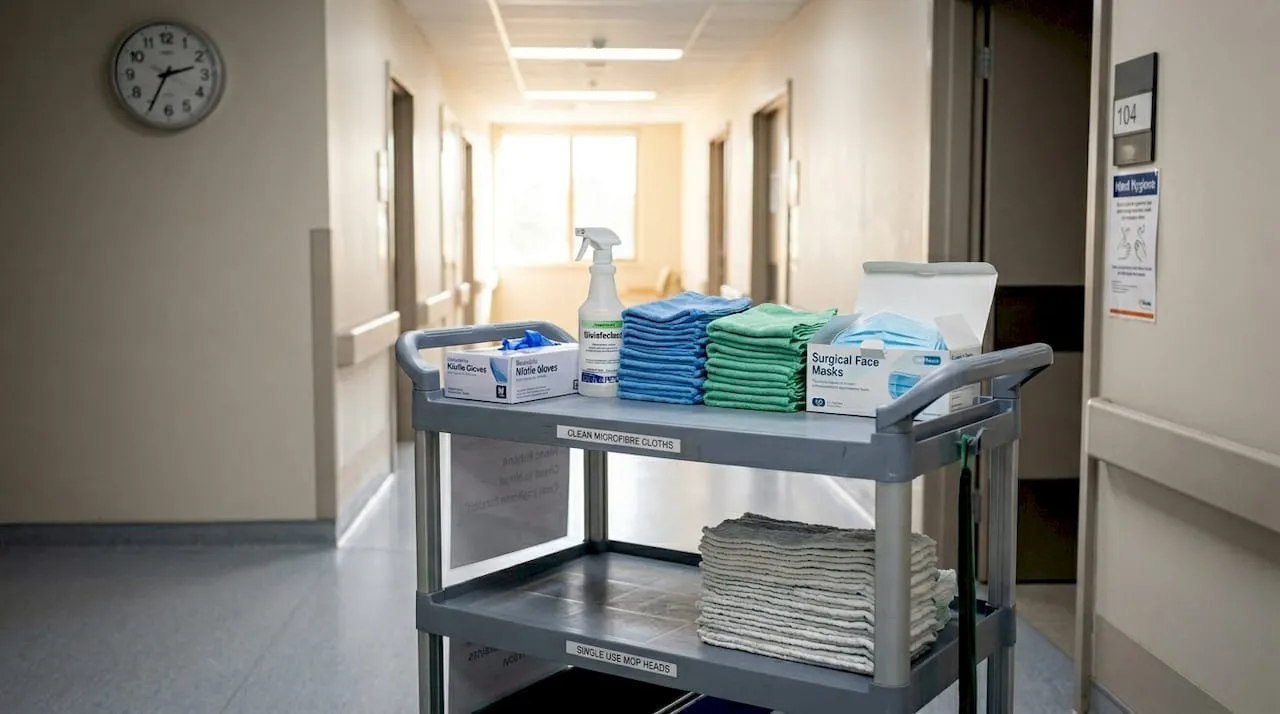
Using appropriate cleaning supplies and PPE is critical to prevent cross-contamination during cleaning. Arriving at a bathroom without the right equipment is not just inefficient — it forces shortcuts that compromise safety. Every member of your cleaning team should have access to a fully stocked trolley before beginning any hospital bathroom clean.

| Supply | Purpose |
|---|---|
| Disposable gloves (nitrile) | Protect hands from pathogens and chemicals |
| Fluid-resistant apron | Prevent splash contamination to clothing |
| Eye protection | Guard against chemical or biological splatter |
| Colour-coded microfibre cloths | Prevent cross-contamination between zones |
| Hospital-grade disinfectant | Kill pathogens on high-touch surfaces |
| Neutral detergent | Remove organic matter before disinfection |
| Single-use mop heads or colour-coded mops | Prevent floor-to-surface contamination |
| Disposable paper towels | Dry surfaces without spreading bacteria |
| Waste bags (clinical and general) | Safe disposal of contaminated materials |
| Signage (wet floor, out of service) | Protect patients and staff during cleaning |
Single-use items deserve particular attention. Reusable cloths and mop heads, if not laundered and dried correctly between uses, become reservoirs for the very bacteria you are trying to eliminate. Where possible, opt for single-use microfibre cloths in high-risk areas.
Safe storage matters too. Chemicals must be stored in locked, ventilated cupboards, clearly labelled, and kept separate from clinical supplies. Refer to PPE guidelines from Safe Work Australia to ensure your team is equipped and trained correctly.
When choosing effective cleaning products, always verify that disinfectants are listed on the Australian Register of Therapeutic Goods (ARTG) for hospital use. Using hospital-grade sanitisers ensures you meet the pathogen kill claims required by accreditation standards.
Pro Tip: Organise your trolley in the order you will use each item — PPE first, then detergents, then disinfectants, then floor supplies. This prevents fumbling mid-clean and reduces the risk of touching contaminated items with clean gloves.
Step-by-step hospital bathroom cleaning procedure
Now that tools are ready, here’s the precise process to follow step-by-step for every hospital bathroom clean.
Adhering to a structured cleaning sequence reduces cross-contamination and is a requirement under the Australian environmental cleaning guide. Follow this sequence every time, without exception.
- Place signage at the entry to notify patients and staff the bathroom is being cleaned.
- Don PPE — gloves, apron, and eye protection — before entering.
- Remove waste — empty bins, replace liners, and bag clinical waste separately.
- Inspect for hazards — check for sharps, spills, or damage before touching any surface.
- Clean high surfaces first — wipe mirrors, shelves, and dispensers using a clean cloth and detergent.
- Clean mid-level surfaces — sinks, tap handles, soap dispensers, and grab rails with detergent, then disinfectant.
- Clean the toilet last — apply disinfectant under the rim, scrub the bowl, then wipe the seat, lid, flush handle, and exterior base using a dedicated cloth.
- Mop the floor — work from the furthest point back towards the door, using a clean mop head.
- Remove PPE safely — peel off gloves and apron without touching the outer surface, then wash hands.
- Document the clean — sign the cleaning log with time and initials.
“Always work clean-to-dirty and high-to-low. Reversing this order is one of the most common ways contamination spreads during a clean.”
| Approach | Advantages | Limitations |
|---|---|---|
| Manual cleaning | Flexible, low cost, thorough in tight spaces | Relies on staff technique and consistency |
| Automated/electrostatic | Rapid disinfection of large areas | Higher cost, requires training, less effective on heavy soiling |
Refer to hospital-specific cleaning protocols for guidance on outbreak situations, which may require additional steps such as extended contact times or sporicidal agents.
Pro Tip: During busy shifts, place a small coloured sticker on the door frame once a bathroom has been cleaned. This gives supervisors an instant visual cue and prevents double-handling without slowing down the team.
Common mistakes and verification after cleaning
Following the steps is important — now let’s focus on how to ensure the work meets standards and avoid common slip-ups.

Routine verification of cleaning tasks boosts compliance rates and supports a culture of accountability. Even experienced staff make errors under time pressure, and a verification system catches problems before they become incidents.
The most frequently missed areas include:
- Under and behind bins, where waste and moisture accumulate
- The base and exterior of the toilet, often wiped but rarely disinfected properly
- Light switches and door handles, skipped when staff are rushing
- Grab rails near the toilet, which have high hand contact but low visibility
- Dispenser nozzles, which can harbour bacteria if not wiped regularly
Common errors go beyond missed surfaces. Misusing chemicals — such as mixing disinfectant with detergent in the wrong order, or not allowing adequate contact time — renders the product ineffective. Using the wrong colour-coded cloth in a zone is another frequent mistake that transfers bacteria from toilets to sinks.
For auditing and verification, three methods work well in Australian hospital settings. First, a signed paper or digital checklist completed after every clean. Second, supervisor spot checks conducted at random intervals. Third, ATP (adenosine triphosphate) testing, which uses a swab and luminometer to measure biological residue on surfaces. Peer-reviewed evidence confirms ATP testing is a reliable indicator of cleaning effectiveness in healthcare environments.
Understanding your team’s hygiene compliance responsibilities means building reporting pathways too. If a staff member finds a surface that was missed or a dispenser that is empty, there must be a clear, blame-free way to report it and get it rectified quickly.
Pro Tip: When giving feedback after a spot check, lead with what was done well before addressing what was missed. Staff who feel recognised for good work are far more likely to maintain standards than those who only hear about failures.
What most guides miss: The art of teamwork and process ownership
Most hospital cleaning guides focus entirely on products and procedures. That is understandable — the steps matter enormously. But after working with facilities across Brisbane, Gold Coast, and Melbourne, we have seen a consistent pattern: the teams with the best audit results are not always the ones with the most expensive products. They are the ones where every cleaner understands why the procedure exists, not just what to do.
When front-line staff are involved in reviewing and improving cleaning processes, something shifts. They spot problems that managers miss. They take ownership of their zone rather than treating it as a task to tick off. One facility we supported transformed its audit scores not by changing products, but by running a monthly ten-minute team discussion about what was working and what was not.
Insightful environmental cleaning advice consistently points to culture as the multiplier that makes every other investment work harder. Pride in the work, clear communication, and genuine respect for cleaning staff as clinical contributors — these are the factors that sustain compliance between audits, not just during them.
Partner with Ozifresh for expert hospital hygiene solutions
To put these cleaning principles into action for your hospital, choose a trusted hygiene partner. Ozifresh has supported healthcare facilities across Brisbane, Gold Coast, and Melbourne for over 40 years, supplying hospital-grade products and tailored service programmes that align with Australian accreditation requirements. From hospital sanitary bins to full-service contracts for nursing home hygiene, our team can help you build a cleaning system that holds up under scrutiny. Whether you need to review your current supplies, train your team, or establish a new compliance framework, Ozifresh is ready to support your facility with practical, proven solutions.
Frequently asked questions
How often should hospital bathrooms be cleaned during a typical shift?
Facility policy and patient volume determine bathroom cleaning frequency, but most hospital bathrooms require cleaning at least two to four times per shift, with additional cleans after known contamination events.
What cleaning chemicals are recommended for hospital bathroom surfaces?
Use hospital-grade disinfectants approved under Australian standards, always following label instructions for correct dilution ratios and minimum contact times to ensure pathogen kill claims are met.
How can mistakes in bathroom cleaning be reduced?
Checklists and audits reduce cleaning errors significantly — combine these with regular training sessions and random supervisor spot checks to maintain consistently high standards across all shifts.
What’s the best way to verify that a hospital bathroom is clean?
Use step-by-step signed checklists after every clean, and consider ATP testing for high-risk areas, as it provides objective, measurable evidence of surface cleanliness beyond what visual inspection alone can confirm.
Recommended
Ready for a cleaner, safer workplace?
Contact our team today to discuss hygiene services for your business in Brisbane, Melbourne or the Gold Coast.