Environmental cleaning: What facility managers need to know
Enhanced environmental cleaning reduces HAIs 30-50%, yet many facility managers across Brisbane, Gold Coast, and Melbourne still treat it as routine surface wiping. That gap between perception and practice is where infection risk lives. Environmental cleaning is a structured, compliance-driven process that protects occupants, satisfies Australian regulatory standards, and directly reduces pathogen transmission. Whether you manage a hospital ward, a school campus, or a commercial office block, understanding how environmental cleaning works, how often it must occur, and how to verify it is meeting the standard is no longer optional. This article gives you the operational clarity to act.
Table of Contents
-
Nuances and edge cases: Outbreaks, novel pathogens, and eco-friendly cleaning
-
Professional environmental cleaning solutions for Brisbane, Gold Coast, and Melbourne
Key Takeaways
| Point | Details |
|---|---|
| Environmental cleaning defined | It involves systematic cleaning and disinfecting surfaces, equipment, and spaces to prevent infection and maintain hygiene. |
| Two-step cleaning process | Effective routines combine detergent cleaning followed by disinfection using approved products with proper technique and timing. |
| Routine and monitoring | Regular cleaning, high-touch focus, and robust monitoring protocols ensure compliance and measurable reduction in infection risks. |
| Special cases and sustainability | Tailored approaches for outbreaks and eco-friendly protocols offer both efficacy and cost-saving environmental benefits. |
| Professional solutions available | Qualified local providers deliver hospital-grade services that match compliance and hygiene standards for Brisbane, Gold Coast, and Melbourne. |
What is environmental cleaning?
Environmental cleaning is far more than a mop and a spray bottle. It is, by definition, the systematic process of cleaning and disinfecting surfaces, equipment, and areas in healthcare, commercial, and educational facilities. The goal is to remove dirt, organic matter, and pathogens from the environment before they can transfer to people.
This applies across a wide range of settings:
-
Healthcare facilities: hospitals, aged care homes, medical centres
-
Educational institutions: schools, universities, childcare centres
-
Commercial workplaces: offices, retail spaces, hospitality venues
-
Shared amenities: bathrooms, kitchens, reception areas, lift buttons
The preventative role of environmental cleaning is significant. Pathogens like Clostridioides difficile, MRSA, and norovirus can survive on hard surfaces for days or even weeks. Routine cleaning disrupts this cycle before it becomes an outbreak.
Environmental cleaning is not a cosmetic exercise. It is an infection control intervention that sits at the foundation of every compliant facility hygiene programme.
For facilities seeking to align their hygiene infrastructure with cleaning outcomes, sanitary hygiene services form a critical part of the overall programme. Australian infection prevention guidelines provide the regulatory framework that underpins these requirements across all facility types.
Core mechanics: How environmental cleaning works
Effective environmental cleaning follows a precise two-step process. Skipping either step, or doing them out of order, compromises the entire outcome.
-
Remove visible soil first: Use a neutral detergent and clean water to physically remove dirt, grease, and organic matter from surfaces. Disinfectants cannot penetrate biofilm or organic load, so this step is non-negotiable.
-
Disinfect with TGA-approved products: Apply a TGA-approved hospital-grade disinfectant at the correct concentration. Allow the product to remain wet on the surface for the full contact time specified by the manufacturer.
-
Respect wet contact time: This is the most commonly skipped step. A disinfectant wiped off immediately after application has not had time to kill pathogens. Most products require 30 seconds to 10 minutes of wet contact.
-
Use correct concentrations: Too dilute and the product is ineffective. Too concentrated and you risk surface damage, staff exposure, and non-compliance with safety data sheets.
-
Work clean to dirty: Always clean from the least contaminated areas to the most contaminated. In a bathroom, that means starting at the door handle and finishing at the toilet bowl.
Pro Tip: Laminate your facility’s approved product list, dilution ratios, and contact times and post them inside every cleaning cupboard. Staff turnover is high in many facilities, and this simple step prevents costly compliance gaps.
The cleaning evidence consistently shows that procedural adherence, not product choice alone, drives outcomes. Supporting hand hygiene at every touchpoint with quality hand sanitiser products and maintaining clean toilet facilities with appropriate toilet sanitiser options reinforces the cleaning programme between scheduled cleans.
Cleaning frequency: How often should facilities clean?
Frequency is where many facilities fall short. The answer is not one-size-fits-all. Cleaning frequencies vary by risk: healthcare patient rooms require daily cleaning with high-touch surfaces addressed three to four times per day, bathrooms two to four times daily, while commercial offices and schools typically require daily cleaning with enhanced attention to high-traffic zones.
| Facility type | General surfaces | High-touch surfaces | Bathrooms |
|---|---|---|---|
| Healthcare (patient rooms) | Daily | 3 to 4 times daily | 2 to 4 times daily |
| Aged care | Daily | 2 to 3 times daily | 2 to 3 times daily |
| Schools | Daily (term time) | 1 to 2 times daily | 2 to 3 times daily |
| Commercial offices | Daily | 1 to 2 times daily | 1 to 2 times daily |
| Outbreak scenario | 2 times daily minimum | Every 2 to 4 hours | Every 2 hours |
High-touch surfaces deserve special attention regardless of facility type. These include:
-
Door handles and push plates
-
Light switches and power points
-
Lift buttons and handrails
-
Shared keyboards, phones, and printers
-
Tap handles and soap dispensers
Pro Tip: During influenza season or any confirmed outbreak, double your standard cleaning frequency immediately. Do not wait for a directive. The cost of a reactive response far exceeds the cost of a proactive one.
For aged care providers, nursing home cleaning standards carry additional regulatory weight under the Aged Care Quality Standards. Commercial facility managers can benchmark their programmes against established office cleaning services frameworks to identify gaps.
Monitoring and compliance: Are you meeting the standard?
Frequency alone does not guarantee quality. A surface can be cleaned daily and still harbour dangerous pathogen loads if the process is flawed. Monitoring closes that gap.
Monitoring uses ATP bioluminescence, fluorescent markers, microbiological sampling, and visual audits. A multimodal approach, combining two or more of these methods, delivers the most reliable picture of cleaning performance.
| Monitoring method | What it measures | Turnaround time | Best used for |
|---|---|---|---|
| ATP bioluminescence | Organic residue (proxy for cleanliness) | Immediate | Routine spot checks |
| Fluorescent markers | Surface coverage by cleaning staff | Immediate | Training and audits |
| Microbiological sampling | Actual pathogen presence | 24 to 72 hours | Outbreak investigation |
| Visual audit | Visible soil and process adherence | Immediate | Daily supervision |
Facilities that implement structured monitoring programmes see cleaning thoroughness improve from approximately 50% to over 80%, with corresponding reductions in healthcare-associated infections.
Enhanced cleaning benchmarks confirm that cleaning thoroughness improves from roughly 50% to above 80% when monitoring is in place, with HAI rates dropping by up to 50%. These are not marginal gains. They represent real patient safety outcomes and real regulatory compliance.
Australian facilities operating under the NSQHS Standards and ACSQHC frameworks are required to maintain documented cleaning programmes, conduct regular audits, and demonstrate continuous improvement. Multidisciplinary compliance teams, where infection control, facilities management, and clinical staff collaborate, consistently outperform siloed approaches.
For facilities managing clinical waste streams, sharps disposal compliance must be integrated into the broader environmental cleaning and infection control programme to meet regulatory requirements.
Nuances and edge cases: Outbreaks, novel pathogens, and eco-friendly cleaning
Routine cleaning protocols are designed for steady-state conditions. When conditions change, your approach must change with them.
Outbreak scenarios require an immediate escalation in both frequency and scope. Outbreaks double frequencies, and novel pathogens require formal risk assessments before standard protocols are applied. During a norovirus outbreak, for example, standard alcohol-based disinfectants are ineffective. Chlorine-based products at appropriate concentrations are required instead.
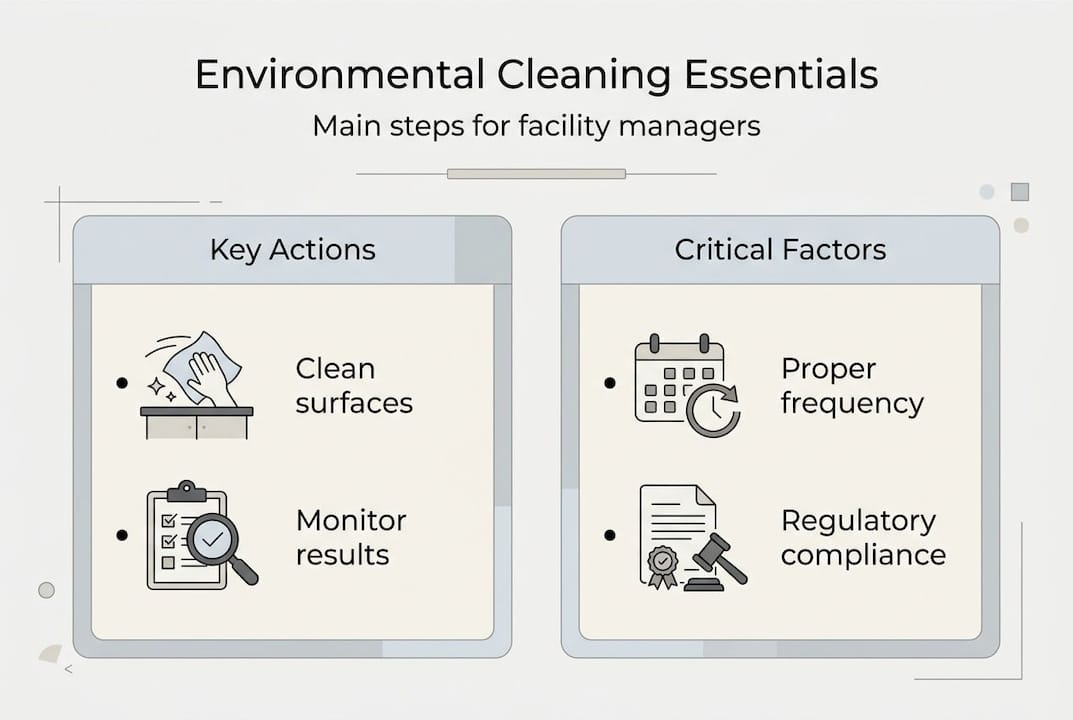
Biofilm management is an often-overlooked edge case. Biofilms form in plumbing, on sink surfaces, and around drain areas. They are resistant to standard disinfectants and require targeted mechanical disruption followed by appropriate chemical treatment. Facilities with older plumbing infrastructure in Brisbane and Melbourne should schedule periodic biofilm audits.
Novel pathogens present a different challenge. When a new pathogen emerges, existing product approvals may not cover it. The correct response is a structured risk assessment that evaluates transmission routes, surface survival times, and appropriate product classes before updating your cleaning protocol.
Eco-friendly cleaning protocols are no longer a compromise. Research confirms that eco-friendly protocols reduce CO2 emissions by up to 50% while matching or exceeding traditional methods in microbial control. Concentrated products, microfibre systems, and cold-water formulations all contribute to this outcome.
Pro Tip: When transitioning to greener products, request independent efficacy data from your supplier. TGA listing and third-party microbial testing results should both be available before you make the switch.
Maintaining hand hygiene infrastructure throughout your facility, including quality hand towel hygiene solutions in bathrooms and kitchens, supports the overall environmental cleaning programme by reducing cross-contamination between scheduled cleans.
Professional environmental cleaning solutions for Brisbane, Gold Coast, and Melbourne
Ozifresh has supported Australian facility managers for over 40 years, delivering hygiene solutions that are built around compliance, not just convenience. If the frameworks in this article have highlighted gaps in your current programme, our team can help you close them. We supply TGA-approved, hospital-grade products, support ATP verification processes, and design hygiene programmes that align with NSQHS Standards and Aged Care Quality Standards. Our Melbourne hygiene experts, Brisbane cleaning specialists, and Gold Coast hygiene services teams understand the specific regulatory environments and facility types in each region. Reach out to discuss a tailored hygiene programme that takes the guesswork out of compliance.
Frequently asked questions
Is environmental cleaning only for hospitals?
No. Environmental cleaning is essential across healthcare, commercial, and educational facilities. Any setting where people gather and share surfaces carries infection transmission risk that structured cleaning addresses.
What products are approved for use in Australian environmental cleaning?
Products must be TGA-approved and hospital-grade, applied at manufacturer-specified concentrations and contact times to meet Australian infection control guidelines.
How can I monitor cleaning effectiveness in my facility?
ATP bioluminescence, fluorescent markers, and microbiological sampling are the primary methods, with a multimodal combination delivering the most reliable and actionable results.
Do green cleaning protocols actually work as well as traditional ones?
Yes. Eco-friendly protocols match or exceed traditional methods in microbial control while reducing CO2 emissions by up to 50%, making them a sound choice for both compliance and sustainability goals.
Recommended
Ready for a cleaner, safer workplace?
Contact our team today to discuss hygiene services for your business in Brisbane, Melbourne or the Gold Coast.