Sharps disposal service cost: what you'll pay in Australia
Most commercial sharps disposal services in Australia cost somewhere between $8 and $35 per container per collection (ex GST). depending on container size, collection frequency, and your location. That price typically bundles container supply, scheduled pickup, licensed transport, high-temperature treatment, and a certificate of destruction. Landfill disposal of untreated sharps is prohibited across all Australian states, so the price you pay reflects a fully regulated chain from your site to final destruction.
Here is what that means in practice before you request a quote:
- Container size drives the base price. A 1.4 L desktop unit costs less per pickup than a 23 L floor-standing bin, but a larger container collected less often can work out cheaper overall.
- Scheduled contracts are cheaper per collection than one-off pickups. Monthly or fortnightly agreements lock in lower per-unit rates.
- GST is added on top of the ex-GST price shown in most supplier quotes.
- Container supply and replacement are usually included in contracted service pricing, not charged separately.
- You will need an EPA-licensed contractor. State EPA rules and RACGP accreditation requirements for clinical practices both mandate disposal by an authorised firm.
- A certificate of destruction and transport manifest are standard deliverables you should request and retain.
To get an accurate quote, have your container sizes, approximate fill rate, site address, and preferred frequency ready before you call.
Key takeaways
Scheduled sharps disposal in Australia typically costs between moderate and higher rates per container per collection, with price determined primarily by container size, collection frequency, treatment method, and region.
| Point | Details |
|---|---|
| Typical price range | $8–$35 per container per collection (ex GST), covering container, transport, treatment, and certificate. |
| Main cost drivers | Container size, collection frequency, treatment method (incineration costs more than autoclave), and site location. |
| Contract vs one-off | Scheduled contracts deliver lower per-collection rates; one-off collections carry a premium and suit occasional needs only. |
| Compliance requirements | EPA-licensed transport, AS 4031/AS/NZS 4261 containers, transport manifest, and certificate of destruction are non-negotiable. |
| Ozifresh | Provides scheduled, AS-compliant sharps collection across Brisbane, the Gold Coast, and Melbourne with itemised monthly invoicing. |
Table of Contents
- What does sharps disposal service cost by container size?
- What actually changes the price of sharps collection?
- Scheduled contracts, one-off collections, and community drop-offs
- Australian regulatory and compliance obligations that affect cost
- How to get an accurate sharps disposal quote
- What happens from booking to first collection?
- Keeping costs down without cutting compliance corners
- Ozifresh sharps disposal: scheduled, compliant, and clearly priced
- Sources
What does sharps disposal service cost by container size?
The table below shows indicative per-collection price bands for common container sizes under a scheduled contract arrangement. These are ex-GST market benchmarks; actual quotes vary by region, volume, and supplier.
| Container size | Typical use | Per-collection price range (ex GST) | Common frequency |
|---|---|---|---|
| 1.4 L | Desktop/chairside | Typical lower price range | Monthly |
| 5 L | GP consulting room | Moderate price range | Monthly / fortnightly |
| 7.5 L | Clinic, allied health | Moderate to upper moderate price range | Monthly / fortnightly |
| 12.5 L | Busy clinic, pharmacy | Higher moderate price range | Fortnightly / weekly |
| 23 L | High-volume facility | Higher price range | Weekly / fortnightly |
A few points worth noting alongside these figures:
- GST adds 10% to every line item. Always confirm whether a quoted price is ex or inc GST before comparing suppliers.
- Container supply and replacement are included in most contracted service agreements. If a quote separates them, ask why.
- Regional pricing varies. Metropolitan Brisbane, Melbourne, and the Gold Coast generally attract lower rates than rural or remote sites, where travel costs push prices up.
- Some suppliers publish promotional pricing for a fixed period. Confirm whether a rate is ongoing or time-limited before signing.
What actually changes the price of sharps collection?
Primary cost drivers
Container size and type set the floor price. Containers must meet AS 4031 or AS/NZS 4261 standards, which govern puncture resistance, labelling, and closure. Compliant containers cost more to manufacture and to handle safely.
Collection frequency has a direct effect. Weekly collection of a 23 L bin costs more in absolute terms than monthly collection of a 5 L bin, but the per-visit rate often drops as frequency increases under a contract.
Treatment method is a significant variable. Autoclave treatment is generally less expensive than high-temperature incineration. Cytotoxic sharps (purple containers, used for chemotherapy waste) require incineration and attract a price premium because of the specialised handling and regulated treatment requirements.
Location and travel matter more than many buyers expect. A site 90 minutes from a treatment facility pays more for transport than one in an inner suburb.
Contract terms affect rate. Volume commitments and multi-site agreements usually unlock lower per-unit pricing.
Secondary cost drivers
- Site access complexity: difficult loading docks, restricted hours, or multi-floor access add time and cost.
- Minimum site fees: some suppliers charge a minimum per-visit fee regardless of container count, which hits low-volume sites hardest.
- Manifesting and tracking: transport manifests are a regulatory requirement, but some suppliers charge separately for digital tracking portals.
- Cytotoxic and pharmaceutical sharps: purple-lidded containers require separate handling and incineration, which raises the per-unit price.
- Insurance and handling documentation: suppliers must carry appropriate waste-handling insurance; this cost is built into compliant pricing.
Pro Tip: If your current 5 L bin fills in three weeks, upsizing to a 7.5 L bin collected monthly often costs less per year than fortnightly 5 L collections. Ask your supplier to model both options before you sign.
Scheduled contracts, one-off collections, and community drop-offs
Not every sharps generator needs the same service model. The right choice depends on volume, frequency, and whether you are a commercial operator or an individual.
Scheduled contract collection suits any business or healthcare facility generating sharps regularly. You agree to a collection frequency, the supplier delivers compliant containers, swaps them on schedule, and provides manifests and certificates. The per-collection rate is lower than ad hoc options, and your compliance obligations are met automatically.
One-off commercial collection is available when you have accumulated sharps waste outside a regular contract, or when you are closing a site. Expect to pay a premium over contracted rates, and allow extra lead time for the supplier to schedule a vehicle and arrange treatment.
Community drop-off is a free option, but only for individuals disposing of personal sharps (such as insulin syringes used at home). NSW Health’s community sharps guidance is explicit: Needle and Syringe Program outlets accept used sharps from community members at no cost, but businesses must use commercial waste contractors. Community bins are not a legal option for pharmacies, clinics, salons, or any commercial generator.
| Service type | Container size | Frequency | Per-unit price (ex GST) | Site fee | Treatment | Contract? |
|---|---|---|---|---|---|---|
| Scheduled contract | 1.4 L–23 L | Monthly to weekly | $8–$35 | Often included or low | Autoclave or incineration | Yes |
| One-off commercial | 1.4 L–23 L | Single collection | Higher than contract rate | Usually charged separately | Autoclave or incineration | No |
| Community drop-off | Personal containers only | As needed | Free | None | Varies by council | No |
Australian regulatory and compliance obligations that affect cost
Clinical sharps cannot go into general waste bins. Every Australian state and territory prohibits it, and the compliance chain that follows is what drives the cost structure of professional sharps disposal.
EPA Victoria’s operational guidance requires that clinical and related waste be treated before disposal, and sets controls on container type, storage, and transport. Similar frameworks operate in every other state. Transport must be carried out by a licensed contractor, and the generator (your business) retains responsibility for ensuring that contractor holds the correct EPA permit.
For healthcare practices, RACGP accreditation requires safe clinical waste management as a condition of practice approval. Sharps must be stored close to the point of use, out of reach of children, and disposed of by an approved waste disposal firm. Failing this is not a minor administrative issue; it can jeopardise accreditation.
Key compliance items that directly affect what you pay:
- AS 4031 and AS/NZS 4261 containers are the mandated standards for sharps containers. Non-compliant containers cannot be used, so any supplier quoting cheaper non-standard bins is a red flag.
- Cytotoxic sharps (purple containers) require incineration, not autoclave. This raises the per-unit cost and requires a supplier with the correct licence for cytotoxic waste.
- Transport manifest: every collection must be documented. The manifest tracks waste from your site to the treatment facility.
- Certificate of destruction: issued after treatment, this is your evidence that waste was destroyed lawfully. Keep it.
Clinical and related waste must be treated before disposal, and transport, temporary storage, treatment and disposal are all regulated activities under EPA Victoria’s framework. Generators who use unlicensed contractors remain liable even after the waste leaves their site.
Retain certificates of destruction and transport manifests for at least several years. WHS and environmental audits can request them, and a gap in records is difficult to explain after the fact. For a fuller picture of your safe disposal obligations as an Australian business, the regulatory picture is worth understanding before you sign any service agreement.
How to get an accurate sharps disposal quote
Suppliers can only give you a meaningful price if you give them the right information upfront. Vague enquiries produce vague quotes with hidden fees attached later.
What to tell the supplier:
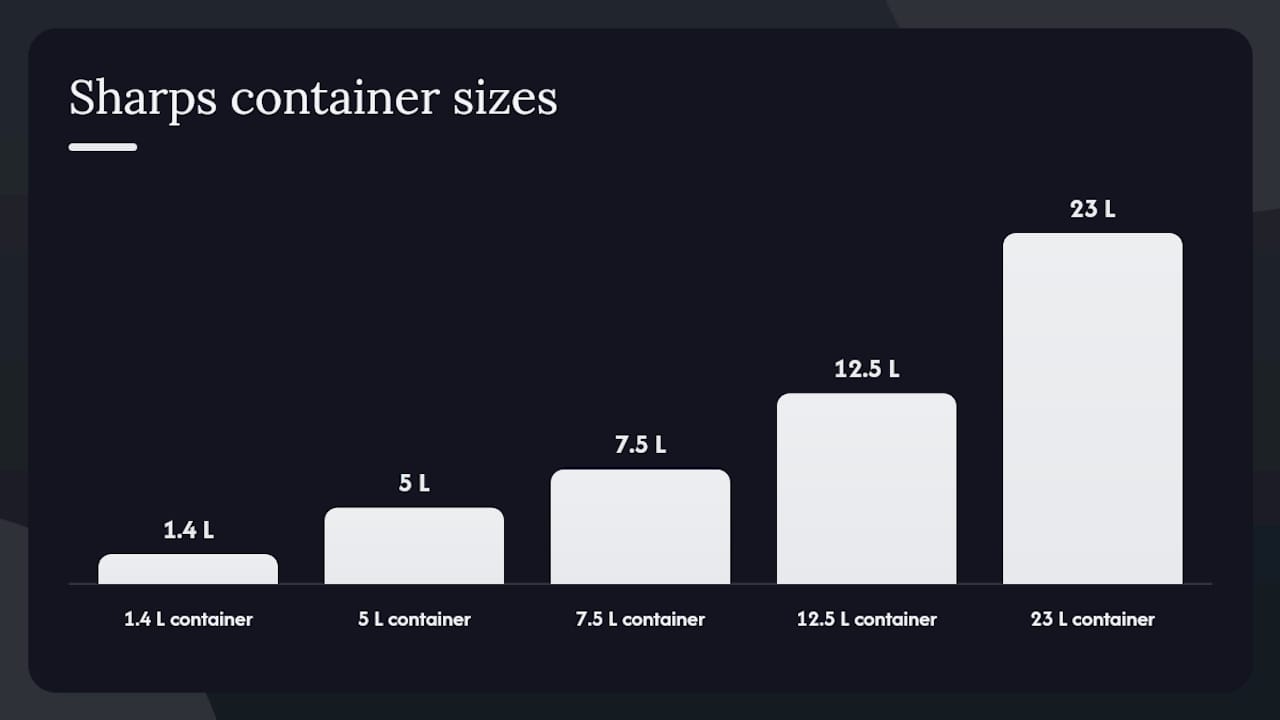
- Container sizes you need (1.4 L, 5 L, 7.5 L, 12.5 L, 23 L) and how many of each.
- Approximate fill rate: how quickly does each container reach the three-quarter mark?
- Full site address and region, including any access constraints (restricted hours, security sign-in, stairs).
- Whether any waste is cytotoxic (purple containers) or pharmaceutical.
- Preferred collection frequency and desired start date.
- Number of sites if you need multi-site coverage.
Questions to ask the supplier:
- Does the price include container supply and replacement?
- Are transport, treatment, and the certificate of destruction included, or charged separately?
- Is there a minimum site fee or minimum number of visits per month?
- What are the contract terms and the notice period to exit?
- Can you provide proof of EPA licensing and waste-handling insurance?
- How is GST applied, and will invoices show ex-GST and inc-GST separately?
Red flags in a quote:
- No evidence of EPA licensing or controlled-waste transport permits.
- No mention of a certificate of destruction.
- Vague treatment description (“disposed of appropriately”) with no method stated.
- Large unexplained site fees that appear only in the fine print.
- Containers that do not reference AS 4031 or AS/NZS 4261 compliance.
What happens from booking to first collection?
The process is straightforward when you know what to expect. Here is the typical sequence for a metropolitan site:
- Enquiry and quote: you provide site details; the supplier confirms pricing, container options, and frequency.
- Site assessment (if required): larger or more complex sites may need a brief on-site visit to confirm container placement and access.
- Container delivery: compliant containers are delivered before the first scheduled collection date.
- Scheduled collection: the collector arrives on the agreed date, swaps sealed containers for fresh ones, signs the transport manifest, and removes the waste.
- Treatment and destruction: waste goes to a licensed treatment facility for autoclave or incineration.
- Certificate of destruction: issued after treatment and delivered via invoice, email, or a customer portal, depending on the supplier.
For metropolitan Brisbane and Melbourne, most suppliers can complete the full cycle from enquiry to first collection within five to ten business days. Remote and regional sites should allow two to four weeks, particularly where transport to a licensed treatment facility requires longer logistics.
Delays most often occur when a site assessment is needed, when cytotoxic waste requires a specialist vehicle, or when a new account requires EPA documentation to be verified. Having your site details and waste type confirmed before you call cuts that lead time significantly.
Keeping costs down without cutting compliance corners
The most common cost mistake is choosing a collection frequency based on habit rather than actual fill rate. A 5 L bin collected fortnightly when it only reaches three-quarters full every six weeks is money left on the table. Upsizing the container and extending the interval is the single easiest legitimate saving, and it does not touch compliance.
Multi-site consolidation is the next lever. If your business runs several locations, a single supplier agreement covering all sites almost always attracts better per-unit pricing than separate contracts negotiated independently. Predictable scheduling also matters: ad hoc call-outs cost more than fixed-date collections, so locking in a regular day reduces both cost and administrative effort.
Internally, staff training on correct sharps handling reduces contamination incidents that can void a container and require early replacement. Replacing at the three-quarter fill line (not overfilling) keeps containers within the weight and closure tolerances that compliant handling requires.
Pro Tip: When negotiating, ask for transparent monthly invoicing that itemises container count, collection dates, treatment method, and certificate reference numbers. This makes audits straightforward and gives you a clear basis for renegotiating at renewal.
Ozifresh sharps disposal: scheduled, compliant, and clearly priced
Ozifresh delivers scheduled sharps disposal across Brisbane, the Gold Coast, and Melbourne, with AS-compliant containers, EPA-tracked transport, and a certificate of destruction included as standard. There are no surprise site fees buried in the fine print, and monthly invoicing is itemised so you can see exactly what each collection covers.
For businesses managing multiple hygiene services, Ozifresh combines sharps disposal with sanitary bin collection, nappy disposal, and hand hygiene supply under a single account, which simplifies both scheduling and invoicing. Volume pricing is available for multi-site clients.
To get a quote tailored to your site, container count, and frequency, contact the Brisbane or Melbourne team directly. A site assessment can be arranged for larger or more complex facilities.
Sources
These are the primary regulators and guidance documents that underpin sharps disposal pricing and compliance in Australia:
- RACGP - Waste management
- NSW Community Sharps Guidance
- Clinical and related industrial waste (EPA Victoria)
- Code of practice for clinical and related waste management
This article provides general information about sharps disposal pricing and regulatory requirements in Australia. Confirm current EPA licensing requirements, container standards, and accreditation obligations with the relevant state regulator or a qualified waste management professional before entering a service agreement.
This article is general information, not a substitute for advice from a qualified lawyer. Consult a qualified legal professional about your own circumstances before acting on anything here.
Recommended
Ready for a cleaner, safer workplace?
Contact our team today to discuss hygiene services for your business in Brisbane, Melbourne or the Gold Coast.