How to maintain clean clinics: the 2026 compliance guide

TL;DR:
- Clinic hygiene relies on documented infection control protocols, TGA-registered disinfectants, and staff training to meet Australia’s NSQHS Standards. Proper product use, zone-specific cleaning schedules, and thorough documentation ensure compliance and reduce infection risks. Regular audits and clear task responsibilities help clinics maintain high standards and pass accreditation inspections.
Maintaining clean clinics is defined as the systematic application of infection control protocols, TGA-registered disinfectants, and documented cleaning procedures that meet Australia’s National Safety and Quality Health Service (NSQHS) Standards. Clinic hygiene is not simply about appearance. It directly determines patient safety outcomes, regulatory compliance, and your facility’s ability to retain accreditation. Australian healthcare administrators face tightening standards in 2026, with updated requirements for medical device reprocessing and stricter documentation expectations. This guide covers how to maintain clean clinics through zone-based scheduling, compliant product selection, staff training, and quality audits.
What are the regulatory requirements for clinic cleanliness?
Australian clinics must meet the NSQHS Standards, which mandate formal accreditation for infection risk management. This applies to all public and private hospitals, day hospitals, and most public dental practices. Accreditation is not optional. It is the legal and operational baseline for delivering safe healthcare in Australia.
The NSQHS Standards framework covers infection prevention, environmental cleaning, and the reprocessing of reusable medical devices. Clinic managers need to understand which standards apply to their specific facility type and service scope. Failing an accreditation audit can trigger mandatory remediation, operational restrictions, or public reporting obligations.
A significant regulatory update takes effect in 2026. AS 5369:2023 replaces previous standards for reprocessing reusable medical devices, and organisations were required to complete a gap analysis by 30 june 2025. This means any clinic that has not yet reviewed its reprocessing procedures against AS 5369:2023 is already behind. The new standard demands documented risk mitigation reporting, not just procedural compliance.
Key regulatory obligations for clinic managers include:
- Maintaining written cleaning protocols aligned with NSQHS Standards
- Using TGA-registered disinfectants for all clinical surfaces
- Keeping cleaning logs and staff training records as audit evidence
- Completing gap analysis for reusable medical device reprocessing under AS 5369:2023
- Scheduling regular internal audits to identify and correct compliance gaps
Understanding regulatory hygiene standards before an inspection arrives is far less costly than responding to a compliance failure after one.
Which cleaning products and methods meet healthcare efficacy standards?
Clinical cleaning requires TGA-registered disinfectants with proven efficacy against healthcare pathogens. Standard commercial cleaning products do not meet this threshold. The difference matters because a product that cleans visible dirt may leave dangerous pathogens intact on clinical surfaces.
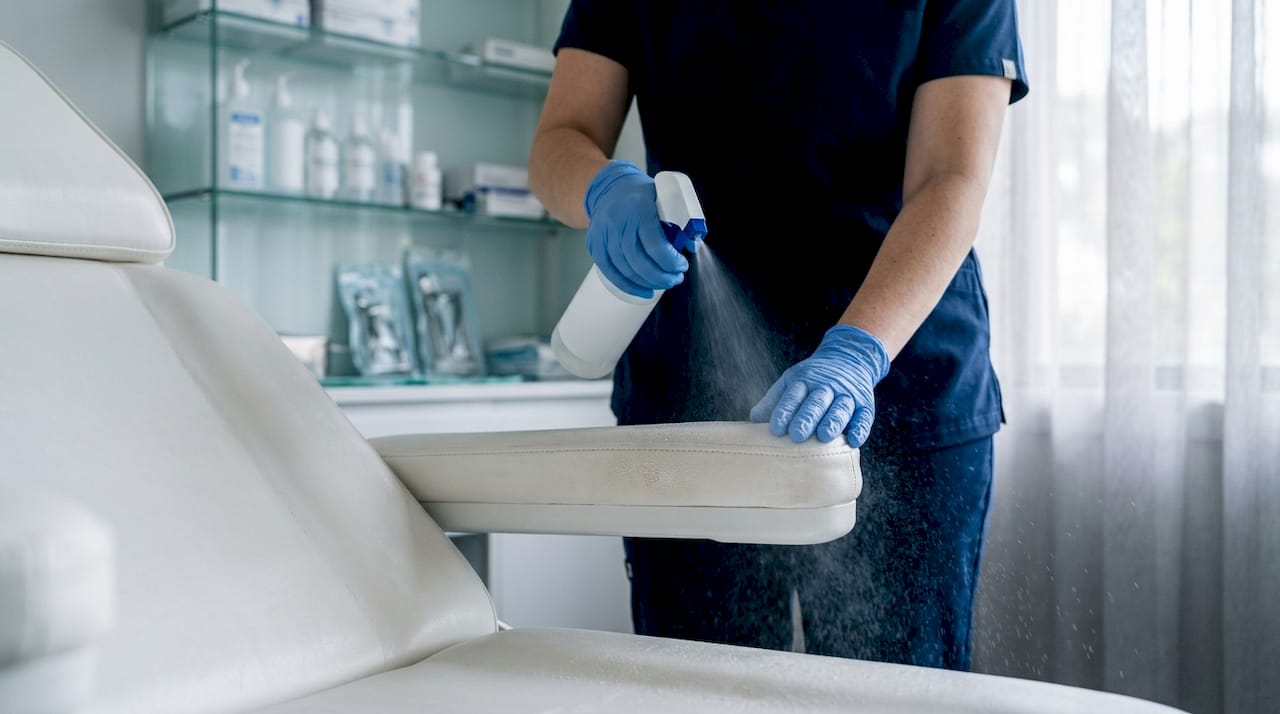
TGA registration confirms that a disinfectant has been tested and approved for use against specific organisms, including bacteria, viruses, and fungi relevant to healthcare settings. Clinic managers should verify TGA registration numbers on all disinfectant products before approving them for use. Purchasing decisions made on price alone create compliance risk.
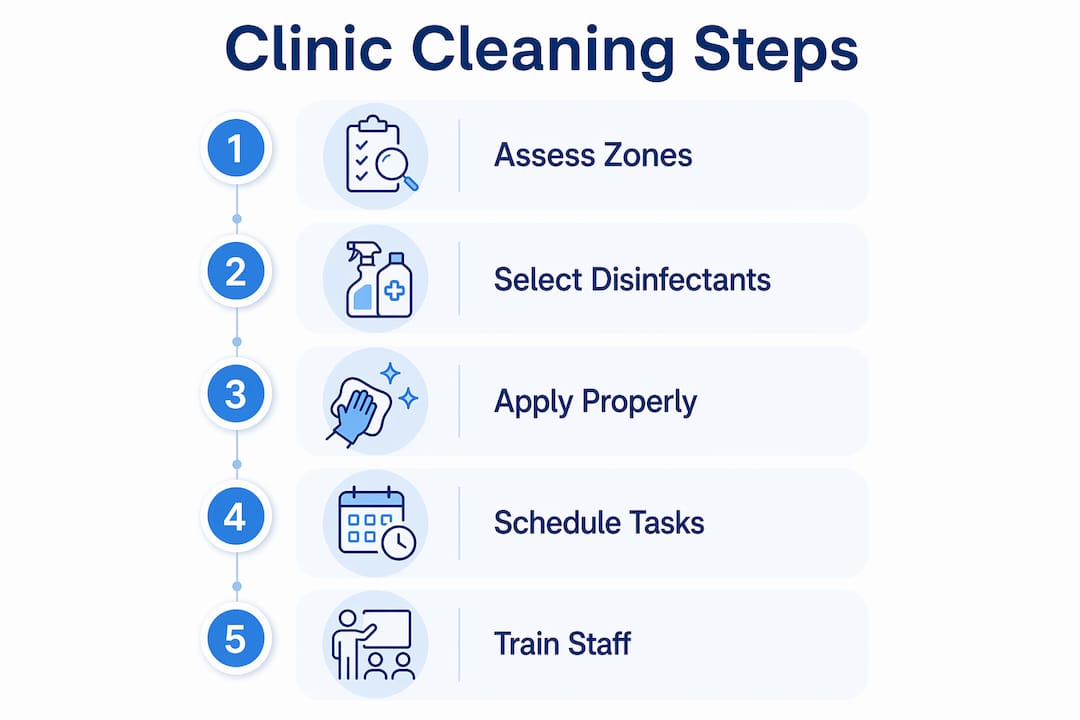
Correct application procedure is as critical as product selection. Pre-cleaning visible soil before applying disinfectant is non-negotiable. Organic matter such as blood, mucus, or body fluids blocks disinfectant contact with the surface, rendering it ineffective. The correct sequence is always: remove visible contamination first, then apply disinfectant and allow the required contact time before wiping.
Contact time is frequently overlooked in busy clinic environments. Most TGA-registered disinfectants require a surface to remain visibly wet for 30 seconds to several minutes to achieve the stated kill rate. Wiping immediately after application defeats the purpose entirely.
Colour-coded cleaning cloths significantly reduce cross-contamination risks between clinic zones. A standard colour system assigns specific cloth colours to specific areas: red for toilets and bathrooms, blue for general areas, yellow for clinical zones, and green for kitchens or food preparation areas. This prevents pathogens from being transferred from high-risk areas to lower-risk ones via shared cloths.
Key product and method requirements for clinical environments:
- TGA-registered disinfectants only, with registration numbers verified
- Pre-clean all surfaces before disinfectant application
- Observe full contact times as specified on product labels
- Use colour-coded cloths and mop heads per zone
- Store cleaning products correctly to maintain efficacy
Pro Tip: Post a laminated contact-time reference card inside each cleaning trolley. Staff can check required dwell times without relying on memory, which reduces errors during busy periods.
How to organise cleaning schedules and zone-specific protocols
Risk-based zoning improves cleaning effectiveness and resource use. Dividing a clinic into exposure risk zones and tailoring cleaning frequency and intensity to each zone is the most practical way to manage hygiene across a complex facility. Not every area carries the same infection risk, and treating them identically wastes resources while leaving high-risk areas under-serviced.
The three primary zone categories for most clinics are:
| Zone type | Examples | Recommended cleaning frequency |
|---|---|---|
| High-risk clinical | Treatment rooms, procedure areas, sterile storage | After each patient, plus terminal clean at day end |
| Medium-risk shared | Waiting rooms, reception desks, staff bathrooms | Multiple times daily, with full clean after hours |
| Low-risk administrative | Staff offices, storage rooms, corridors | Once daily, with spot checks as needed |
Terminal cleaning involves comprehensive disinfection of patient care areas at the end of each day. It goes well beyond spot cleaning and is a non-negotiable method for disrupting pathogen transmission cycles. Terminal cleaning covers all surfaces, floors, fixtures, and fittings in clinical zones, not just the obvious touchpoints.
High-touch surfaces require cleaning multiple times daily in busy clinics due to rapid re-contamination. Door handles, light switches, chair armrests, reception counters, and payment terminals are all vectors for pathogen spread. A single cleaning pass in the morning is insufficient for a clinic seeing 40 or more patients per day.
Flexible cleaning schedules adapted to patient flow and clinic operating hours improve efficiency and minimise disruption. A clinic running extended hours on Wednesdays needs a different schedule than one that closes at 1:00 PM on Fridays. Build your schedule around actual operational patterns, not a generic template.
Pro Tip: Assign a designated midday cleaning round specifically for high-touch surfaces in waiting and reception areas. This single addition catches the contamination peak that builds during morning appointments.
What staff training and documentation practices support clean clinics?
Clinic hygiene is as much about systematic process and documentation as it is about surface cleaning. A clinic that cleans thoroughly but keeps no records cannot demonstrate compliance during an inspection. Documentation is the evidence that your protocols exist and are followed consistently.
Staff training in infection control and cleaning procedures must be structured, not informal. New cleaning staff should receive formal induction training before working independently in clinical areas. Refresher training should occur at least annually, or whenever protocols change. Training records must be kept on file as evidence for accreditation audits.
Cleaning completion logs and training records are the primary evidence inspectors examine. A log that shows consistent, dated completion of all scheduled tasks tells a far stronger compliance story than verbal assurances. Digital logs are increasingly preferred because they create time-stamped, tamper-evident records.
Checklists reduce the need for repetitive training and enforce task completion during busy periods or staff changes. A well-designed checklist removes ambiguity about what needs to be done, in what order, and how often. It also gives managers a fast way to identify gaps when reviewing completed records.
Core documentation and training practices for sustainable clinic hygiene:
- Formal induction training for all cleaning staff before independent work
- Annual refresher training with signed acknowledgement records
- Zone-specific checklists completed and signed after each cleaning round
- Cleaning product usage logs including batch numbers and dilution records
- Scheduled internal audits with written findings and corrective action notes
Quality audits close the loop between policy and practice. A monthly walkthrough audit comparing actual conditions against checklist records will surface discrepancies before they become compliance failures. Pair audit findings with a simple feedback mechanism so cleaning staff can flag issues they encounter during their rounds.
What are the most common clinic cleaning challenges and how do you fix them?
Clinic cleaning failures rarely stem from a lack of effort. They stem from unclear responsibilities, inconsistent procedures, and poor scheduling. Recognising the specific failure mode is the first step to fixing it.
-
Unclear task ownership. Separating clinical cleaning tasks from medical staff responsibilities prevents compliance failures and maintains safe workflow. Cleaners handle floors, bins, and touchpoints. Medical staff handle sterile instruments and sharps. When these boundaries blur, both groups perform tasks outside their training, and critical tasks fall through the gaps.
-
Inconsistent cleaning during busy periods. High patient volumes create pressure to skip or rush cleaning tasks. Checklists with mandatory sign-off prevent this by making skipped tasks visible. Managers can review unsigned checklist items at the end of each session and address them before the next patient round begins.
-
High staff turnover in cleaning teams. Reliable, familiar cleaning staff improve consistency and reduce management burden. High turnover means constant retraining and increased error rates during the learning period. Partnering with a cleaning provider that maintains low staff turnover and uses police-checked personnel reduces this risk considerably.
-
Rushed disinfection and missed contact times. Post visible reminders of required contact times at each cleaning station. Supervisors should spot-check disinfectant application during peak periods to confirm staff are not wiping surfaces before the required dwell time has elapsed.
-
Cross-contamination from shared equipment. Enforce colour-coded cloth and mop systems without exception. Provide enough colour-coded stock so staff are never tempted to reuse a cloth from a different zone because supplies have run out.
For a broader view of environmental cleaning procedures in healthcare facilities, including surface-specific guidance, the principles of zone management apply across all facility types.
Key takeaways
Effective clinic hygiene requires documented protocols, TGA-registered products, risk-based zone scheduling, and trained staff working to signed checklists.
| Point | Details |
|---|---|
| Regulatory compliance is mandatory | All Australian clinics must meet NSQHS Standards and maintain records to demonstrate compliance. |
| Product selection determines efficacy | Only TGA-registered disinfectants provide the pathogen kill rates required in clinical environments. |
| Zone-based scheduling reduces risk | Tailor cleaning frequency and intensity to each area’s exposure risk, not a one-size approach. |
| Documentation is your audit defence | Signed checklists, training records, and cleaning logs are the evidence inspectors examine first. |
| Clear role separation prevents gaps | Assign cleaning tasks explicitly to cleaning staff and clinical tasks to clinical staff, with no overlap. |
What I’ve learned from 40 years of clinic hygiene in practice
The clinics that consistently pass accreditation audits share one trait: they treat cleaning as a managed system, not a background task. The managers who run those facilities know their zone classifications, their disinfectant contact times, and the name of every person on their cleaning roster. That level of ownership is not common, but it is entirely achievable.
The biggest mistake I see is treating the cleaning checklist as a formality rather than a management tool. A checklist that nobody reviews is just paper. When managers actively use completion logs to spot patterns, such as a treatment room that consistently shows unsigned afternoon tasks, they catch problems before they become audit findings or, worse, infection incidents.
Healthcare sanitisation compliance in 2026 demands more than good intentions. The AS 5369:2023 transition alone has caught many facilities unprepared. My advice is to treat every regulatory update as a trigger for a full protocol review, not just a targeted fix. The facilities that do this proactively are the ones that never scramble before an inspection.
Reliable cleaning staff with low turnover are worth more than a cheaper contract with constant changeover. Familiarity with a facility’s layout, zones, and quirks translates directly into fewer errors and less supervision time. That is a management efficiency argument as much as a hygiene one.
— Ozifresh
Professional clinic hygiene services across Australia
Ozifresh has delivered professional hygiene solutions to Australian healthcare facilities for over 40 years. Clinic managers across Brisbane, the Gold Coast, and Melbourne rely on Ozifresh for TGA-compliant products, clinical sharps disposal, and hand sanitiser supply tailored to infection control requirements. For facilities in Victoria, Ozifresh’s Melbourne hygiene services cover the full scope of clinical hygiene needs, from sanitary disposal to compliant consumables. If your clinic needs a hygiene partner that understands NSQHS Standards and keeps your documentation audit-ready, Ozifresh is the provider built for that brief.
FAQ
What are the NSQHS Standards for clinic cleanliness?
The NSQHS Standards are Australia’s national framework for safe healthcare delivery, requiring all accredited facilities to maintain documented infection control and environmental cleaning protocols. Accreditation is mandatory for public and private hospitals, day hospitals, and most public dental practices.
What disinfectants are required in Australian clinical settings?
Australian clinics must use TGA-registered disinfectants with proven efficacy against healthcare pathogens. Standard commercial cleaning products do not meet the required efficacy standard and cannot be used on clinical surfaces.
How often should high-touch surfaces be cleaned in a clinic?
High-touch surfaces such as door handles, reception counters, and chair armrests require cleaning multiple times daily in active clinics. Rapid re-contamination from patient and staff contact makes a single daily clean insufficient.
What is terminal cleaning and why does it matter?
Terminal cleaning is the comprehensive disinfection of all surfaces, floors, and fixtures in patient care areas at the end of each clinical day. It disrupts pathogen transmission cycles that spot cleaning alone cannot address.
What records do clinics need to keep for hygiene compliance?
Clinics must maintain signed cleaning completion logs, staff training records, and product usage evidence. These documents are the primary evidence reviewed during NSQHS accreditation inspections.
Recommended
Ready for a cleaner, safer workplace?
Contact our team today to discuss hygiene services for your business in Brisbane, Melbourne or the Gold Coast.