Improve office air quality: a guide for facilities managers

Prioritise ventilation and lock in a scheduled hygiene contract covering HVAC servicing, filter changes, and washroom sanitation. That single action addresses the majority of IAQ complaints in Australian offices and satisfies your core WHS obligations as a PCBU.
Three steps to take in the next 24–72 hours:
- Check your HVAC is running in fresh-air mode, not full recirculation. If you cannot confirm this, call your HVAC technician today.
- Open windows in occupied zones where outdoor air quality permits. The Model Code of Practice recommends natural ventilation openings of at least 5% of floor area and comfortable air movement between 0.1 and 0.2 m/s.
- Increase cleaning frequency in washrooms and communal kitchens immediately. If you do not have a professional hygiene contractor, arrange temporary cover while you tender a contract.
Who to call first: your HVAC technician for a system check, and a hygiene services contractor for washroom sanitation and air-freshener servicing. While you wait for scheduled servicing, deploy portable HEPA units in high-occupancy areas as a temporary control.
Table of Contents
- Why indoor air quality is a WHS obligation in Australian workplaces
- Low-cost steps to improve office air quality right now
- What HVAC servicing must cover to protect air quality
- What to measure and what the numbers should tell you
- How to stop mould before it needs specialist remediation
- What your hygiene and IAQ service contract must include
- Sample maintenance schedule and realistic timelines
- Ozifresh: scheduled hygiene contracts for Australian workplaces
- Key takeaways
- The compliance gap most facilities managers miss
- Useful sources for Australian facilities managers
Why indoor air quality is a WHS obligation in Australian workplaces
Indoor air quality is not a comfort issue. Under Australian WHS legislation, PCBUs must manage airborne risks and maintain ventilation and air-conditioning systems in accordance with manufacturers’ instructions. Failure to do so is a breach of duty, not just a facilities oversight.
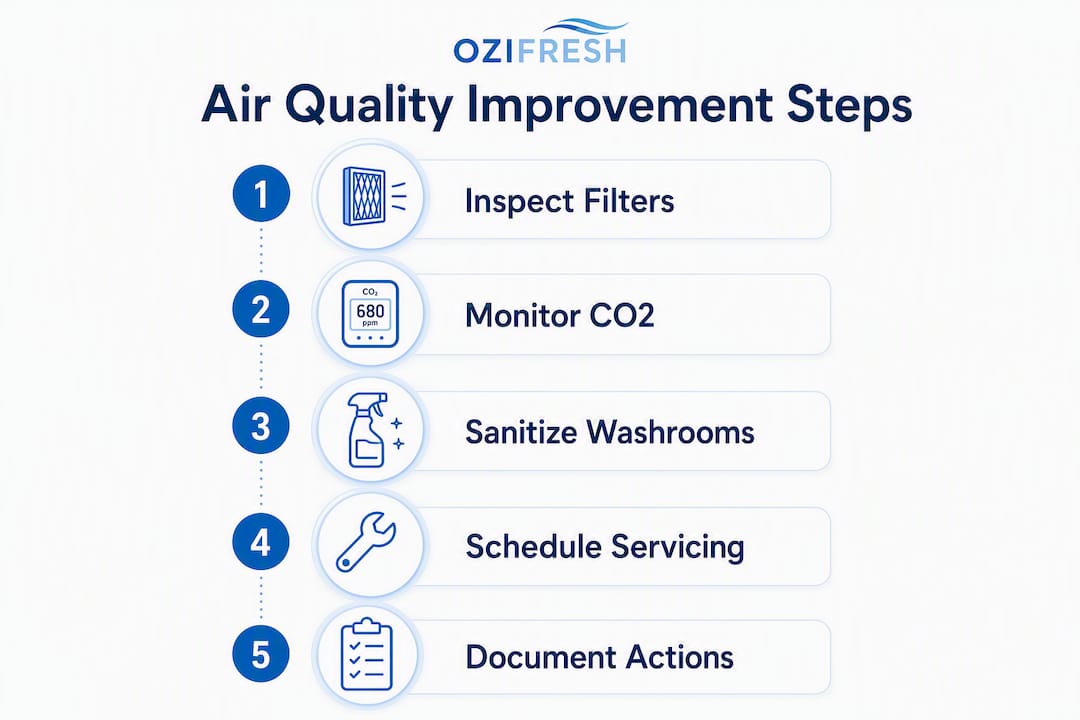
The hierarchy of controls applies directly here: eliminate the hazard source first, then substitute, then engineer controls (ventilation, filtration), then administrative measures, with PPE as a last resort. Administrative controls and PPE do not replace engineering solutions. A portable air freshener over a mouldy ceiling cavity is not a control measure.
Safe Work Australia’s exposure standards guidance is explicit: individual susceptibility varies, so exposure should be kept ALARP (as low as reasonably practicable), not simply kept below the published limit. That distinction matters for how you set monitoring trigger points.
The cost of inaction: Neglected cooling towers create conditions for Legionella bacteria, which causes Legionnaire’s disease. Poorly maintained HVAC systems accumulate moisture and mould, triggering remediation costs that dwarf the price of a scheduled service contract. Cooling towers must be designed and maintained to AS/NZS 3666 — this is a Code of Practice requirement, not a recommendation.
Low-cost steps to improve office air quality right now
Fix the source before you reach for filtration. That is the hierarchy of controls in practice.
- Adjust HVAC run schedules to increase fresh-air intake during occupied hours, and pre-ventilate for 30 minutes before staff arrive.
- Implement a window-use policy for perimeter offices: open when outdoor air quality is acceptable and temperature permits.
- Stagger occupancy or rotate desk assignments in dense zones to reduce CO2 build-up per square metre.
- Prohibit indoor smoking, strong aerosols, and scented candles in enclosed spaces. These are source-control measures, not lifestyle rules.
- Remove or relocate indoor plants in damp microclimates. Overwatered pots harbour mould, which then circulates through the HVAC.
- Switch washroom consumables to professional-grade toilet sanitisers and urinal sanitisers on a scheduled service cycle.
Professional washroom sanitation materially reduces both odour and airborne contaminants. Facilities managers consistently underestimate how much washroom hygiene drives overall occupant air-quality perception.
Pro Tip: Document every quick win in your WHS register the day you implement it. A dated log of actions taken is your evidence of ALARP compliance if a regulator or insurer asks. It also gives you a baseline to measure against when you commission IAQ monitoring.
What HVAC servicing must cover to protect air quality
Regular HVAC servicing is not optional maintenance. It is the primary engineering control for indoor air contaminants, and manufacturer-scheduled maintenance must be followed to discharge WHS obligations.
Key maintenance items your service contract must cover:
- Filter replacement: MERV-rated or pleated filters should be inspected regularly and replaced according to the manufacturer’s schedule, which varies based on occupancy and dust load.
- Coil cleaning: dirty evaporator and condenser coils reduce efficiency and become breeding grounds for mould and bacteria.
- Condensate drain checks: blocked drains cause moisture accumulation, the primary trigger for mould growth inside ductwork.
- Cooling tower maintenance: water testing, biocide programmes, and physical cleaning per AS/NZS 3666, audited at least annually. For practical detail on Legionella risk in commercial HVAC, the maintenance requirements are specific and non-negotiable.
- Fan and damper checks: confirm dampers open to the specified fresh-air fraction and fans deliver design airflow.
- Humidity control: target 40–60% relative humidity. Outside this range, either mould (high) or respiratory irritation (low) becomes a risk.
| HVAC task | Recommended frequency | WHS/compliance rationale |
|---|---|---|
| Filter inspection | Monthly | Prevents particulate recirculation; manufacturer requirement |
| Filter replacement | Every 3 months | Maintains airflow and filtration efficiency |
| Coil cleaning | Quarterly | Prevents mould and bacterial growth on coil surfaces |
| Condensate drain flush | Quarterly | Eliminates moisture source for mould |
| Cooling tower check | Quarterly + annual audit | AS/NZS 3666 compliance; Legionella risk management |
| Full system service | Annually | Manufacturer sign-off; WHS documentation |
SafeWork NSW is direct: skipping ventilation maintenance causes moisture and mould, and the cost of remediation is substantially higher than the cost of prevention.
What to measure and what the numbers should tell you
Measure CO2, relative humidity, and PM2.5 particulates. CO2 is the most practical ventilation proxy in office settings because it tracks directly with occupancy and fresh-air supply.

WorkSafe Victoria references AS 1668.2 guidance recommending a minimum of 10 L/s of outdoor air per person. Use CO2 as your field check: if levels climb steadily with occupancy and do not drop when HVAC is running, your fresh-air intake is insufficient.
Practical targets:
- CO2: set an operational trigger at 800 ppm. Above 1,000 ppm, ventilation is inadequate for the occupancy load. Aim ALARP rather than treating 1,000 ppm as an acceptable ceiling.
- Relative humidity: 40–60%. Persistent readings above 65% in any zone require investigation.
- PM2.5: follow the conservative approach the exposure standards guidance recommends. Any sustained elevation above background warrants source investigation before you reach for an air purifier.
Pro Tip: Correlate sensor spikes with your cleaning and occupancy schedule before calling a contractor. A CO2 spike at 9 AM that resolves by 10 AM is a pre-ventilation problem. One that persists all day is a fresh-air supply problem. The distinction saves you a service call.
For continuous monitoring, standalone CO2 and RH loggers are cost-effective in most offices. Integrate with your building management system if available, and use the logs in quarterly contractor performance reviews.
How to stop mould before it needs specialist remediation
Persistent moisture and musty odours are early red flags, not cosmetic issues. Treat them as a priority control point.
Prevention checklist:
- Inspect condensate drains monthly and after any extended HVAC shutdown.
- Check roof penetrations, pipe lagging, and window seals quarterly.
- Respond to any spill or flood event within 24 hours. Wet carpet or ceiling tiles left for 48 hours will grow mould.
- Maintain humidity below 60% in all occupied zones.
- Confirm HVAC condensate maintenance is documented in your service logs.
Signs that require a specialist, not just a clean: visible mould covering more than a localised patch, repeated occupant complaints of respiratory irritation in a specific zone, humidity that stays elevated despite HVAC operation, or any cooling-tower concern where Legionella is a health priority.
Cost perspective: Preventive HVAC servicing and scheduled hygiene rounds cost a fraction of mould remediation, which typically requires specialist contractors, temporary workspace relocation, and potential WHS incident reporting. The business case for a service contract is straightforward.
What your hygiene and IAQ service contract must include
A good contract covers scheduled HVAC servicing, filter supply, washroom sanitation, consumables, and clear reporting and response SLAs. Anything less leaves gaps in your WHS compliance evidence.
Contract checklist:
- Coverage: HVAC servicing (filters, coils, drains, cooling towers), washroom sanitation (toilet and urinal sanitisers, sanitary bins, air fresheners), hand hygiene consumables.
- Service frequency: defined intervals for each task, not “as required.”
- WHS/compliance documentation: manufacturer sign-off on servicing, AS/NZS 3666 compliance certificates for cooling towers, and maintenance logs retained per WHS record-keeping requirements.
- Response time: maximum response SLA for urgent remediation (e.g. 4 hours for a mould or water event).
- Pricing model: per-site or per-contract, with consumables included or clearly itemised.
- Reporting and certificates: monthly service reports, annual compliance certificates, and access to maintenance logs for WHS audits.
Questions to ask suppliers during tender:
- Can you provide sample maintenance logs from a comparable site?
- What is your documented process for AS/NZS 3666 cooling tower compliance?
- Who is the competent person carrying out ventilation inspections, and what are their qualifications?
- What is your response time SLA for urgent remediation events?
- Can you provide references from Australian commercial clients with similar occupancy profiles?
Competent persons and documented maintenance are both required under the Model Code of Practice. Ask for evidence, not assurances.
Understanding your WHS hygiene responsibilities before you go to tender puts you in a stronger position to evaluate proposals.
Sample maintenance schedule and realistic timelines
One practical cadence that balances compliance and operational reality:
| Task | Frequency | Typical labour time | Common follow-up |
|---|---|---|---|
| Washroom sanitation and consumable restock | Weekly | 1–2 hours per site | Consumable reorder if stock low |
| Air-freshener system service | Monthly | 30 minutes per unit | Refill or cartridge replacement |
| HVAC filter inspection | Monthly | 1 hour per system | Replace if loaded; log result |
| Condensate drain flush | Quarterly | 30–60 minutes | Investigate if blockage found |
| HVAC filter replacement | Every 3 months | 1–2 hours per system | Update maintenance log |
| Coil clean | Quarterly | 2–4 hours per system | Mould treatment if contamination found |
| Cooling tower check and water test | Quarterly | 2–3 hours | Biocide dosing; AS/NZS 3666 log entry |
| Full HVAC system service | Annually | Half to full day | Compliance certificate issued |
| Mould remediation (if triggered) | As required | 1–5 days depending on extent | Structural investigation if recurring |
Budget planning note: mould remediation timelines vary significantly with extent. A localised ceiling tile replacement takes a day. A ductwork contamination event can take a week and require temporary relocation of staff. Preventive servicing is the only reliable way to avoid that scenario.
Ozifresh: scheduled hygiene contracts for Australian workplaces
Facilities managers who want to improve workplace air quality and meet their WHS obligations need more than a one-off clean. They need a recurring contract with a provider who documents everything.
Ozifresh delivers hygiene services and consumables across Brisbane, the Gold Coast, and Melbourne, with over 40 years of Australian experience. The service scope covers washroom sanitation, air-freshener systems, sanitary bin collection, urinal and toilet sanitisers, and hand hygiene consumables. Every service visit is documented, giving you the maintenance logs your WHS records require.
For facilities managers tendering a hygiene contract, Ozifresh provides site-specific service schedules, compliance-aligned reporting, and rapid response for urgent remediation. The industry solutions page covers commercial offices, healthcare, education, hospitality, and managed properties. Request a site assessment to get a contract proposal mapped to your specific occupancy, compliance obligations, and budget.
Key takeaways
Improving office air quality in Australia starts with ventilation and a documented hygiene service contract. Every other measure is secondary to those two.
| Point | Details |
|---|---|
| WHS obligation is clear | PCBUs must manage airborne risks and service ventilation per manufacturer instructions under Australian WHS law. |
| CO2 is your ventilation proxy | Set an operational trigger at 800 ppm; investigate fresh-air supply before it reaches 1,000 ppm. |
| Cooling towers need AS/NZS 3666 compliance | Quarterly checks and annual audits are required; document everything for WHS records. |
| Contract must include reporting | Demand monthly service reports, compliance certificates, and maintenance logs as contract minimums. |
| Ozifresh covers the full scope | Scheduled washroom sanitation, air fresheners, and consumables across Brisbane, Gold Coast, and Melbourne. |
The compliance gap most facilities managers miss
The facilities managers who get IAQ right are not the ones with the most sophisticated sensor arrays. They are the ones who treat washroom sanitation and consumable servicing as a compliance function, not a cleaning cost.
Regulators and auditors look at maintenance logs first. A site with a modest HVAC system but complete, dated service records is in a far better position than one with premium equipment and no documentation. The ALARP obligation is not satisfied by good intentions. It is satisfied by evidence.
After 40 years of on-site servicing across Australian commercial properties, the pattern is consistent: the first complaint is usually odour, the second is a respiratory symptom, and by the time a specialist is called, the root cause has been present for months. Scheduled hygiene contracts, including washroom sanitation and air-freshener servicing, catch the early signals before they escalate. That is not a sales argument. It is what the data from site visits shows, repeatedly.
Useful sources for Australian facilities managers
- Safe Work Australia — managing risks from air pollution: the primary guidance for PCBUs on airborne hazard controls, hierarchy of controls, and ALARP obligations.
- Model Code of Practice — managing the work environment and facilities: covers ventilation design, natural ventilation requirements, air-conditioning standards, and cooling tower obligations including AS/NZS 3666.
- Workplace exposure standards for airborne contaminants (Safe Work Australia): defines exposure limits, ALARP requirements, and monitoring obligations for specific airborne substances.
- SafeWork NSW — ventilation at work: practical inspection checklists, competent-person requirements, and maintenance log guidance.
- WorkSafe Victoria — designing a healthy and safe working environment: references AS 1668.2 ventilation design guidance including the 10 L/s per person outdoor air target.
- AS/NZS 3666 SET:2011 — air-handling and water systems of buildings: the mandatory standard for cooling tower design, installation, and maintenance. Available through Standards Australia.
- AS 1668.2 — ventilation design for indoor air contaminant control: the technical standard for mechanical ventilation design referenced in the Model Code of Practice.
This article provides general information for facilities management purposes. Confirm current regulatory requirements with Safe Work Australia, your state regulator, or a qualified WHS professional for your specific workplace.
Recommended
Ready for a cleaner, safer workplace?
Contact our team today to discuss hygiene services for your business in Brisbane, Melbourne or the Gold Coast.