Healthcare sanitization steps: the 2026 compliance guide
TL;DR:
- Effective healthcare cleaning requires proper sequencing, adequate dwell times, and objective verification to prevent contamination. High-touch areas need frequent disinfection, with procedures supported by staff training, accurate documentation, and specialized protocols for spills and terminal cleans. Relying solely on visual checks risk incomplete pathogen removal; tools like ATP testing and time audits ensure true decontamination and compliance.
Routine cleaning that looks thorough can still leave a ward dangerously contaminated. That gap between appearance and actual pathogen kill is where healthcare-associated infections take hold, and it happens far more often than most facility managers realise. Getting the healthcare sanitization steps right is not about working harder; it is about sequencing correctly, applying disinfectants properly, and verifying the outcome with objective tools. This guide covers preparation, step-by-step execution, quality assurance, and troubleshooting, giving you a practical framework grounded in current evidence and Australian compliance expectations.
Table of Contents
- Key takeaways
- Preparation essentials for healthcare sanitization
- Step-by-step execution of cleaning and disinfecting
- Verification and quality assurance
- Troubleshooting common sanitization challenges
- My take on what healthcare sanitization gets wrong
- How Ozifresh supports healthcare hygiene compliance
- FAQ
Key takeaways
| Point | Details |
|---|---|
| Clean before you disinfect | Organic matter blocks disinfectant activity, making the two-step sequence non-negotiable in every setting. |
| Dwell time is mandatory | Surfaces must stay visibly wet for the full contact period, which can range from 30 seconds to 10 minutes. |
| High-touch surfaces need priority | Bed rails, call buttons, and restroom fixtures require multiple disinfecting rounds daily based on patient traffic. |
| Verification goes beyond visual checks | ATP testing and time audits provide objective evidence of cleaning effectiveness that visual inspection cannot. |
| Written protocols protect compliance | Task-specific procedures for bloodborne pathogen spills, terminal cleans, and high-risk areas are a regulatory requirement, not optional. |
Preparation essentials for healthcare sanitization
Before any cloth touches a surface, the groundwork you lay determines whether your cleaning protocols in healthcare will actually reduce infection risk or simply move contamination around. Preparation is where most programmes quietly fail.
Understanding your surfaces and contamination risk
Not all surfaces carry equal risk. High-touch zones such as bed rails, call buttons, IV poles, doorknobs, and restroom fixtures are primary transmission points. CDC guidance recommends multiple daily disinfecting rounds for these surfaces in high-traffic clinical areas. Low-touch surfaces like ceiling tiles and walls can follow a weekly or as-needed schedule. Mapping your facility by contact frequency and patient acuity gives you a prioritised cleaning schedule that allocates effort where it matters most.
Selecting the right disinfectants
Disinfectant selection is a compliance decision as much as a practical one. Products must be EPA-registered, with label instructions specifying dilution ratios, pathogen coverage, and required contact time. Read those labels carefully because the pathogen spectrum varies significantly between products. A quaternary ammonium compound effective against most bacteria may not cover Clostridioides difficile spores, which require a sporicidal agent. Match the product to the actual pathogens present in each care area.
Assembling tools and PPE
Your cleaning team needs colour-coded microfibre cloths to prevent cross-contamination between zones, appropriate PPE including gloves, gown, and eye protection where splash risk exists, and clearly labelled solution containers with correct dilutions prepared fresh. Expired or improperly diluted disinfectants are a common and entirely avoidable failure point.
- Colour-coded cloths and mop heads by zone (clinical, bathroom, common area)
- Appropriate PPE matched to the risk level of the area being cleaned
- Freshly prepared disinfectant solutions at correct label dilutions
- Microfibre or single-use cloths rather than reusable cotton rags
- A printed cleaning schedule pinned to each trolley, showing surface priorities and frequencies
Pro Tip: Never prepare disinfectant solutions in bulk at the start of a shift and use them all day. Many formulations degrade within hours of dilution. Check your product label for solution stability and prepare fresh batches accordingly.
Staff training is the final preparation element and arguably the most important. Best-practice programmes incorporate both microbiology fundamentals and hands-on technique training so staff understand why each step matters, not just what to do. That understanding is what prevents shortcuts under time pressure.
Step-by-step execution of cleaning and disinfecting
Knowing the correct sequence is one thing. Executing it consistently across every shift, every room, and every surface category is the real operational challenge. Here is the workflow that aligns with current sanitization best practices.
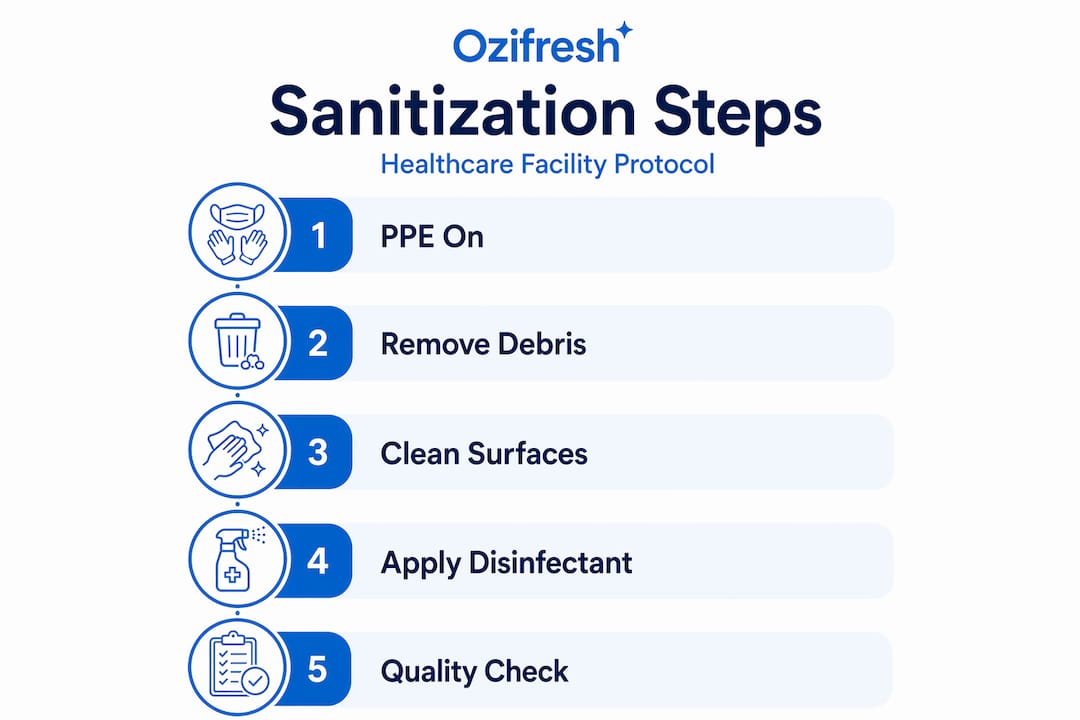
- Don PPE before entering any clinical space. Gloves must be changed between rooms. Eye protection is required where aerosol or splash risk exists.
- Remove visible debris and clutter from surfaces. Pick up disposables, clear bedside tables, and remove any items that will obstruct access to cleanable surfaces.
- Clean all surfaces with a detergent solution, working top to bottom and from clean areas toward dirtier zones. This removes the organic soil that blocks disinfectant efficacy if skipped.
- Allow the surface to dry or wipe dry with a clean cloth before applying disinfectant, depending on your product’s instructions.
- Apply the EPA-registered disinfectant using a fresh cloth or wipe, again working top to bottom and clean to dirty. Apply enough product to keep the surface visibly wet.
- Maintain visible wetness for the full dwell time. Contact time ranges from 30 seconds to 10 minutes depending on the product and target pathogen. Do not wipe dry before this period expires.
- Address high-touch surfaces last within the clean zone, then dispose of cloths and change gloves before moving to the next room.
- Perform hand hygiene after removing gloves, every time, without exception.
Pro Tip: Set a physical timer when applying disinfectant to surfaces in isolation rooms or post-discharge terminal cleans. Under workload pressure, staff consistently underestimate elapsed time. A timer removes the guesswork entirely.
Handling blood and OPIM spills
Bloodborne pathogen contamination requires a separate protocol. OSHA mandates written, task-specific procedures covering PPE requirements, surface type, soil volume, and the disinfectant or diluted bleach solution to be used. The written procedure must be readily accessible to cleaning staff, not filed away in a compliance folder. Absorbent material is applied first to contain the spill, removed and bagged as biohazardous waste, and only then is the disinfectant applied at the appropriate concentration and dwell time.
Terminal cleaning after discharge or isolation
Terminal cleaning is the most thorough form of decontamination in a ward setting. It requires preparation and specific staff training to prevent recontaminating the room before the next patient is admitted. The sequence is consistent: remove all linen and disposables, clean and disinfect all surfaces top to bottom including bed frame, mattress, and pillow, replace curtains where indicated, and clean the floor last. Removing unnecessary equipment and fabrics before starting reduces the number of hard-to-reach zones and directly improves outcomes.

| Surface category | Recommended frequency | Notes |
|---|---|---|
| Bed rails, call buttons, IV poles | Multiple times daily | Frequency increases with patient acuity and contact volume |
| Bathroom fixtures and door handles | At least twice daily | After each patient use in isolation settings |
| Bedside tables, overbed tables | At least once per shift | Terminal clean on discharge |
| Floors in clinical areas | Once per shift minimum | More frequently after spills or high traffic |
| Low-touch surfaces (walls, ceilings) | Weekly or as needed | After visible soiling or discharge of infectious patients |
For a detailed workplace disinfection workflow that maps to these principles, the Ozifresh resource library is a practical starting point.
Verification and quality assurance
Completing a clean is not the same as verifying that it worked. Healthcare facilities that rely solely on visual inspection are missing the greater part of the picture. Objective verification tools such as ATP bioluminescence meters provide measurable evidence of organic residue and therefore cleaning adequacy. ATP testing should be performed on high-touch surfaces on a rotating schedule and results documented with pass or fail thresholds defined in advance.
Time audits serve a complementary function. They confirm that sufficient time was allocated for each room or surface category and flag when workload is being managed at the expense of thoroughness. If a terminal clean that should take 45 minutes is being completed in 20, that is a systems problem, not purely a training problem.
Documentation requirements in healthcare sanitization include:
- Signed checklists for each cleaning event, including the date, time, surfaces covered, and products used
- Deviation records when protocols cannot be followed as written, with the reason noted
- ATP test results logged against surface location and shift
- Staff competency assessment records updated at least annually
- A corrective action log for any failed audits or inspection findings
Environmental cleaning management frameworks that incorporate these documentation elements reduce the administrative burden at accreditation time because the evidence is already compiled.
Regular quality reviews tie these data streams together. Monthly reviews of ATP results, audit scores, and deviation records allow you to identify patterns, for example, a particular shift consistently undercleaning bathroom fixtures, before those patterns create an infection incident.
Troubleshooting common sanitization challenges
Even well-designed systems encounter friction. Knowing where breakdowns typically occur gives you a faster path to resolution.
- Disinfectant drying before dwell time completes. This is the single most common operational failure in clinical environments. Mitigation requires standardising how much product is applied per surface area, training staff to recognise visible wetness as a non-negotiable marker, and selecting products with longer dwell times for large or porous surfaces.
- Fabric and soft furnishings. Chairs with fabric upholstery, curtains, and mattress seams are genuinely difficult to disinfect. Where possible, replace fabric with wipeable materials in clinical spaces. For existing fabric, follow manufacturer-approved disinfection methods and flag items for laundering on a defined schedule.
- High patient turnover areas. When discharge rates are high, the pressure to turn rooms quickly competes directly with thorough terminal cleaning. The solution is not to shorten the clean; it is to roster sufficient cleaning staff during peak discharge periods.
- Chemical incompatibility. Some disinfectants degrade certain plastics or coatings on medical equipment. Always verify compatibility between your chosen disinfectant and the equipment manufacturer’s guidance on how to sanitize medical equipment correctly before adopting any new product facility-wide.
- Bloodborne pathogen response readiness. Staff who rarely encounter spills may be uncertain about the correct procedure when one occurs. Conduct scenario-based training drills at least twice yearly so the protocol is rehearsed, not read for the first time under pressure.
Thorough sanitization in healthcare is not achievable through goodwill and effort alone. It requires precise chemistry, correct sequencing, adequate dwell time, and objective verification. Every element depends on the others.
My take on what healthcare sanitization gets wrong
I have seen highly committed cleaning teams in well-resourced facilities still fall short on infection control because one element of the process was treated as optional. In my experience, dwell time is the step that gets sacrificed most often, and it is the step that matters most chemically.
Staff are not cutting corners out of laziness. They are managing real workload pressure. But when a disinfectant wipe is applied and immediately rubbed dry, you have spent the time, the product, and the PPE to achieve almost nothing. The chemistry simply has not had time to work. Visible wetness for the full contact period is not a preference; it is the mechanism of kill.
What I have also found is that terminal cleaning is consistently underestimated as a complexity. It is often assigned to less experienced staff because it looks like a longer version of a routine clean. It is not. Terminal cleaning requires specific preparation and training to prevent recontamination, and the consequences of getting it wrong fall entirely on the next patient admitted to that room.
The facilities that get sanitization right treat it as a clinical function, not a domestic one. They invest in staff training, use ATP verification rather than visual sign-off, and review their data monthly. That discipline is what separates compliance on paper from compliance in practice.
— Ozifresh
How Ozifresh supports healthcare hygiene compliance
Ozifresh has delivered professional hygiene solutions to healthcare facilities across Brisbane, the Gold Coast, and Melbourne for over 40 years. The team understands the specific compliance obligations, patient safety priorities, and operational pressures that facility managers in clinical settings face every day. Their hygiene and sanitary services are configured for healthcare environments and include hospital-grade sanitary disposal, hand hygiene product supply, sharps and nappy disposal, and hygiene consumables sourced from reputable suppliers. For aged care and nursing home settings, Ozifresh also provides specialised nursing home hygiene programmes tailored to the unique demands of continuous-care environments. If your facility needs a reliable partner to maintain hygiene standards between internal cleaning cycles, contact the Ozifresh team to discuss a service plan built around your compliance requirements.
FAQ
What are the basic healthcare sanitization steps?
The core sequence is: don PPE, remove debris, clean surfaces with detergent to remove organic soil, apply an EPA-registered disinfectant, maintain visible wetness for the full dwell time, and document the procedure. Cleaning must always precede disinfection.
Why does dwell time matter so much in hospital cleaning procedures?
Disinfectants require contact with a surface for a defined period, ranging from 30 seconds to 10 minutes, to kill target pathogens. Wiping the surface dry before that time elapses compromises the kill rate, regardless of the product used.
How often should high-touch surfaces be disinfected in a clinical setting?
High-touch surfaces including bed rails, call buttons, and door handles should be disinfected multiple times daily, with frequency increasing based on patient acuity and area traffic volume.
What verification tools should facility managers use beyond visual inspection?
ATP bioluminescence testing and time audits provide objective evidence of cleaning thoroughness. Visual inspection alone cannot confirm that surfaces are free of organic residue or that dwell times were observed.
When is terminal cleaning required?
Terminal cleaning is required after every patient discharge and after any patient under infectious disease isolation vacates a room. It involves a full top-to-bottom decontamination of all surfaces, fixtures, and equipment in the space before the next patient is admitted.
Recommended
Ready for a cleaner, safer workplace?
Contact our team today to discuss hygiene services for your business in Brisbane, Melbourne or the Gold Coast.