Explaining washroom safety: a guide for facility managers

TL;DR:
- Washroom safety involves hazard prevention, accessible design, and hygiene maintenance to protect all users. Proper flooring, grab bars, layout, lighting, and hygiene protocols are essential to prevent injuries and contamination. Ongoing management, regular audits, and staff training ensure compliance and promote dignity for every user.
Washroom safety is defined as the systematic combination of hazard prevention, accessible design, and hygiene maintenance that protects every person who uses a facility’s bathroom. For facility managers, safety officers, and educators, getting this right is not optional. Slip and fall incidents, infectious contamination, and accessibility failures carry real legal, financial, and human costs. The core principles of washroom safety span slip-resistant flooring, correctly installed grab bars, compliant fixture heights, adequate lighting, and structured cleaning protocols. This guide covers each of those elements with the specificity your role demands.
What is explaining washroom safety and why does it matter?
Washroom safety is the practice of identifying, controlling, and eliminating hazards in bathroom environments to prevent injury and illness. The hazards fall into two broad categories: physical risks such as slips, trips, and falls, and biological risks such as pathogen transmission through contaminated surfaces and poorly maintained sanitary equipment.
Bathroom falls cause serious injury, particularly to older adults, due to the high-energy impact of falling on hard, wet surfaces. This means that in aged care facilities, hospitals, and any environment serving older or mobility-impaired users, washroom safety is directly linked to clinical outcomes, not just compliance scores.
Facility owners carry legal responsibility for washroom accessibility and safety compliance, regardless of whether a professional designer specified the original fitout. Frequent audits and proactive maintenance are the mechanism that keeps daily operations within those legal obligations. Knowing the standards, applying them consistently, and documenting the process is the baseline expectation for any safety officer managing a public or commercial washroom.
What are the key physical hazards in washrooms and how can they be mitigated?
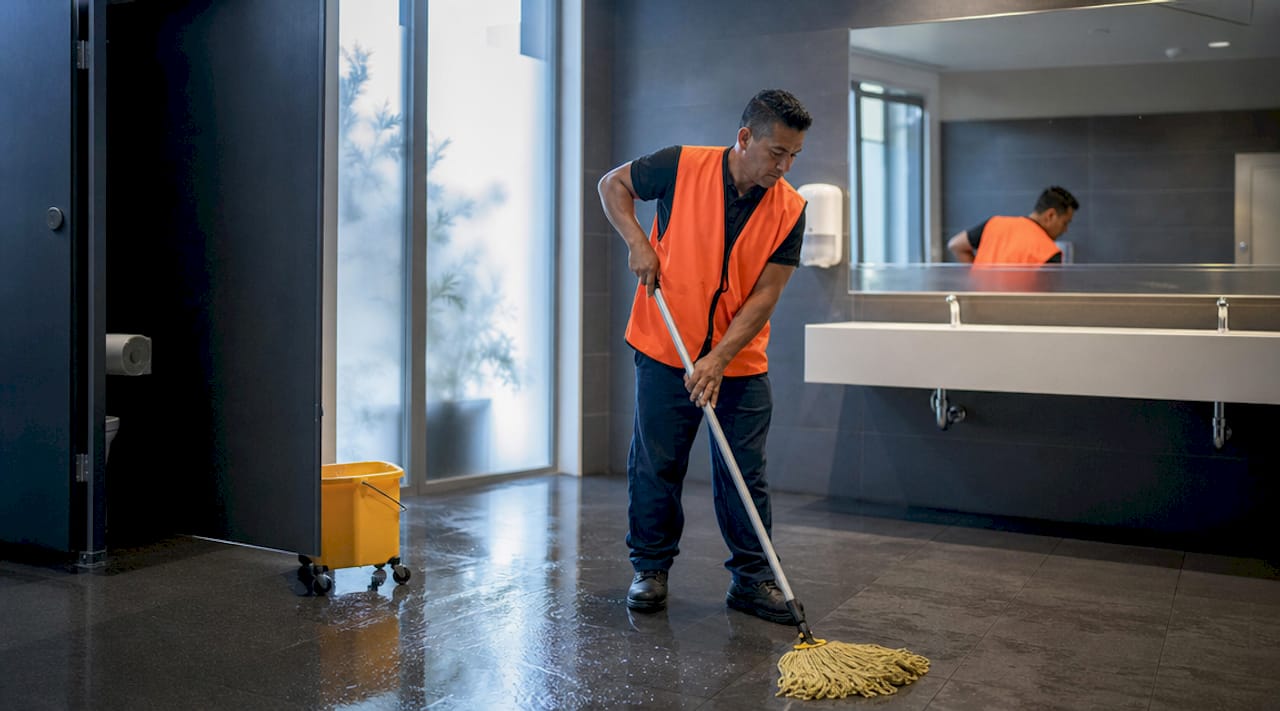
Wet surfaces are the primary physical hazard in any washroom. Slip-resistant flooring must achieve a DCOF of 0.42 or higher in wet areas to meet current industry standards. A DCOF below that threshold means the floor is statistically more likely to cause a fall under normal wet conditions, which is a liability no facility manager should accept.
Grab bars are the single most effective fixed intervention for fall prevention, but only when installed correctly. Grab bars require 1.5 inch clearance from walls and must withstand a minimum of 250 pounds of force. Critically, towel racks are not a substitute. Towel racks do not support body weight and can actually worsen a fall by giving way under load. Successful installation requires wooden blocking between wall studs and corrosion-resistant fasteners to maintain structural integrity over time.

Fixture height is another frequently overlooked variable. Toilet seat heights between 17 and 19 inches allow safe, stable transfers for users with limited lower-body strength or mobility aids. Operable hardware such as taps, door handles, and dispensers must also satisfy the closed fist test, meaning a user should be able to operate them without gripping, pinching, or twisting.
Lighting compounds every other hazard when it is inadequate. Bright, motion-activated lighting with high contrast improves visibility and reduces accident rates. Using contrasting colours for grab bars against wall tiles also helps users with low vision locate them quickly.
| Hazard | Standard or specification | Mitigation |
|---|---|---|
| Wet floor surfaces | DCOF 0.42 or higher | Slip-resistant tiles, non-slip mats |
| Grab bar failure | 250 lb minimum load capacity | Stud-backed installation, correct fasteners |
| Incorrect toilet height | 17 to 19 inches seat height | Compliant pan or raised seat |
| Poor visibility | Motion-activated, high-contrast lighting | LED sensors, contrasting fixture colours |
| Inaccessible hardware | Closed fist test compliance | Lever taps, push-button dispensers |
Pro Tip: When specifying new flooring, request the manufacturer’s DCOF test certificate for wet conditions specifically. Dry DCOF ratings are significantly higher and will not reflect real-world washroom performance.
How does washroom layout and design affect safety and accessibility?
Layout determines whether a washroom is physically usable by everyone, including wheelchair users, people with walking frames, and those with temporary injuries. The minimum clear floor space requirement is a 60-inch diameter turning circle or a T-shaped equivalent, which allows a standard wheelchair to complete a full turn without obstruction. This is a non-negotiable compliance requirement under ADA and ICC A117.1 standards, both of which inform Australian accessible design practice.
Door width measurement must occur at the 90-degree open position to accurately assess wheelchair clearance. A door that appears wide enough when partially open may still fail compliance when measured correctly. This is a common audit finding that results in costly retrofits.
The placement of hand dryers, soap dispensers, sanitary bins, and waste receptacles matters more than most facility managers realise. Objects that reduce required clear floor space create compliance violations even when the fixed fixtures meet standard dimensions. A sanitary bin placed in the transfer zone beside a toilet, or a hand dryer mounted at an obstructing height, can fail an audit despite a correctly specified fitout.
The following layout principles apply to any compliant washroom:
- Maintain the 60-inch turning circle free of all temporary and permanent obstructions
- Position dispensers and dryers within the reach range of 15 to 48 inches from the floor
- Keep transfer zones beside accessible toilets completely clear of bins, furniture, and equipment
- Measure door clearance at 90 degrees open, not at the door frame width
- Confirm that accessible washroom design supports user dignity and independence, not just minimum compliance
| Design element | Non-compliant scenario | Compliant solution |
|---|---|---|
| Turning radius | Bin placed in wheelchair path | 60-inch circle kept permanently clear |
| Door width | Measured at frame, not at 90 degrees open | Measured at full open position |
| Dispenser height | Mounted above 48 inches | Positioned within 15 to 48 inch reach range |
| Transfer zone | Sanitary bin beside accessible toilet | Transfer zone kept completely unobstructed |
Which hygiene protocols and maintenance practices are essential for washroom safety?
Physical safety features protect users from injury, but hygiene protocols protect them from illness. Regular cleaning and maintenance of hygiene equipment including dispensers, hand dryers, and sanitary bins prevents the build-up of mould, grime, and infectious pathogens that create biological hazards. Professional hygiene services also support legal compliance and reduce user complaints, which are often the first signal that a maintenance gap exists.
A structured hygiene programme for washrooms should follow these steps:
- Establish a cleaning schedule based on usage frequency. High-traffic washrooms in commercial buildings, schools, or healthcare facilities require multiple cleans per day, not just end-of-day servicing.
- Train cleaning staff on the correct sequence for washroom cleaning, including surface-to-floor order, correct dilution of disinfectants, and the difference between cleaning and disinfecting.
- Service all dispensers and sanitary bins on a fixed rotation. Empty or non-functional soap dispensers are a hand hygiene failure point that directly increases pathogen transmission risk.
- Inspect fixtures during every clean. Cleaning staff are the most frequent washroom visitors and the most likely to notice a loose grab bar, a cracked tile, or a blocked drain before it becomes a safety incident.
- Integrate hygiene audits with safety audits. A washroom that passes a safety inspection but fails a hygiene check is still a liability. Both disciplines must be assessed together.
- Act on user feedback within 24 hours. Responsive user feedback mechanisms significantly improve ongoing facility safety standards. A QR code feedback system or a simple log sheet near the entrance captures issues before they escalate.
Pro Tip: Assign a named staff member to each washroom zone rather than a general cleaning team. Named accountability produces faster response times and more consistent standards.
Understanding your WHS hygiene responsibilities under Australian workplace health and safety legislation is the foundation for building any credible hygiene maintenance programme.
What practical steps can facility managers take to ensure ongoing washroom safety?
Ongoing washroom safety requires a system, not a one-time fitout. Fall risks correlate to the interaction between environment and user mobility rather than to any single isolated hazard. This means a washroom that is safe for a healthy adult may still be dangerous for a user with reduced mobility, and your safety programme must account for the full range of users your facility serves.
The following steps form a repeatable safety management cycle:
- Conduct quarterly safety audits that assess flooring condition, grab bar integrity, fixture heights, lighting function, and layout compliance. Document findings and corrective actions with dates.
- Educate staff on hazard recognition. Cleaning and maintenance staff should be trained to identify worn floor surfaces, loose fittings, and blocked access zones and to report them immediately rather than waiting for a scheduled inspection.
- Implement a hazard reporting system. A digital log, a physical maintenance book, or a facilities management platform all work. The critical factor is that reports are acknowledged and resolved within a defined timeframe.
- Invest in durable, purpose-built equipment. Specify commercial-grade grab bars, slip-resistant floor tiles rated for wet areas, and sensor-activated lighting from the outset. Retrofitting is always more expensive than specifying correctly.
- Review your washroom safety programme after any incident. Near-misses and complaints are data. Use them to identify systemic gaps rather than treating each event as isolated.
- Apply hygiene compliance strategies that align with Australian regulatory expectations to keep your facilities audit-ready at all times.
Low-cost modifications such as non-slip mats and correctly installed grab bars can prevent the majority of washroom falls. Safety modifications between $50 and $500 address the most common fall hazards, which means budget constraints are rarely a valid reason to delay action on identified risks.
Key takeaways
Effective washroom safety requires layered intervention across physical design, hygiene maintenance, and management systems, not any single fix applied in isolation.
| Point | Details |
|---|---|
| Flooring specification | Specify slip-resistant flooring with a DCOF of 0.42 or higher for all wet areas. |
| Grab bar installation | Anchor grab bars to wall studs with correct fasteners; never substitute towel racks. |
| Layout compliance | Keep the 60-inch turning circle permanently clear of bins, furniture, and equipment. |
| Hygiene maintenance | Service dispensers and sanitary bins on a fixed schedule and train staff on correct cleaning sequences. |
| Ongoing audits | Conduct quarterly safety audits, document findings, and resolve corrective actions within a defined timeframe. |
What facility managers often get wrong about washroom safety
After working alongside facility teams across commercial, healthcare, and educational environments, the pattern I see most often is not ignorance of the standards. It is the assumption that a compliant fitout stays compliant without active management. A washroom that passed its accessibility audit three years ago may now have a sanitary bin blocking the transfer zone, a grab bar with a loose fastener, and a soap dispenser that has been empty for two days. None of those failures show up on the original compliance certificate.
The second pitfall is treating physical safety and hygiene as separate programmes with separate owners. In practice, they are inseparable. A wet floor caused by a blocked drain is both a hygiene failure and a slip hazard. A non-functional hand dryer increases surface contamination and also creates a crowding hazard near paper towel dispensers. The most effective safety programmes I have seen assign joint accountability, where the person responsible for the cleaning schedule also signs off on the safety inspection.
The third issue is dignity. Washroom safety integrates physical hazard control with dignity and independence for users with disabilities. A washroom that is technically compliant but poorly maintained, poorly lit, or difficult to navigate sends a clear message to users with mobility challenges that their needs are an afterthought. Proactive leadership in this space means designing and maintaining washrooms that work well for everyone, not just meeting the minimum standard and moving on.
— Ozifresh
How Ozifresh supports safer washrooms across Australia
Ozifresh delivers professional hygiene and sanitary services to facilities across Brisbane, the Gold Coast, and Melbourne, with over 40 years of experience supporting industries where washroom safety is non-negotiable. Their services cover nursing homes, service stations, and residential complexes, providing sanitary bin servicing, hand hygiene product supply, and regular maintenance programmes tailored to each facility’s usage profile. For facility managers who need a reliable partner to maintain compliant, hygienic washrooms without managing every detail in-house, Ozifresh provides the systems, products, and scheduled servicing that keep facilities audit-ready. Explore Ozifresh’s full range of hygiene services and products to find the right solution for your environment.
FAQ
What is the minimum DCOF rating for washroom flooring?
Slip-resistant flooring in wet areas must achieve a Dynamic Coefficient of Friction of 0.42 or higher to meet current industry standards. This rating applies specifically to wet conditions, so always request wet-condition test data from flooring suppliers.
Can a towel rack be used as a grab bar in a washroom?
Towel racks cannot substitute for grab bars because they are not structurally designed to bear body weight and will fail under load, potentially worsening a fall. Compliant grab bars must withstand a minimum of 250 pounds of force and be anchored to wall studs with appropriate fasteners.
How often should facility managers audit washroom safety?
Quarterly safety audits are the recommended minimum, with additional checks following any incident or user complaint. Audits should assess flooring condition, grab bar integrity, fixture heights, lighting function, and layout compliance, with all findings documented and actioned within a defined timeframe.
What layout requirement applies to accessible washrooms?
Accessible washrooms must maintain a clear floor space of at least 60 inches in diameter to allow a wheelchair to complete a full turn. Temporary objects such as bins or furniture placed within this zone create compliance violations even when the fixed fixtures meet standard dimensions.
How do hygiene protocols connect to washroom safety?
Hygiene maintenance and physical safety are directly linked because failures in one area create hazards in the other. A blocked drain creates a wet floor slip hazard, and a non-functional soap dispenser increases pathogen transmission risk. Integrating hygiene and safety audits under shared accountability produces the most consistent outcomes.
Recommended
- Workplace sanitation explained: Steps for safer facilities | Ozifresh
- Hygiene compliance explained: Strategies for safer Australian facilities | Ozifresh
- Professional hygiene for safer workplaces: What managers need to know | Ozifresh
- Sanitary bin compliance: Essential rules and best practices | Ozifresh
Ready for a cleaner, safer workplace?
Contact our team today to discuss hygiene services for your business in Brisbane, Melbourne or the Gold Coast.