Explaining regulatory hygiene standards for compliance

TL;DR:
- Regulatory hygiene compliance encompasses a broad system of controls including staff health, procedures, and microbial reduction, not just visible cleanliness.
- Effective hygiene programs require documented evidence, clear policies, staff training, and validation of microbial reduction targets, such as a 5-log pathogen elimination standard.
Explaining regulatory hygiene standards to a room of managers often uncovers a shared misconception: that hygiene compliance is mostly about looking clean. Wipe down the surfaces, mop the floors, done. In reality, what is regulatory hygiene compliance encompasses a far broader system of controls. Formal hygiene regulation spans staff health management, documented procedures, microbial reduction targets, and evidence of ongoing training. The industry term you will encounter most frequently across audits and legislative frameworks is hygiene compliance management. This article walks you through the full scope, from the legal foundations through to the operational controls that actually determine whether your facility passes or fails.
Table of Contents
- Key takeaways
- Explaining regulatory hygiene standards: scope and legal foundations
- Personal hygiene requirements and staff health controls
- Cleaning, sanitising, and microbial reduction standards
- Food hygiene rating schemes: what compliance officers must know
- Practical strategies for sustained hygiene compliance
- My perspective on what compliance officers get wrong
- How Ozifresh supports your hygiene compliance programme
- FAQ
Key takeaways
| Point | Details |
|---|---|
| Hygiene is more than cleanliness | Regulatory standards cover staff health, documented procedures, and microbial control, not just visible tidiness. |
| Microbial targets matter | A 5-log reduction standard means 99.999% pathogen elimination and is a measurable compliance benchmark. |
| Staff exclusion policies are mandatory | Food handlers must remain off work for 48 hours after symptoms of vomiting or diarrhoea resolve. |
| Rating schemes penalise weak links | The lowest-scoring category caps the overall hygiene rating, so one gap cancels strong performance elsewhere. |
| Documentation is evidence | Auditors require proof of training, cleaning logs, and validated procedures, not just a tidy facility. |
Explaining regulatory hygiene standards: scope and legal foundations
Regulatory hygiene standards are the legally enforceable requirements that govern how organisations control contamination risks in their environments, processes, and workforce. They exist across multiple sectors including food production, healthcare, hospitality, retail, and residential facilities, and the specific legislation varies by industry. In Australia, the Food Standards Code sits alongside state food safety laws, workplace health and safety legislation, and sector-specific guidelines from bodies such as Safe Work Australia.
The most influential international framework underpinning hygiene compliance is HACCP, Hazard Analysis and Critical Control Points. HACCP-based procedures are legally mandated to be proportionate to business size and risk profile, with Article 5 of Regulation (EC) 852/2004 requiring documented hazard analysis and control systems. While that regulation applies directly in the UK, Australian food businesses operate under equivalent requirements through the Australia New Zealand Food Standards Code, and the HACCP principles are universally referenced in audits here.
Hygiene standards at their core address four interconnected areas:
- Physical contamination control: Equipment cleaning, surface sanitation, and waste management
- Microbial control: Reducing pathogen loads through validated sanitising and disinfection processes
- Environmental hygiene: Air quality, water quality, pest management, and facility maintenance
- Staff hygiene and health: Personal hygiene practices, protective clothing, and illness exclusion protocols
Pro Tip: When reading any hygiene regulation, identify which of these four areas it addresses. This prevents the common error of treating a cleaning schedule as your entire hygiene compliance programme.
Understanding hygiene regulations requires recognising that each area carries its own evidence requirements. A food safety audit will assess all four simultaneously.
Personal hygiene requirements and staff health controls
This is the compliance area most frequently underweighted by managers, and it is the one most likely to cause a contamination event. Personal hygiene is not simply about staff washing their hands before touching food. It encompasses a full set of behavioural controls that determine whether an individual is even safe to be at work.
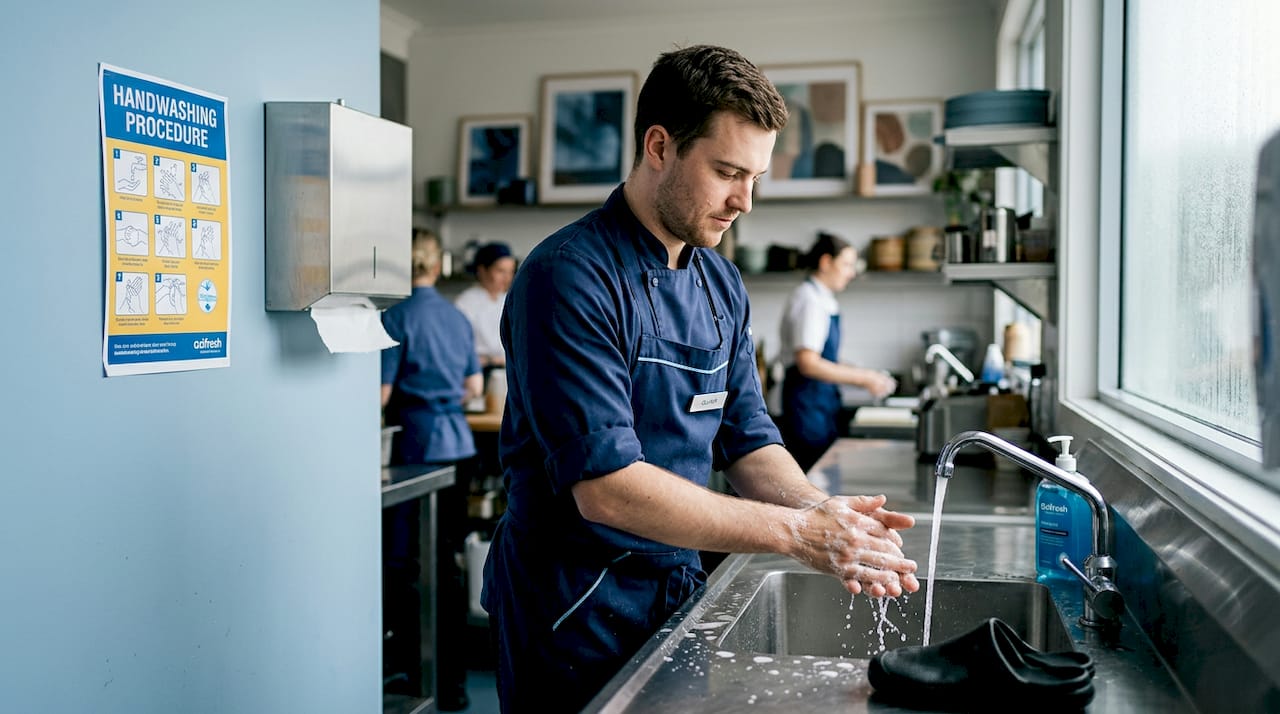
Victorian government guidance operationalises this clearly. Food handlers must exclude themselves from work while experiencing vomiting or diarrhoea, and must remain symptom-free for 48 hours before returning. Illnesses warranting exclusion include viral gastroenteritis and hepatitis A and E. The rationale is straightforward: an asymptomatic person who has just recovered is still shedding pathogens at levels capable of causing illness in others.
To build a compliant personal hygiene system, work through these requirements in order:
- Establish a written illness exclusion policy that names specific symptoms and minimum exclusion periods, referenced against current health authority guidance for your sector.
- Create a reporting mechanism where staff can notify supervisors of symptoms without fear of financial penalty for missing a shift.
- Define return-to-work criteria clearly, specifying that symptom-free means at least 48 hours without any episode of vomiting or diarrhoea.
- Set protective clothing standards appropriate to each role: hair restraints, gloves, clean uniforms, and footwear requirements must be documented and enforced consistently.
- Document handwashing protocols with step-by-step procedure cards at relevant stations, specifying minimum wash duration, soap type, and drying method.
Compliance failures frequently arise from poorly communicated illness policies and the absence of fitness-for-duty thresholds tied to exclusion criteria. Staff who are unaware of the rules, or who feel financially pressured to attend work while unwell, represent one of the highest contamination risks in any facility.
Pro Tip: Run an anonymous survey once a year asking staff whether they have ever attended work while unwell. The results will tell you far more about your real compliance posture than your written policy ever could.
Cleaning, sanitising, and microbial reduction standards
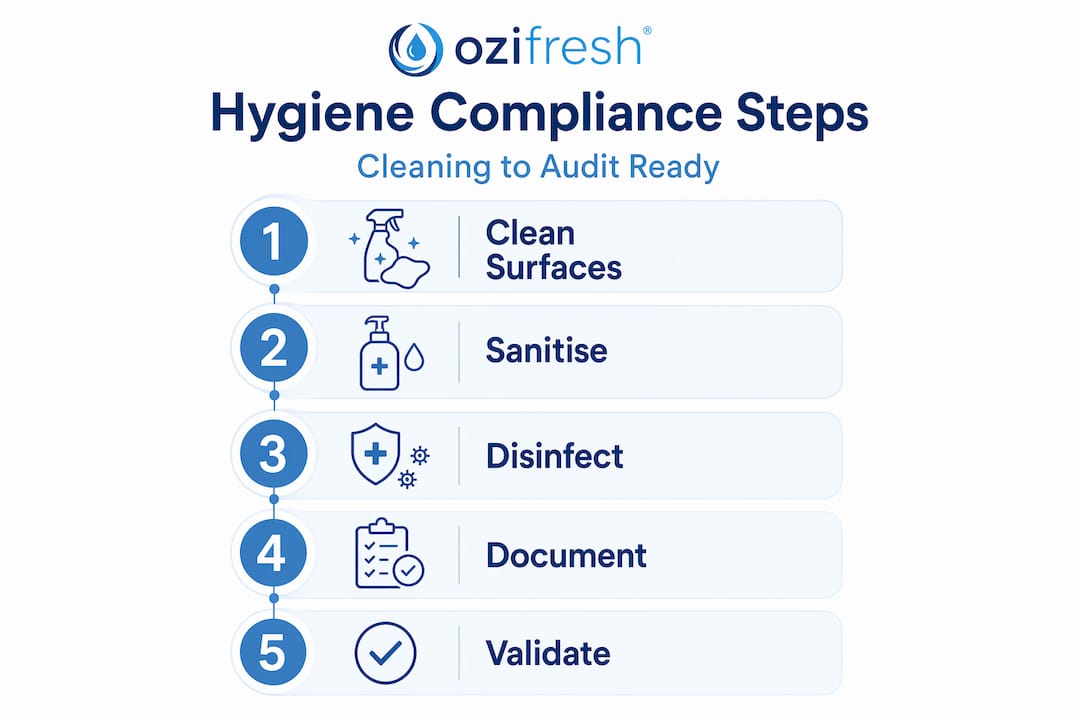
Compliance officers regularly encounter the terms cleaning, sanitising, and disinfection used interchangeably. They are not the same thing, and using the wrong process for the wrong situation is both a food safety risk and a compliance gap.
| Process | What it does | Regulatory role |
|---|---|---|
| Cleaning | Removes physical soils, grease, and organic matter | Prerequisite for sanitising to work effectively |
| Sanitising | Reduces bacterial loads to a target level on a pre-cleaned surface | Required for food contact surfaces; defined by microbial reduction targets |
| Disinfection | Kills a broader spectrum of microorganisms including viruses and fungi | Required in healthcare settings and during outbreak response |
Sanitising and disinfecting differ in their microbial spectrum and intended application. A sanitiser is not a disinfectant and is not approved for the same uses. Your operational hygiene controls must specify which product applies to which surface or process, backed by the manufacturer’s validation data.
The key quantitative benchmark in hygiene compliance is the 5-log microbial reduction, which represents a 99.999% reduction in pathogen load. Process validation reports and microbial reduction certification demonstrate compliance in high-hygiene industries. Regulatory assessors in food processing, healthcare, and pharmaceutical settings will ask for documented evidence that your sanitising process achieves this target under real operating conditions, not just in a laboratory.
“A clean surface is not the same as a safe surface. The regulatory standard requires that you demonstrate pathogen reduction to a measurable threshold, supported by documented validation and consistent monitoring records.”
Cleaning schedules that specify frequency without specifying product, dilution rate, contact time, and validation reference are incomplete from a compliance perspective. If an auditor asks why you chose a particular sanitiser, the answer must reference a microbial reduction target, not a product advertisement. For healthcare environments, see hospital hygiene compliance steps as a practical application of these principles.
Food hygiene rating schemes: what compliance officers must know
The Food Hygiene Rating Scheme, commonly referenced in UK and adopted in various forms across different jurisdictions, scores premises on a 0 to 5 scale. What compliance officers often miss is the scoring logic beneath the number.
The scheme assesses three pillars: food handling practices, the condition of the premises, and the management of food safety. The critical design feature is that the lowest score across any single category determines the overall rating. Strong management systems cannot compensate for poor facility condition. A spotless kitchen with inadequate temperature logs will still score poorly.
Key facts compliance officers must know about hygiene rating frameworks:
- Documented controls and staff training carry equal weight to visible cleanliness in determining a score
- Risk-based inspection frequencies mean higher-risk businesses face more frequent unannounced visits
- A low score triggers mandatory re-inspection, which incurs cost, disruption, and reputational damage
- Proof of training and documentation is assessed as evidence of management control, not just paperwork
- Appeal and re-rating processes exist but require demonstrating that the original deficiencies have been remediated with evidence
The biggest gap Ozifresh sees in facilities preparing for inspection is the assumption that a thorough clean the week before will lift a score. Inspectors are specifically trained to assess whether systems exist and whether staff can articulate them. A staff member who cannot explain your cleaning schedule is evidence that your training programme is not working.
Practical strategies for sustained hygiene compliance
Understanding hygiene regulations is only useful if you can translate them into daily operations that your staff actually follow. The implementation gap is where most compliance programmes break down.
Digital document control offers a practical answer to the challenge of keeping procedures current and audit-ready. Centralised digital platforms allow you to update a cleaning procedure once and push it to every relevant workstation, replacing the problem of out-of-date laminated cards on the wall. Audit readiness improves significantly when records are retrievable in seconds rather than stored in filing cabinets.
For training, specificity matters more than frequency. A generic food hygiene induction once a year is less effective than short, role-specific refreshers tied to actual exclusion criteria and cleaning protocols. Commercial hygiene best practices for facilities managers show how layering targeted training with clear procedures creates sustainable compliance outcomes.
Practical strategies that work across sectors:
- Procedure clarity: Write procedures in plain language, tested against the reading level of the staff who must follow them, not the compliance officer who wrote them
- Training specificity: Link every training module to a measurable competency, such as correctly identifying exclusion symptoms or demonstrating product dilution
- Monitoring cadence: Schedule internal audits at a frequency matching your regulatory inspection risk, so compliance is maintained continuously rather than restored before audits
- Staff engagement: Involve frontline workers in reviewing and updating procedures. Staff who contribute to a document are more likely to follow it
Pro Tip: Keep a compliance evidence folder updated monthly rather than annually. When an unannounced inspection occurs, you will be glad you did.
My perspective on what compliance officers get wrong
I have spent a considerable amount of time working through hygiene compliance frameworks with managers across food, healthcare, and commercial environments. The pattern I see most consistently is this: organisations invest heavily in cleaning products and schedules, then neglect the two things that auditors weight just as heavily. Staff illness policies and documented evidence.
A well-resourced facility can fail an inspection because a staff member was unable to explain what they should do if they arrived at work with stomach cramps. That is a training failure, not a cleaning failure. The cleaning schedule looked perfect on paper.
What I have found actually works is treating hygiene compliance as a staff health programme, not just a facilities programme. When people understand why the 48-hour exclusion rule exists, not just that it does, they are far more likely to respect it. The contamination risk is real and personal. That framing lands differently than a policy notice on a noticeboard.
The other thing I will say plainly: if your hygiene programme cannot produce a validation report for your sanitising process, it is incomplete regardless of how often your floors are mopped. Measurable microbial targets are not bureaucratic overhead. They are the mechanism that distinguishes a documented safe outcome from a hopeful one.
For managers who want practical, proportionate frameworks rather than theoretical compliance manuals, professional hygiene guidance for managers is a useful place to start building the operational side.
— Ozifresh
How Ozifresh supports your hygiene compliance programme
Ozifresh has delivered professional hygiene services across Brisbane, the Gold Coast, and Melbourne for over 40 years. If the operational demands of maintaining compliant hygiene standards across your facility feel resource-intensive, that is exactly where professional support makes a measurable difference. Ozifresh’s hygiene products and services cover sanitary disposal, hand hygiene stations, air care, sharps management, and consumables, all supplied with the consistency and documentation support that compliance officers need. Whether you manage a hospitality venue, a healthcare facility, or a multi-residential complex, Ozifresh offers industry-specific hygiene solutions tailored to your regulatory context. Speak to the team to discuss how professional hygiene services can take the operational burden off your compliance programme.
FAQ
What does regulatory hygiene compliance actually cover?
Regulatory hygiene compliance covers physical cleaning, microbial control, environmental management, and staff health controls including illness exclusion policies. It requires documented evidence across all four areas, not just visible cleanliness.
How long must a food handler stay off work after illness?
Food handlers must stay away from work while symptomatic with vomiting or diarrhoea and for a minimum of 48 hours after all symptoms have resolved.
What is a 5-log microbial reduction and why does it matter?
A 5-log reduction means eliminating 99.999% of pathogens. It is the standard quantitative benchmark for validated sanitising and disinfection processes in regulated industries.
Why does a food hygiene rating not reflect how clean the premises looks?
Hygiene ratings assess food handling practices, premises condition, and management systems together. The lowest-scoring pillar caps the overall score, so visual cleanliness alone cannot produce a high rating without documented controls and trained staff.
What is the difference between sanitising and disinfecting?
Sanitising reduces bacterial loads to a specific microbial target on pre-cleaned surfaces and is used for food contact areas. Disinfection covers a broader spectrum of microorganisms including viruses and fungi and is required in healthcare and outbreak situations.
Recommended
Ready for a cleaner, safer workplace?
Contact our team today to discuss hygiene services for your business in Brisbane, Melbourne or the Gold Coast.