Explaining hand hygiene standards for businesses
TL;DR:
- Effective hand hygiene requires understanding when and how to perform it, not just the correct technique.
- Monitoring compliance with standards—focused on timing and transitions—is crucial for workplace health and safety.
Most workplaces treat hand hygiene as a matter of common sense. Wash your hands, use some soap, done. But explaining hand hygiene standards properly means going beyond technique. It means understanding when hygiene must occur, under what conditions, and how compliance is measured and maintained over time. For business leaders and workplace health and safety officers, getting this right is not optional. It affects staff health, regulatory compliance, and the safety of everyone who walks through your doors.
Table of Contents
- Key takeaways
- What hand hygiene standards actually cover
- Proper handwashing techniques in the workplace
- Monitoring compliance: beyond the audit sheet
- Australian and international standards compared
- Turning standards into daily practice
- My perspective on where businesses go wrong
- How Ozifresh supports your hygiene compliance
- FAQ
Key takeaways
| Point | Details |
|---|---|
| Standards are about timing, not just technique | Hand hygiene standards specify when hygiene must occur, not just how to wash hands correctly. |
| WHO’s Five Moments applies beyond healthcare | The five critical moments framework can be adapted for food handling, hospitality, aged care, and general workplaces. |
| Soap and sanitiser serve different purposes | Visible soil requires soap and water; alcohol-based handrub is appropriate only when hands appear clean. |
| Manual audits miss compliance gaps | Observation-based audits are prone to bias and miss transitions between tasks where lapses actually occur. |
| Policy without product access fails | Signage and training mean nothing if soap dispensers and sanitisers are not reliably stocked and accessible. |
What hand hygiene standards actually cover
There is a persistent misconception that hand cleanliness guidelines are simply instructions for washing hands. They are not. Proper standards define the moments when hand hygiene must happen, the method appropriate for each situation, and the level of compliance expected across a workforce.
The most widely referenced framework in professional settings is the WHO’s Five Moments for Hand Hygiene. While originally developed for patient care, its logic applies across many industries. The five critical moments are: before touching a patient or high-risk surface, before an aseptic or clean procedure, after body fluid exposure, after contact with a person or contaminated object, and after touching surrounding areas. In a healthcare facility, these moments are non-negotiable. In food production, hospitality, or aged care, the same principle applies: hygiene must occur at defined transition points, not just when someone remembers.

Understanding hygiene protocols at this level matters because compliance gaps cluster at workflow transitions. The risk is not usually a worker skipping a scheduled wash. It is the person who moves from handling waste to preparing food, or from patient to patient, without stopping. Standards address those transition moments specifically.
For businesses outside healthcare, the core components of hand hygiene standards include:
- Critical moments: Defined points in the work process requiring hand hygiene, based on contamination risk
- Method selection: Whether soap and water or alcohol-based handrub is appropriate for the situation
- Product specifications: Handrubs must meet alcohol concentration requirements and be applied correctly to work
- Compliance measurement: A system for monitoring whether staff actually follow the standard, not just whether they know it
- Accountability structures: Who is responsible for training, monitoring, and responding to compliance gaps
Each component depends on the others. A policy with correct moments but no monitoring will drift. Products without training on proper use will underperform.
Proper handwashing techniques in the workplace
Getting the technique right is where many workplaces fall short, not because staff are careless, but because training rarely goes beyond a poster on the wall. Effective handwashing is a physical process with specific duration and coverage requirements.
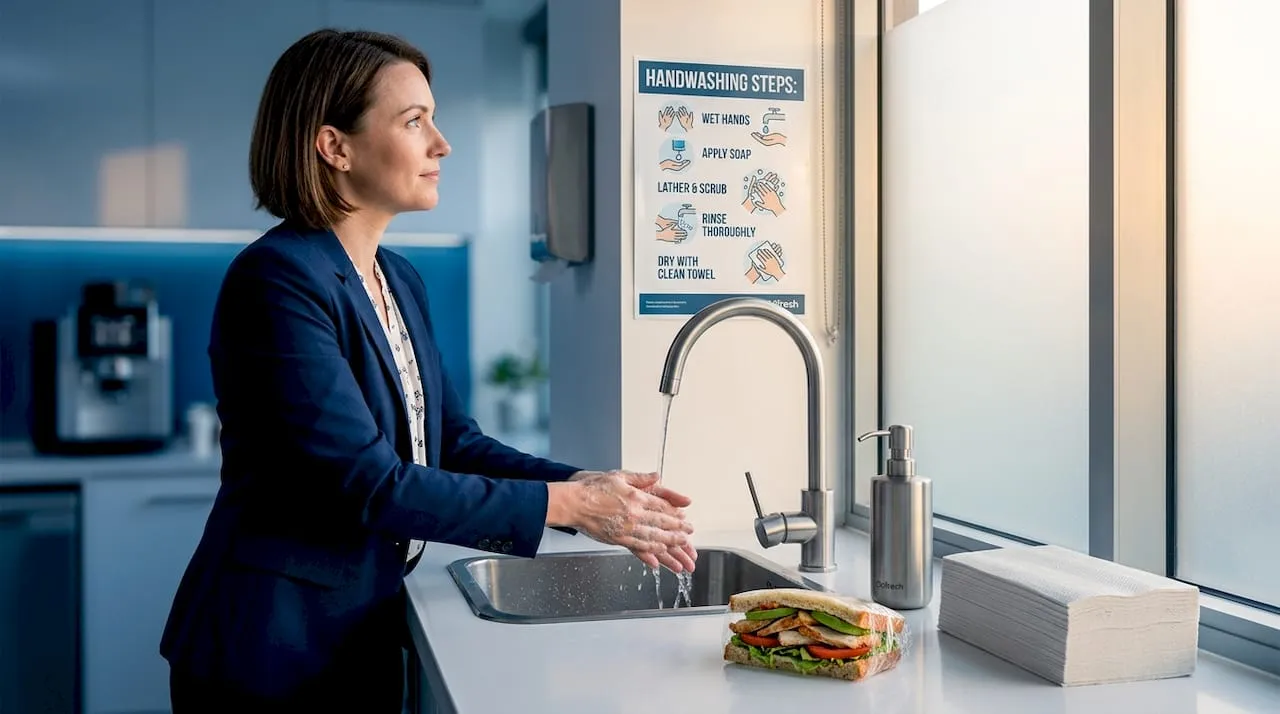
Here is the procedure that meets the standard across healthcare, food safety, and general business settings:
- Wet hands thoroughly with clean running water before applying soap
- Apply enough soap to cover all hand surfaces
- Scrub all surfaces including between fingers, under nails, and the backs of hands for at least 20 seconds
- Rinse hands well under running water until all soap is removed
- Dry hands using a clean single-use towel or an air dryer, patting rather than rubbing
Drying is not a minor detail. Wet hands transfer pathogens far more readily than dry ones. Single-use paper hand towels remain the preferred method in food handling and healthcare-adjacent workplaces because they also provide a final mechanical removal of any remaining contamination.
When hands are not visibly soiled, alcohol-based handrub is an acceptable alternative in many settings. Typical formulations contain 70 to 80 per cent ethanol, isopropanol, or n-propanol. But the application must cover all surfaces completely, and hands must be rubbed until fully dry. The “spray and walk away” habit common in many offices does nothing. Products used incorrectly provide only false confidence.

Food-handling environments carry a higher bar. Sanitiser cannot replace handwashing before food contact because it does not remove physical soil or chemical residues, and it is ineffective against certain pathogens. This distinction is not optional. It reflects the difference between food safety compliance and a hygiene breach.
Pro Tip: When training staff on handwashing technique, have them apply a non-toxic UV lotion before washing, then check under a UV light afterwards. It is a fast, visual demonstration of which surfaces they missed, and it sticks far better than a written instruction.
Common pitfalls worth addressing in any workplace training programme include: not wetting hands before applying soap, using insufficient soap volume, scrubbing for less than the required time, rinsing inadequately, and using shared cloth towels.
Monitoring compliance: beyond the audit sheet
Knowing your standard is one thing. Knowing whether your team follows it consistently is another. This is where many businesses get stuck.
Manual hand hygiene audits, where an observer watches staff and records whether they washed their hands at the right moment, have well-documented limitations. They are time-consuming and prone to observer bias. Staff behave differently when they know they are being watched. And periodic audits capture only snapshots, missing the gaps that occur during busy transitions when risk is highest.
Digital monitoring tools now exist to address this. The ECDC’s hyFive tool provides real-time compliance data aligned with WHO’s Five Moments, enabling targeted interventions and continuous improvement cycles. While developed for healthcare, the data-driven logic applies equally in food production, aged care, and high-traffic commercial facilities.
For businesses building a monitoring strategy, consider the following:
- Baseline measurement first: Before changing anything, measure current compliance honestly. You need a starting point.
- Align moments to your workflow: Map the moments in your specific work process where contamination risk is highest. Generic checkboxes do not capture operational reality.
- Use data to target training: If data shows staff consistently miss hand hygiene after handling waste but not before food contact, that is a specific coaching opportunity, not a general retraining event.
- Make compliance visible: Posting compliance rates publicly within a team, not as punishment but as a shared goal, creates a culture where hygiene is a collective standard rather than a personal habit.
- Review at intervals: Local infection prevention guidance from Australian authorities recommends periodic review of protocols to reflect workflow changes and emerging risk profiles.
Pro Tip: Do not wait for a hygiene incident to review your monitoring approach. Schedule a quarterly compliance review as part of your WHS calendar, and treat it with the same seriousness as a safety equipment inspection.
Businesses that treat compliance as a number to report are missing the point. Compliance data is a coaching tool. The goal is a workforce that understands why the standard exists, not just what it requires.
Australian and international standards compared
If you have tried to reconcile Australian infection control guidance with WHO recommendations or FDA Food Code requirements, you have probably noticed they do not always speak the same language. They do not contradict each other, but their framing and focus differ.
Here is how the key frameworks compare across common business contexts:
| Setting | Primary guidance | Key requirements | Monitoring expectations |
|---|---|---|---|
| Healthcare (AU) | ACSQHC / Safety & Quality Health Service | WHO Five Moments adapted to local workflows; soap and water or handrub per risk | Ongoing audit with IPC governance; local protocol review |
| Food handling (AU/International) | FSANZ / FDA Food Code | Soap and water before food contact; 20-second scrub; sanitiser not a substitute | Manager observation and food safety plans |
| Aged care | ACQSC / ACSQHC | WHO Five Moments; personal protective equipment integration | Scheduled compliance audits; incident reporting |
| General commercial | Safe Work Australia / WHS Act | Risk-based hygiene protocols; product availability; training records | Self-administered WHS compliance checks |
Australian guidance emphasises local adaptation, meaning your protocol should reflect your actual workforce, facility layout, and risk profile, not just copy a template designed for a different industry. A warehouse does not face the same contamination risks as a food manufacturing line, and a one-size policy reflects neither.
The practical take for businesses is this: use the WHO framework as your structural foundation, apply Australian regulatory requirements as the compliance floor, and then build upward based on your specific risks and workflows.
Turning standards into daily practice
Understanding the framework is only the starting point. Getting your team to actually follow it, every shift, every day, takes deliberate effort.
Effective implementation rests on several practical foundations:
- Written policy tailored to your operation: Generic hand hygiene policies are a liability. Your policy should name the specific moments, methods, and products relevant to your workplace.
- Product access without friction: Staff cannot comply with a standard if the soap dispenser is empty, the sanitiser is on the other side of the room, or there are no paper towels. Product placement matters as much as the policy itself.
- Training that builds understanding, not just compliance: Staff who understand why a moment requires hand hygiene are far more likely to comply during a busy shift than those who have simply been told to wash their hands.
- Signage at the point of action: Reminders placed at sinks, entry points, and workstation transitions reinforce training without requiring management presence.
- Linking hygiene to WHS duties: Under Australian WHS legislation, employers have a duty to provide a safe working environment. WHS hygiene responsibilities include ensuring hygiene infrastructure is adequate and that staff are trained and equipped to meet the standard.
Reputation is also at stake. In food service, aged care, and hospitality, a single hygiene incident reported publicly can do damage that takes years to recover from. The investment in getting hand hygiene right is small compared to that risk.
My perspective on where businesses go wrong
I have seen enough workplaces to know that the gap between policy and practice is where most hygiene failures actually live. Businesses invest in laminated posters and a box of disposable gloves and believe they have addressed the standard. They have not.
What I have found consistently is that timing is the most underestimated factor in hygiene compliance. Organisations spend time training on technique and almost no time on the moments between tasks, which is precisely where the risk concentrates. A worker who washes beautifully before their shift but does not hygiene between handling packaging and touching food presents exactly the kind of risk that standards are designed to prevent.
Technology helps, and I am genuinely enthusiastic about real-time monitoring tools. But technology does not fix a culture where hygiene is seen as an individual’s private responsibility rather than a shared operational standard. Leadership commitment is the multiplier. When managers visibly follow the standard themselves and reference compliance data in team discussions, behaviour shifts in ways that no poster achieves.
My practical advice: stop treating hygiene compliance as a box-ticking exercise for an audit. Treat it as a live operational metric, the same way you track production output or customer satisfaction. That shift in framing changes everything.
— Ozifresh
How Ozifresh supports your hygiene compliance
Translating hand hygiene standards into consistent workplace practice requires the right products, the right infrastructure, and expert guidance tailored to your industry. Ozifresh has spent over 40 years helping businesses across Brisbane, the Gold Coast, and Melbourne get this right. From fully serviced hand sanitiser stations to professionally maintained soap dispensers and hand towel systems, Ozifresh provides the hygiene infrastructure that makes compliance achievable, not aspirational. Whether you operate a food facility, a commercial office, a healthcare-adjacent service, or an aged care residence, the team at Ozifresh will build a hygiene programme matched to your specific risk profile and regulatory obligations.
FAQ
What is the WHO Five Moments framework?
The WHO Five Moments for Hand Hygiene defines five specific points during care or task work when hand hygiene must occur to prevent contamination. It applies beyond healthcare in any setting where contamination risk exists at task transitions.
When should soap and water be used instead of sanitiser?
Soap and water is required whenever hands are visibly soiled and is mandatory in food handling regardless of visible soil. Alcohol-based handrub is appropriate for hands that appear clean and in settings where handwashing facilities are temporarily inaccessible.
How long does proper handwashing take?
Effective handwashing requires scrubbing for at least 20 seconds with soap, covering all surfaces including nails and between fingers, followed by thorough rinsing and drying.
What are the main hand hygiene compliance challenges for businesses?
The biggest challenges are workflow transitions where hygiene moments are overlooked, inconsistent product availability, and monitoring approaches that rely on observation rather than data. Manual audit limitations mean businesses often have less compliance than they think.
Do Australian businesses have a legal obligation to meet hand hygiene standards?
Yes. Under Australian WHS legislation, employers must provide a safe working environment, which includes adequate hygiene infrastructure and staff training. Industry-specific regulations in food safety and aged care impose additional obligations aligned with hand cleanliness guidelines.
Recommended
Ready for a cleaner, safer workplace?
Contact our team today to discuss hygiene services for your business in Brisbane, Melbourne or the Gold Coast.